

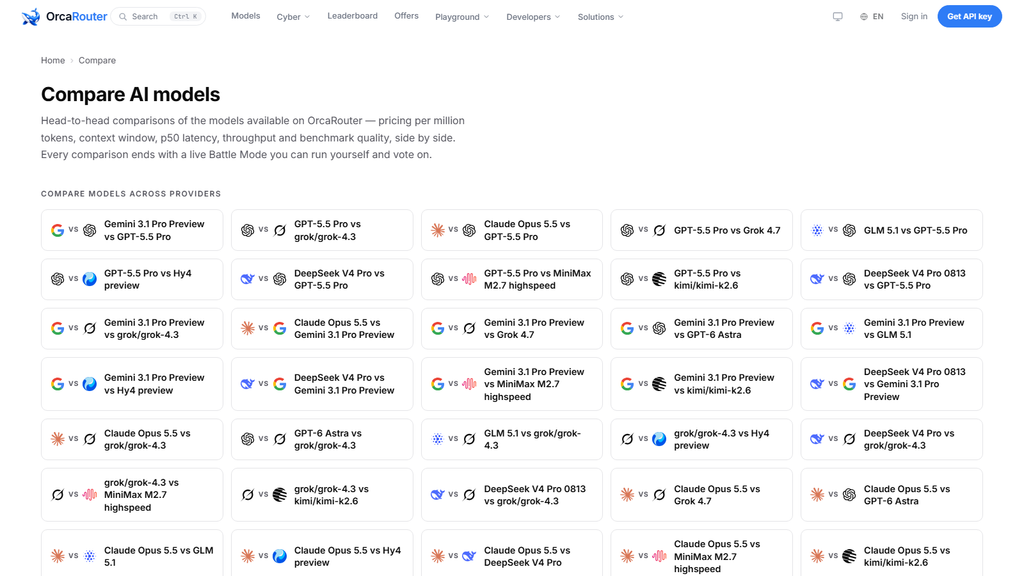
Every invoice from a model provider is really two bills stapled together: one for the tokens you send in, one for the tokens the model sends back. On OrcaRouter the llm comparison page prints both numbers for all twelve models, and once you start reading the ratio between them, the table starts explaining your own bills back to you.
Input price and output price do not move together. They are set independently, billed independently, and the space between them is where most of the money in a modern AI budget actually sits.
Two prices, one bill
Every rate card carries a price per million input tokens and a price per million output tokens, and the two pay for different work. Input tokens are everything you hand the model: your prompt, your attached documents, your conversation history replayed on every request. Output tokens are what the model generates back: the answer, the code, the draft, the summary. A support bot that feeds a long document into every call is paying mostly for input. A translation service that reads a short prompt and emits long passages is paying mostly for output. The same model, two completely different bills.
The two columns exist because the underlying costs are genuinely different, and a comparison page that welds them into one number hides the part of the story you actually get invoiced for. On our comparison page, DeepSeek V4 Pro charges $0.66 per million input tokens and $1.98 per million output, while MiniMax M2.7 highspeed charges $0.60 in and $2.40 out. The two rows are close on input and far apart on output — $0.66 against $0.60, then $1.98 against $2.40 — and a reader who collapsed them into a single price would have seen two models that behave differently on paper as one identical row.
The ratio that decides your bill
The useful number is not either price alone; it is the output multiplier, the number of times the output price exceeds the input price. It tells you which side of the bill the provider is really charging for. Across the twelve rows we publish, the multiplier ranges from 3.0 times to 6.0 times, and that range is not decoration.
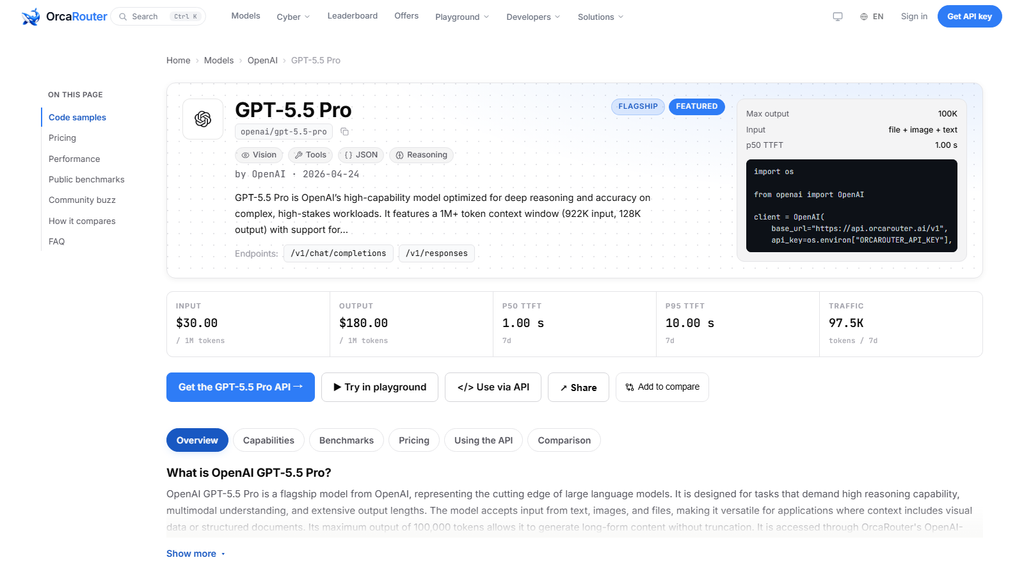
A 3.0-times multiplier means the provider treats output tokens as three times the work of input tokens. That is the pricing shape on DeepSeek V4 Pro, at $0.66 in and $1.98 out, and on Grok 4.7, at $2.00 in and $6.00 out. A 6.0-times multiplier is twice as steep: Gemini 3.1 Pro Preview at $2.00 in and $12.00 out, GPT-5.4 at $2.50 in and $15.00 out, and GPT-5.5 Pro at $30.00 in and $180.00 out, the dearest row in the table. Between those extremes, kimi-k2.6 multiplies output by 4.2 times, on $0.95 in and $4.00 out, and MiniMax M2.7 highspeed by 4.0 times, on $0.60 in and $2.40 out, while five rows — Claude Fable 5.1 at $10 and $50, Claude Opus 5.5 at $4.00 and $20.00, Claude Sonnet 5.5 at $2.00 and $10, Gemini 3.8 Flash at $0.75 and $3.75, and GPT-6 Sol at $2.00 and $10 — all multiply by 5.0 times.
Which side of the bill you live on
Your own workload has a ratio too: the volume of tokens you generate divided by the volume you send in. Match that number against the table and the row that suits you falls out quickly.
If your app is read-heavy — an assistant that ingests a large knowledge base and answers in short replies — the multiplier barely matters, because your bill is dominated by the input column, and the rows that win are simply the ones with the lowest input prices. MiniMax M2.7 highspeed at $0.60 in and DeepSeek V4 Pro at $0.66 in lead that column, and their multipliers, 4.0 and 3.0, are almost beside the point. If your app is write-heavy — a code generator, a summarizer, a content tool that emits far more tokens than it consumes — the multiplier is the whole game, because a 6.0-times row turns every cheap input token into six paid output tokens. For that workload, DeepSeek V4 Pro’s 3.0-times multiplier on top of a $1.98 output price is the cheapest way to write at scale in the entire table, and GPT-5.5 Pro’s $180.00 output price is the most expensive.
A quick way to feel the difference: run the same workload on Gemini 3.8 Flash and on Gemini 3.1 Pro Preview. The input gap is $0.75 to $2.00; the output gap is $3.75 to $12.00. A writer-heavy task spends most of its time on the output side, so the flash row’s 5.0-times multiplier against the pro row’s 6.0-times multiplier turns a modest input discount into a far larger total discount — and that is before the quality column even gets a vote. There is no correct multiplier that applies to everyone, only the multiplier that happens to fit your own read-to-write ratio, which is why a comparison page is only useful when it prints the number instead of hiding it inside a blended price.
Reading the multiplier the right way
The multiplier is a pricing shape, not a quality signal. A 6.0-times row is not greedier in any moral sense, and it is not more capable in any automatic one: Gemini 3.1 Pro Preview and GPT-5.4 both sit at 6.0 times for reasons that have nothing to do with each other, and each posts a perfect 10.0 on our quality composite — the score we build ourselves by grading every model across our own quality dimensions, never a third-party benchmark. What the multiplier does do is tell you where a provider expects the money to come from, and therefore which workloads the row is priced to serve.
The honest caveat is that real workloads rarely sit at one extreme. Most applications both read and write, and the correct move is to estimate your own in-to-out ratio from actual logs before choosing a row. That estimate is the single most useful number you can bring to a comparison page, because it converts a table of twelve rows into maybe three or four candidates: the cheapest input row for read-heavy traffic, the cheapest output row for write-heavy traffic, and one or two 5.0-times rows for everything in between. The pages that publish the multiplier as a column of its own are doing you the favor of making that arithmetic visible.
None of this changes if your volume is small. The two-price structure applies from the first request: a short prompt with a long answer already spends most of its money on the output side, and the multiplier decides how much of that spend goes to the model rather than to the task. The columns are worth reading the same way at every scale.
The takeaway
A modern rate card is two prices, and the space between them is the shape of your bill. DeepSeek V4 Pro multiplies its $0.66 input price by 3.0 times to a $1.98 output price; Gemini 3.1 Pro Preview, GPT-5.4 and GPT-5.5 Pro multiply by 6.0 times, pushing GPT-5.5 Pro to a $180.00 output price, the dearest in the table; and five rows cluster at 5.0 times.
Price your workload on the side it actually spends on. Read-heavy apps should shop the input column and can ignore the multiplier; write-heavy apps should shop the output column, where a 3.0-times multiplier on a $1.98 base is a different business than a 6.0-times multiplier on a $180.00 base. The comparison is only as good as the ratio you bring to it.
Sourcing note: all input and output prices and all output multipliers are OrcaRouter production data from the comparison page and the linked model page, read 2026-10-12. Composite quality scores are our own, built by grading each model across our own quality dimensions; they are not a third-party benchmark. All checked 2026-10-12.