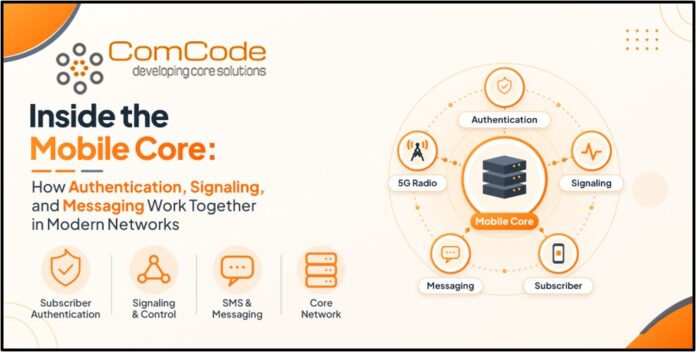

You send a text from a train or open a map in a city you’ve never visited. Your phone sets off a string of checks you never see. Nearly all of it happens in thecore network in telecom the part of an operator’s system that sits behind the towers and decides who you are what you’re allowed to do and what it costs. Radio gets the credit. Without the core though your phone would show full bars and do nothing.
Here I’ll cover three jobs the core does all day: authentication, signaling, and charging. I’ll also cover how they lean on each other, because when one breaks, the other two usually feel it.
What the core actually does
The radio network connects your handset to a tower. After that, the core takes over. It registers the device, keeps track of roughly where it is, sets up voice and data sessions, applies policy, records usage, and links the operator to other networks.
2G and 3G cores ran on circuit-switched equipment and SS7. 4G moved to an all-IP design called the Evolved Packet Core. 5G went a step further and turned network functions into services that call each other through APIs. The catch is that hardly anyone has switched anything off. Most operators run all three generations at once so engineers work with old and new protocols in the same week sometimes the same day. A single-vendor single-generation build is rare.
Authentication and the Home Subscriber Server
Before anything else the network has to know the SIM in your phone belongs to a real active customer. In 4G that check starts at the Home Subscriber Server or HSS.
Think of the HSS as the master record for every subscriber. It holds the IMSI (the subscriber’s identity), a secret key shared with the SIM, the services the person pays for, and the last known serving node. In 2G and 3G this was the Home Location Register. In 5G it’s split into two functions, UDM and AUSF.
The method is challenge and response, called AKA (Authentication and Key Agreement). The phone attaches and announces itself. The MME, which is the serving node in 4G asks the HSS for authentication data. The HSS uses the stored key to produce a random challenge and the answer it expect back. The network passes the challenge to the phone & SIM works out its own answer. If the two match the subscriber is in and encryption keys get set up for the session.
A secret key never travels over the air. Only the challenge and the reply do, and that’s the main reason SIM authentication has lasted so long. Since the HSS holds so much sensitive data, operators almost always run it in geo-redundant pairs. If it goes dark, nobody can attach.
Signaling: how the nodes talk
Authentication only works if messages can move between nodes. Signaling does that and two protocol families carry most of it.
SS7 and SIGTRAN
Most people assume SS7 is long gone. It is not,The protocol dates back to the 1970s and 80s when exchanges talked to each other over dedicated circuits yet it still sets up calls routes SMS and handles roaming lookups. Prepaid checks run on it too, through MAP and CAP. Those circuits became expensive and hard to find, so operators moved the same messages onto IP.
That’s what SIGTRAN is for.
SIGTRAN isn’t one protocol but a family of adaptation layers. M3UA is the one you’ll run into most between signaling gateways and it runs on SCTP. The SS7 message format doesn’t change so older equipment keeps working. You’ll see SIGTRAN mostly at the network edge where roaming partners and interconnect carriers still swap SS7-style messages. If your network has a roaming agreement you’re probably using it right now.
SS7 also has a security problem. It was designed when every connected operator was assumed to be honest and that assumption died a long time ago. Researchers have shown location tracking and SMS interception through abused signaling links and the GSMA publishes guidance on filtering that traffic. If I were auditing a setup, the interconnect point is where I’d look first, before anything inside the network.
Diameter in 4G
In 4G Diameter took over much of SS7’s work. In 4G the MME needs authentication data from the HSS so it sends a Diameter request over the S6a interface. Diameter was a step up from SS7. It routes more cleanly, deals with errors better, and can be extended without much pain. That’s why policy control and charging ended up on it as well. Most operators also put a Diameter Routing Agent in the middle which spreads the load and decides where each request goes.
Charging with Gy and the OCS
A subscriber who is connected and authenticated still has to be billed. For prepaid users, that has to happen while the session is live. That’s where diameter gy ocs comes in.
Gy sits between the packet gateway, which carries the user’s data, and the Online Charging System (OCS). It’s built on the Diameter Credit-Control Application from RFC 4006, with later updates. The gateway can’t see a prepaid balance, so it has to ask first.
A session goes like this. The gateway sends a Credit-Control-Request to the OCS. The OCS checks the balance & grants a quota say 10 MB or five minutes. When that quota runs out the gateway reports what was used & asks for more. When the session ends 1 last request closes it.
Problems shows when something goes wrong. If the OCS is slow users see pages stall. If it’s down you have to pick: block everyone or let traffic through and fix the billing afterward. Neither is free and customers won’t like either one. That’s why timers quota size and a failure policy need to be settled before an outage not in the middle of one. Gy design mostly comes down to those three. 5G moves the OCS role to the Charging Function but the cycle is the same: reserve, use, report.
How the three layers depend on each other
Picture a prepaid subscriber landing in another country and switching on their phone.
The visited network contacts the home network through interconnect signaling often over SIGTRAN. The home side checks the SIM and sends back what the visited network needs including the service profile. The user opens a web page the gateway sends a Gy request and data flows only after credit is approved.
Now break one link. If signaling between the two operators fails, authentication never finishes. If the HSS can’t be reached, there’s nothing to deliver. If the OCS goes quiet, the user is connected but can’t use data. On a diagram these are 3 separate boxes. In production they fail together which is why teams that study each piece alone often miss the real cause of an outage.
When outside help makes sense
Few in-house teams cover all of this well: protocols, vendor integration, capacity planning, security. Smaller operators and MVNOs who often rent part of a host network’s core, face an extra question about what to build what to buy and what to hire for.
That’s where telecom consulting services can pay for themselves. Hiring a consultant only makes sense if you get specifics. Can they review your design and find the weak spots? Can they test your interconnect security, or work out when your HSS or OCS will run out of room? Ask to see past work, like a migration from SS7 to Diameter or a test plan for what happens when Gy fails. I’d also watch how they talk. If you can’t follow the explanation, that’s a bad sign.
Final thoughts
These aren’t three separate systems. The HSS proves who the user is. SIGTRAN and Diameter carry that proof between networks. Gy decides whether the session keeps going. Once you see how they connect & upgrades fault-finding and revenue protection all get easier Comcode Tech helps operators build and manage that core network.