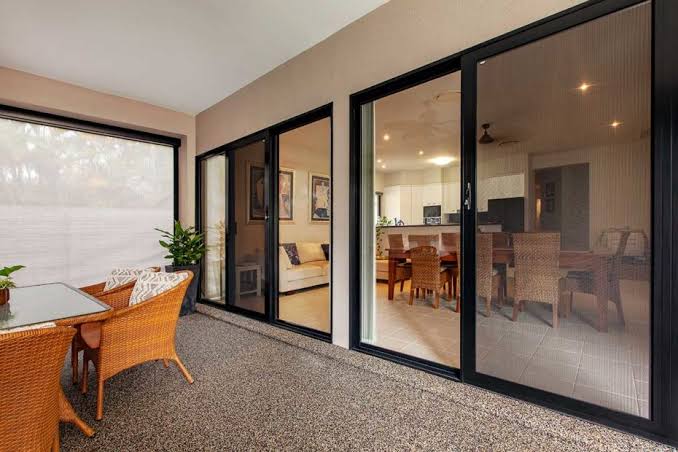

Put two stainless steel mesh doors side by side in a showroom and they can look the same. Try to force them, though, and one may hold while the other gives way. The difference might be the grade of the mesh, a lighter frame, or mesh held in by a strip of rubber instead of being clamped in place.
So, buying one takes more homework than picking a colour. This guide explains what makes a stainless steel mesh security door good or just average, and what to ask the installer before you pay a deposit.
What Is a Stainless-Steel Mesh Security Door?
Instead of a grille or a perforated sheet, this type of door uses woven stainless-steel mesh fitted into an aluminium frame. The mesh is tough enough to resist cutting and impact, and the weave is tight enough to keep insects out, so you don’t need a separate flyscreen.
Looking out from inside, the view is clear with almost nothing in the way. From the street, the mesh reads as a dark, even screen. That clean look is one of the main reasons so many Melbourne homeowners now choose them.
Why Homeowners Choose Stainless Mesh
Visibility is the big one. A diamond or colonial grille puts a pattern across your view, while mesh keeps it open, so the front door still feels open when it’s locked.
The mesh does the flyscreen’s job too, so flies and mosquitoes stay outside on summer nights.
Good stainless steel also handles the weather. It won’t rust like plain steel, and it copes with Melbourne’s hot days, wet winters and salt air near the bay.
It’s tough, too. A dog scratching to get in or a kid running into it won’t tear it, which fibreglass mesh can’t promise.
What to Look For
Mesh Grade: 304 or 316
Most stainless security mesh is either grade 304 or grade 316. Grade 304 is common and does the job in most places. Grade 316, often called marine grade, resists corrosion better, so it’s the safer choice near the bay or coast, or anywhere that gets salt air or harsh weather.
A quote won’t always say which grade you’re getting, so ask.
Wire Thickness
Thicker wire is harder to cut and takes impact better. Many securities mesh use wire about 0.8 to 0.9 mm thick. A thinner mesh can look much the same, but it won’t protect you as well.
How the Mesh Is Held in the Frame
Few buyers think to ask about this, but it matters a great deal. On a well-built door, the mesh is clamped or mechanically fixed into the frame so it can’t be pushed or pulled out. On a cheaper door, it may just be pressed into a channel and held with a rubber wedge, and that’s far easier to force.
Ask the installer how their system holds the mesh and look at a cut-away sample if they have one.
The Frame
When someone tries to break in, the frame takes most of the force. Look for heavy-duty extruded aluminium with strong corner joins. If the frame is too light, it can bend enough for even excellent mesh to pop out.
Locks and Hinges
A three-point lock holds the door at the top, middle and bottom of the latch edge, which makes it much harder to pry open than a door with one lock. Hinges should be heavy duty, with fixings that can’t be undone from outside.
Compliance With AS 5039
Security screen doors in Australia are tested against AS 5039. The testing covers cutting, levering, impact and pull tests on the whole door, not only the mesh. Ask whether the exact door you’re buying has passed and ask to see the paperwork.
Stainless Mesh vs a Traditional Steel Security Door
Some people still ask about a solid steel security door with bars or a heavy grille. A traditional steel security door can be very strong. It’s also heavier, it blocks more of the view, and it can rust if the coating gets chipped.
A tested stainless mesh system gives similar protection. You also see out more clearly, it keeps insects out and it needs less maintenance. For most Melbourne homes, that’s the better trade. A steel security door can still make sense for some commercial or higher-risk sites, and your installer can help you decide.
Configuration Options
Stainless mesh isn’t only for front doors. It’s commonly made up as:
- Hinged front and back doors
- Double doors for wide entries
- Sliding security doors for patio sliders
- Stacker security doors for large openings
- Window security screens
Using the same mesh throughout the house keeps the look consistent and gives every opening the same protection.
Care and Maintenance
Stainless steel is low maintenance, but it still needs a clean now and then. Every few months, scrub the mesh with warm soapy water and a soft brush, then rinse it with fresh water. Near the coast, do this more often, because salt builds up on the surface.
Keep the lock and hinges lubricated, and check that the door still closes and latches properly. Small adjustments made early save wear on the frame later.
Buying in Melbourne
PA Flyscreens is based in Epping and makes and installs stainless steel mesh security doors across Melbourne. It uses 316 marine grade stainless steel mesh in heavy-duty powder-coated aluminium frames and fits a three-point lock as standard. Doors are made to measure as hinged, sliding, stacker or double doors, and the business says its doors are tested to comply with AS 5039.
The Short Version
A well-made stainless steel mesh security door gives you a clear view, strong protection and insect screening all in one. Before you buy, check the mesh grade and wire thickness, how the mesh is held in, and the frame, locks and AS 5039 test results. Those details tell you whether a door is secure.