
Every spring a first-year rec coach sends me some version of the same message: “We got quoted $1,100 for twelve kids. Is that normal?”
Yes. It’s normal. It’s also avoidable.
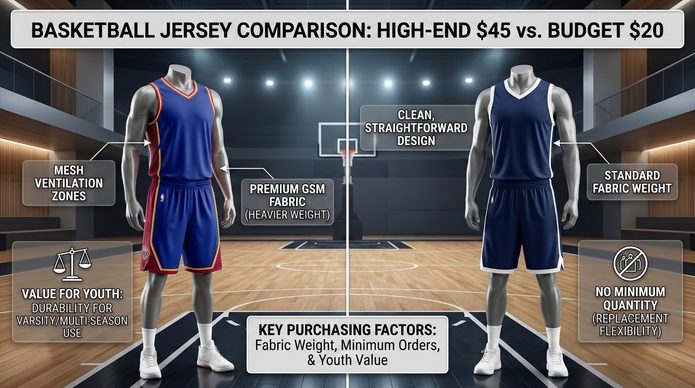
Custom basketball jerseys have the widest price spread of any team sport I shop for. Wooter Apparel publishes sublimated basketball jerseys and shorts between $37.99 and $47.99 per piece at its smallest tier, which starts at 10 units. Xtream Active Wear lists custom basketball jerseys starting near $18.99, with most of the catalog sitting at $21.99. Same sport. Same print method. More than double the gap.
So what does the extra $25 buy?
Sometimes it buys fabric weight. Often it doesn’t.
The honest answer is that above roughly $20 a jersey, you stop paying for the shirt and start paying for the process.
Full-sublimation printing dyes the color into the polyester rather than sitting on top of it. That’s why sublimated jerseys don’t crack at the numbers after a season of hot-cycle washing, and it’s why almost every serious supplier uses it now. But sublimation is sublimation. A $45 sublimated jersey and a $21 sublimated jersey come off similar machines. What separates them is usually fabric GSM, whether the mesh is engineered in specific body zones, and how much of the price is a sales rep’s commission.
For a varsity program buying two sets that need to survive four seasons and a shared laundry room, heavier fabric is worth arguing about. For a 10-year-old rec team that will outgrow every jersey by March, it isn’t.
The minimum order is the part nobody warns you about
Here’s what actually blows up small-team budgets, and it’s not the unit price.
Most uniform suppliers price in tiers, and the tiers start at 10 or 12 pieces. If you have nine kids, you buy twelve. If a tenth kid signs up in week three, you’re re-opening a whole order at the same minimum, because the supplier isn’t running a press for one shirt.
That’s the trap. You didn’t overspend on jerseys. You overspent on the supplier’s production floor rules.
A few sellers have dropped minimums entirely. Xtream Active Wear is one of them — no minimum quantity, free shipping, so a single replacement jersey is a single replacement jersey. If your roster moves during the season, and youth rosters always move, that flexibility is worth more than a couple of dollars saved per unit.
Reversibles: buy them for practice, not for games
Reversible jerseys sound like two uniforms for the price of one. They’re not.
They’re two layers of fabric, which means more heat, and the second side is almost always the one that fades first because it spends its life against a sweaty back. Reversibles earn their keep at practice, where you need instant scrimmage teams and nobody cares about the finish. For game day, single-layer sublimated jerseys with proper numbers hold up better and look sharper on film.
I’d rather see a program buy one good game set and cheap reversibles for practice than split the difference on twelve mediocre do-everything jerseys.
Order numbers you’ll still want in two years
Two mistakes I see constantly:
Sequential numbering. Coaches order 1 through 12. Then a new player joins, or a jersey gets lost, and now you need a 13 that matches a two-year-old dye lot. Order in a range instead — 0 through 5, 10 through 15, 20 through 25 — so replacements slot in without a redesign.
Fashion numbers. Thin, stylized number fonts photograph badly and read badly from the bleachers. Referees have to see them too. Block or varsity block, high contrast against the body color, at least 6 inches on youth sizes.
Sponsor logos are the third one. If a local business is paying for the set, get their logo placement in writing before you approve the mockup, because a chest logo that overlaps the number is the fastest way to redo an order at your own cost.
Sizing is where the money really goes
The largest avoidable cost in team uniforms isn’t the jersey price. It’s the reorder.
Youth sizing is not standardized between brands, and the athletic cut most jersey makers use runs narrower than a school-brand t-shirt in the same nominal size. Kids will guess “medium” because that’s what their hoodie says, and 20% of the order will come back wrong.
Pull the supplier’s actual size chart, measure chest and length on one player per size, and order a fit kit if it’s offered. It takes an extra week. It saves a second order.
What I’d tell a coach with $400
Buy single-layer sublimated jerseys in the 20–25 range from a supplier with no minimum. Spend nothing on reversibles until you know you need them. Put the leftover money into a second set of shorts, because shorts get destroyed twice as fast as tops and nobody plans for it.
If you want a feel for what that price point looks like in practice, Xtream Active Wear publishes its full catalog with per-item pricing rather than making you request a quote — which, when you’re comparing four suppliers on a Tuesday night, matters more than it should.