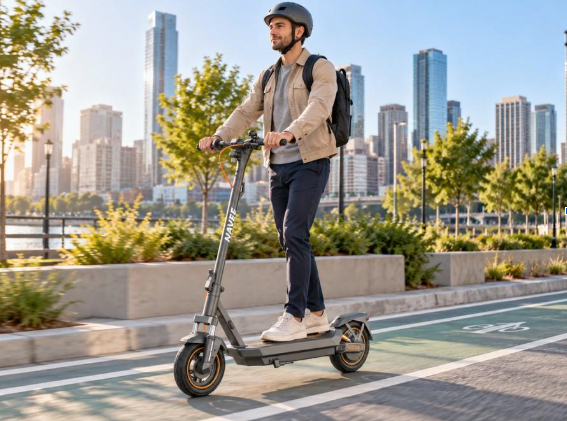

Your first month of electric scooter commuting is a chance to find out what works for your route and schedule. Before the first workday ride, confirm five essentials: a permitted route, enough battery for the return trip, secure storage, a workable charging routine, and backup transportation.
You do not need to start by riding every day. A few well-planned trips can show you where to allow more time, how much battery your commute uses, and which parts of the journey need adjusting. Use the first four weeks to build a routine you can maintain.
Plan Your Commute
Check Distance and Battery Needs
Measure the entire round trip, including station connections and regular errands. If work is four miles away, plan for at least eight miles of riding unless you have confirmed charging at your destination.
Compare that distance with the range figures and their test conditions. Advertised maximum range is not a promise of the same distance at every speed or on every route. Hills, rider and luggage weight, temperature, wind, and frequent acceleration can affect battery use.
For longer trips, consider a long-range electric commuter scooter and compare range figures at speeds relevant to your ride. Allow extra capacity for detours and changing conditions instead of choosing a scooter whose advertised maximum barely covers the journey.
Before relying on it for work, test battery consumption with your usual bag. Start with shorter rides, then extend them as you learn the scooter’s capabilities. Record charge levels while stopped, and turn back early if the battery is dropping faster than expected. Do not test range by deliberately riding until the battery runs out.
Choose a Suitable Route
The shortest route may include heavy traffic, poor pavement, or a difficult intersection. Look for permitted streets and riding areas with predictable crossings and manageable traffic. A slightly longer route may make the commute more comfortable and consistent.
Check the route for:
- Hills that could affect climbing, braking, and battery use.
- Potholes, uneven pavement, and sections with little riding space.
- Intersections and driveways where vehicles cross your path.
- Construction or closures that could require a detour.
When comparing e-scooter for commuting, match range, braking, tires, suspension, and carrying weight to these conditions. Suspension can improve comfort, but it does not make damaged pavement safe to ride over at speed.
Check state and local government guidance for permitted riding locations, speed limits, and age or helmet requirements. For example, NYC DOT’s electric scooter rules prohibit sidewalk riding and limit e-scooter riding speed to 15 mph in New York City. These are location-specific rules, so verify the requirements for every jurisdiction your commute crosses.
Confirm Storage and Transit Access
Decide where the scooter will stay at home and work. Ask your employer or building manager whether indoor storage and charging are allowed. Check that the storage spot will not block a doorway or walkway.
If outdoor parking is necessary, identify a permitted location and a suitable fixed object. Plan how to secure the scooter with a physical lock; an electronic lock alone should not be your parking plan.
Consider carrying weight as well as folded size. A scooter that fits under a desk may still be difficult to lift up stairs. Assess the required lifts before making them part of your daily trip.
For a bus or train connection, check the operator’s current rules for electric scooters and batteries. Folding does not automatically make a scooter eligible for carriage. Confirm any restrictions before depending on that connection.
Prepare Before Your First Ride
Check Your Scooter and Gear
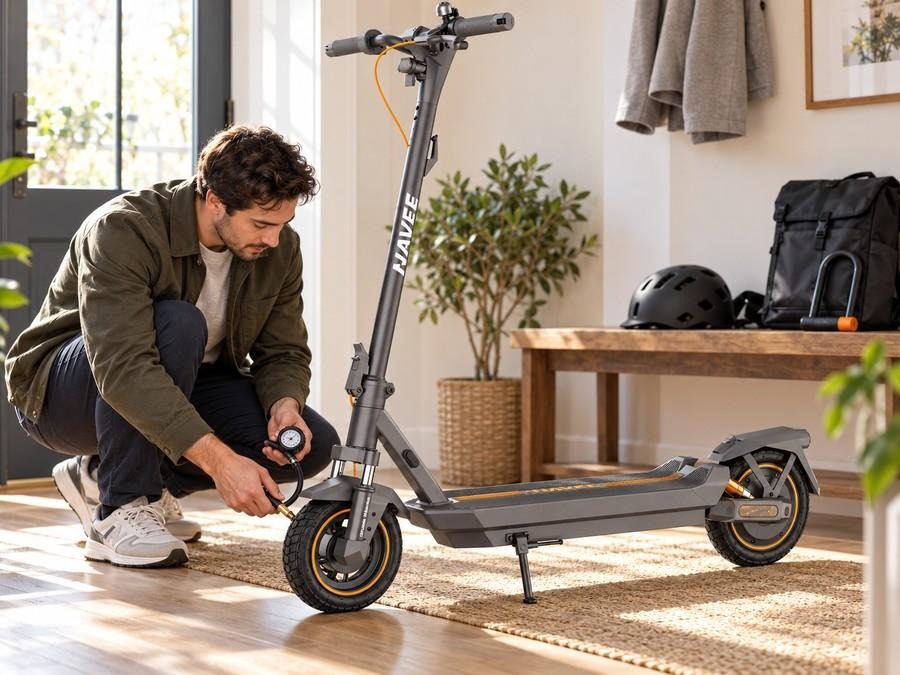
Complete assembly and setup according to the model’s manual, including app activation if required. Learn the controls before leaving home, and prepare a properly fitted helmet, closed-toe shoes, visible clothing, and a suitable lock.
Make these checks before each ride:
- Tires: Look for damage and check pneumatic tire pressure against the model’s instructions.
- Brakes: Confirm normal operation with a controlled, low-speed check in a suitable area.
- Folding mechanism: Make sure the latch is fully secured and nothing feels loose.
- Lights and signals: Check that fitted equipment works, particularly before an evening return trip.
- Battery: Confirm sufficient charge for the planned journey.
Carry work essentials in a secure bag that does not shift or interfere with balance. Avoid hanging bags from the handlebars, and keep both hands available to control the scooter.
Practice and Test the Route
Practice starting, turning, braking, and looking around in a quiet area where riding is permitted. Begin at a manageable speed. Learn how the scooter responds before adding traffic, time pressure, and a loaded work bag.
Once comfortable, rehearse the commute when you are not rushing. Locate your storage spot and time the whole journey, including carrying, folding, locking, and walking to your destination.
An off-peak rehearsal helps you learn the route, but rush-hour traffic may be different. Allow extra time on the first workday and adjust any section that feels difficult under busier conditions.
Plan Charging and Backup Travel
Choose a charging window that fits your model’s charging time and your schedule. Follow the manual’s temperature limits and instructions for charging after riding. Check that the scooter and charging connection are dry before connecting the charger.
Follow the CPSC’s battery charging guidance: use the charger supplied with or recommended by the manufacturer, stay present during charging, and do not charge while asleep or away from home. Unplug when charging is complete, as directed by the manufacturer.
Have another way to reach work when weather, a mechanical problem, or low battery makes riding impractical. Also plan how to get the scooter home if it becomes unrideable. A transit option helps only if the operator allows the scooter on board.
Follow a First-Month Plan
Week 1: Start Gradually
Choose a few days with favorable weather and enough time to handle delays. Keep your usual transportation option available while you test the routine.
Track door-to-door travel time rather than riding time alone. Putting on gear, carrying the scooter outside, parking, and walking into work all affect when you need to leave.
After each commute, make a short note about battery use, delays, and uncomfortable sections. Record observations after stopping, never while riding.
Week 2: Build Your Routine
Use the first week’s notes to refine your route and departure time. A quieter street or a less awkward crossing may be worth a few extra minutes.
Keep your helmet, lock, and work bag ready in one place. Continue the pre-ride checks, and resolve unusual braking, loose parts, or other faults before heading out.
Check whether your charging routine supports consecutive riding days. Increase commuting frequency only when the return trip, storage, and charging arrangements are working consistently.
Week 3: Fix Recurring Problems
Focus on issues that keep coming up. If your bag shifts, adjust its fit or contents. If carrying the scooter is tiring, reassess storage or the transit connection. If rough pavement causes discomfort, try a smoother route.
For unexpectedly high battery use, compare trips of similar distance and note changes in speed, weather, load, and tire pressure. Avoid changing several things at once if you want to understand what helps. Follow the manual for adjustments and seek service for unresolved mechanical problems.
Review the return journey as well as the morning ride. Earlier darkness, rain, or stronger winds may change the conditions you prepared for. Water resistance does not mean a scooter is suitable for every wet-weather ride; follow the model’s limits and use backup travel when needed.
Week 4: Review What Works
Use your notes to decide whether scooter commuting fits your workday:
| What to review | What to decide |
| Typical door-to-door time and delays | A realistic departure time |
| Battery remaining after the round trip | Whether charging and range margin are sufficient |
| Completed commutes and backup trips | How often riding fits your schedule |
| Carrying, parking, and comfort problems | Which arrangements still need changing |
| Recurring expenses | Whether actual savings meet your expectations |
Separate initial spending on the scooter and gear from ongoing electricity, maintenance, and backup fares. Compare recurring expenses with costs actually avoided, such as parking or individual transit fares. A prepaid transit pass or fixed car expense may remain even when you ride.
Choose a sustainable schedule based on the results. You might ride most weekdays, cover only the connection to transit, or reserve scooter commuting for certain days. Continue the pre-ride checks and follow the model’s maintenance schedule.