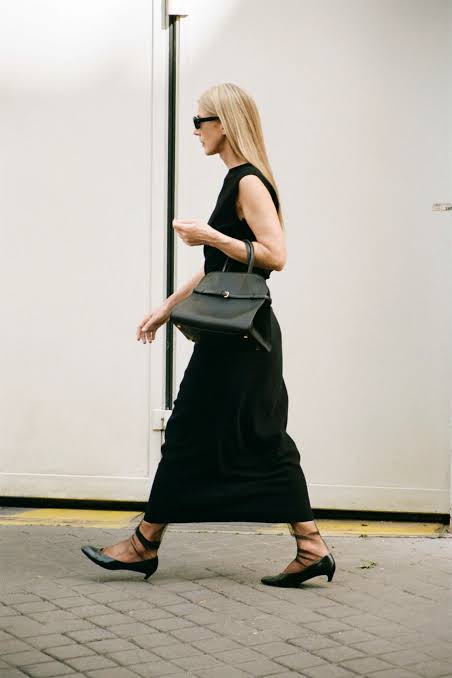

There is a particular hour in the working week that no wardrobe plan survives. It lands somewhere around six, after the last call ends and before the reservation, and it comes with no window to go home. You have a train to catch or a lobby to cross, and the outfit that carried you through three meetings has to carry you through dinner with people who were not in them.
Most people solve this badly. They either overdress at nine in the morning and spend the day feeling costumed, or they undershoot and arrive at eight looking like they wandered in from a desk, because they did. The better solution is not a second outfit stuffed into a tote. It is a small, deliberate set of accessories that shifts the register of everything you already have on.
That shift is mostly about contrast and light. Daytime dressing rewards structure, matte texture, and restraint. Evening rewards a little shine and a looser silhouette. A handful of pieces can move you across that line in under two minutes, and once you own them, you stop thinking about the six o’clock problem entirely.
Start With Fabric, Not With Hardware
Every transition trick in the world falls apart on a base layer that quit at lunch. Cotton poplin creases the moment you sit through a long meeting, and cheap synthetics hold the smell of a warm conference room, so the accessories end up decorating something that already looks tired. Wool is the workhorse here for a reason, and the Woolmark Company’s own suiting guide describes the fiber as breathable enough to take you from the boardroom to the bar, with wrinkle recovery that survives a commute.
Build the day around two or three pieces in that category and the rest gets easy. A lightweight wool trouser, a fine knit in a color that is not quite black, a jacket with real shoulders. None of it screams for attention at nine in the morning, and none of it collapses by seven. The wider principle, that a small set of well made classics outperforms a closet of trend pieces, is one Late Magazine has made before, and it holds double when your clothes have to work a fourteen hour shift.
The One Piece of Jewelry That Handles Both Shifts
Accessories are where the actual transformation happens, and earrings do more work per gram than anything else you own, because they sit next to your face and catch whatever light is in the room. Daylight is flat and overhead; restaurant light is warm and low. A stone that looks sharp at noon can look dull at eight, which is why nacre beats faceted stone for this particular job.
A pair of real pearl earrings will sharpen a plain wool jacket in the morning and read as evening jewelry by candlelight, without a single change of clothes. The luster is the reason. Nacre scatters light instead of throwing it back in a hard line, so the effect reads as warmth rather than sparkle, and warmth is what a dim room wants.
It also helps to know what you are buying, since the category is wider than most people assume. JCK’s market primer on pearl varieties lays out the differences between freshwater, akoya, South Sea, and Tahitian pearls, with real price ranges attached, and the gap between them is significant. Akoya tend to have the brightest luster at a wearable size. The Pearl Association of America, the nonprofit that has represented the trade since 1957, runs a specialist education course on exactly this, which tells you something about how much nuance sits under a gem most shoppers treat as one thing.
One pair, worn daily, is the play. Studs or a small drop, nothing that needs a mirror to put on.
Bags and Shoes That Earn Their Keep
The tote is a daytime object and there is no hiding that. It holds a laptop, which is the whole point, and no amount of nice leather makes a laptop bag look like an evening accessory. The workaround is to carry a small flat clutch or a thin crossbody folded inside it, then leave the tote at the office or in the car. Two seconds, and your hands change the story.
Shoes are harder, because you have to walk. A block heel in a dark suede splits the difference well; it survives pavement and still photographs like an evening shoe.
Build the Kit, Then Stop Thinking About It
The last piece is a small drawer or pouch that lives where you work. A spare pair of earrings in case one goes missing, a lipstick in a color you would not wear to a standup, a silk scarf that can go around the neck or the handle of the bag, a folding hairbrush. It costs very little and it removes the low grade dread that builds through a Thursday afternoon.
None of this is about owning more. It is about owning the four or five things that change register on command, so the rest of the wardrobe can stay quiet and useful. The people who look effortless at eight in the evening are almost never carrying a second outfit; they are carrying a second pair of earrings and a clutch the size of a paperback.
Start with one transition and get it right. Pick the jacket, pick the earrings, pick the bag that folds inside the other bag, and run the swap until it takes under two minutes. Everything else in the closet gets easier once that sequence is automatic.
And the payoff is not really about clothes. It is about walking into the second half of a long day without a detour home and without the quiet hum of feeling underdressed.