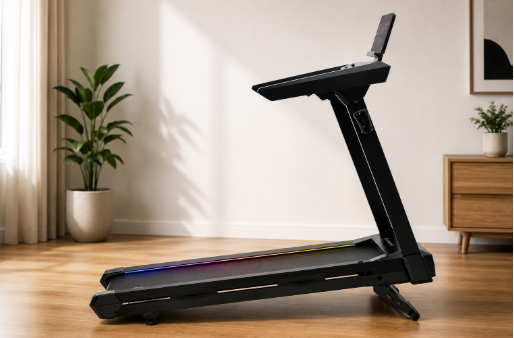

Yes, you can store most foldable treadmills upright. Vertical storage is how the manufacturer designed them to sit between workouts. The bigger question is whether horizontal storage fits your machine, and that comes down to which folding type you bought.
The answer depends on your model. A vertical-fold treadmill stands up against a wall and takes up about 3 by 3 feet of floor. A flat-fold model folds down to under 10 inches and slides under a bed or sofa. Your space, your machine, and how often you actually fold it all play into the right call.
The fear most owners have is that standing the machine up hurts it. Oil leaking into the motor, the belt warping, the hinge giving out. None of that happens on a machine built to fold, as long as the deck locks in place and the room is dry. What actually kills treadmills is dust, humidity, and a belt that never gets lubricated.
This guide walks through what vertical storage does to the machine, when horizontal storage makes more sense, and the checks to run every time you put the treadmill away. By the end you’ll know exactly how to store your model without second-guessing it.
Yes, Most Foldables Are Built to Store Upright
A foldable treadmill stores upright by design. The running deck pivots up, locks against the frame, and the machine stands on its base with the weight on the transport wheels. That’s how the manual tells you to store it.
Most mainstream models fold to about this size. The folded footprint runs about 3 by 3 feet, and the machine stands 65 to 70 inches tall. That’s the trade for saving the 6 to 7 feet of running space the treadmill needs when it’s down. Most owners park it in a corner, a closet, or along a bedroom wall.
Here’s the catch: foldable means different things on different machines. A vertical-fold treadmill lifts the deck up to meet the console. A flat-fold model drops the console down onto the deck, so the whole machine lies flat and slides under furniture. Both store fine. They just store differently, and knowing which type you own settles most of the confusion about horizontal storage.
What Vertical Storage Does to the Machine
Standing the treadmill up does not hurt it. The motor, the belt and the deck are all designed to sit vertical between workouts. If that were a problem, no manufacturer would build the fold in the first place.
The lubrication worry is a myth. Treadmills use 100 percent silicone lubricant, which stays put. It doesn’t run like motor oil, and it can’t pool on top of the motor while the machine stands. The stuff that does drain is sweat and dust, which is why you wipe the machine down before you fold it.
Two things actually matter when the deck goes up. First, the locking pin or latch has to click fully into place. That latch carries the whole weight of the deck, and a half-latched deck can drop on you or on a kid. Second, unplug the machine before you fold it, and give it a minute after you unplug. The electronics hold a charge, and moving a machine that’s still live is the fastest way to fry the control board. Unplug, fold, click, then wheel it into place.
When Horizontal Storage Makes More Sense
Vertical storage works for most machines, but it isn’t always the smarter call. Horizontal storage makes more sense in a few clear situations. Here’s when going flat beats standing upright.
When Your Only Open Space Is Low
Most bedrooms and small apartments have a gap under the bed or sofa that a folded upright machine can’t fit into. A flat-fold treadmill folds down to 8 to 10 inches tall and slides right in, so the rest of the room stays clear. If the only space you have is that low gap, horizontal is the only option that works.
When You Own a Flat-Fold or Under-Desk Model
Some treadmills are built to lie flat. The console folds down onto the deck, and the unit is meant to disappear under furniture. Standing one of these against a wall isn’t what it was designed for, and it leaves the machine awkward to use. If your model is a flat-fold or under-desk walker, horizontal storage is the intended call.
When the Machine Hardly Ever Stands Up
If the treadmill lives under the bed and only comes out for a walk, you don’t need it eating wall space in a corner. Horizontal storage keeps it out of the way between short sessions, which fits light home walkers that see a few miles a day. A full-size machine built for daily running is the exception, and it belongs upright.
None of this means horizontal is always better. If you plan to run real miles, or you own a vertical-fold machine, upright in a corner is still the right move. Let the method follow the machine and the room, not the other way around.
Do These Checks Before You Store It
Folding is a 30-second job once you get the routine down. Run these three checks every time and the machine will store safely for years.
Lock the Deck
Listen for the click. The deck locks in place when the latch engages fully, and that’s the sound you want before you let go. If the deck feels loose or won’t click, stop and find out why. A deck that drops while you’re moving the machine is a real hazard, and it can bend the frame. Test the latch once a month by lifting the deck a few inches and letting it settle back on the pin.
Pick a Stable Spot
Stand the treadmill against a wall in a corner, on a level floor. Keep it out of hallways and away from where kids and pets play. If the floor slopes, a folded treadmill can walk itself over time, so check it now and then. A mat under the base keeps it from sliding and catches dust at the same time.
Keep It Cool and Dry
Treadmills are electronics. They want a dry room at normal home temperature, around 60 to 75 degrees. Garages and sheds are the wrong home for them. Temperature swings make the belt brittle and the plastic parts crack, and humidity rusts the motor. If the machine has to live in a garage, at least keep it covered and off the concrete floor.
Final Thoughts
Here’s the short version. Most foldable treadmills are built to store upright, and standing yours up between workouts will not damage the motor, the belt, or the lubrication. The machine only fails when the deck isn’t locked, the spot isn’t stable, or the room is damp and dusty. Horizontal storage is for flat-fold models and under-bed spaces, and it comes with a smaller motor and a lower top speed.
Check the folding type, measure the space, and run the three checks before you put it away. Do that and your treadmill stays ready for the next run.
Ready to find a treadmill that fits your space? Start your search at UREVO and compare the foldable options for your home.