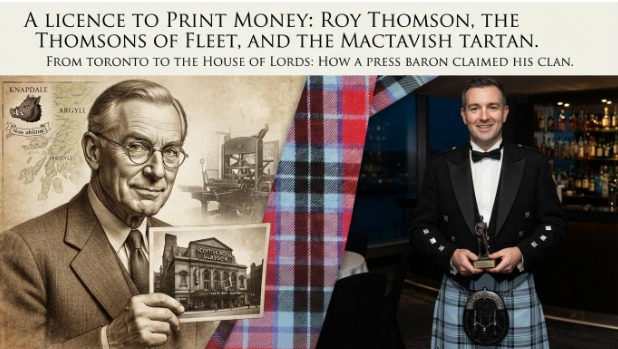

The story of the MacTavish tartan is tied to a self-made Canadian who arrived in Scotland late in life and, in the middle of building a newspaper and television empire, had a tartan designed for his name. In 1957 a short, round, bespectacled Canadian with a Toronto accent and a taste for bad puns was asked what he thought of the commercial television franchise he had just been granted for central Scotland. He said it was “just like having a licence to print money.
He was not wrong, and the phrase followed him to his grave. But the man who said it had arrived in Scotland only four years earlier, at the age of fifty-nine, with a newspaper in Timmins, Ontario, and a small chain of Canadian radio stations to his name, and by the time he died he owned The Times, The Sunday Times, a large slice of the North Sea oilfields, and a seat in the House of Lords. He was also, by descent, a MacTavish. And in 1958, at the height of his rise, he did a very Scottish thing for a self-made man. He had a tartan designed.
The barber’s son
Roy Herbert Thomson was born in Toronto in 1894, the son of a barber. He was so short-sighted he could barely see the blackboard at school, and he left at fourteen. He sold radios in northern Ontario in the Depression, and finding that nobody would buy a radio where there was no signal, he started a radio station in North Bay to give them something to listen to. Then he bought the local paper. Then another. By the end of the war he owned a string of small-town Canadian newspapers and radio stations and had a reputation as a man who could make a profit from anything with a masthead.
In 1953 he bought The Scotsman, the Edinburgh paper, and moved across the Atlantic to run it. Edinburgh was appalled. He was loud, he was cheerful, he talked about money in public, and he was Canadian. He did not care. When the government created commercial television in Scotland in 1957, he won the franchise, launched Scottish Television from the Theatre Royal in Glasgow, and made the remark about the licence. Two years later he bought the Kemsley newspaper group, which included The Sunday Times, and in 1966 The Times itself. He was made Baron Thomson of Fleet in 1964, took the title from Fleet Street, and died in 1976, still going to the office.
He had no pretensions to being a gentleman and was proud of his father the barber. But he was interested in where the name came from, and the name was MacTavish.
Sons of Tammas
Thomson, Thompson and MacTavish are the same name. Tavish is the Gaelic form of Thomas, and Mac Tamhais, son of Thomas, became MacTavish in the Highlands and Thomson in the Lowlands. The MacTavishes of Dunardry held lands in Knapdale, in Argyll, from the fourteenth century, at the neck of land between Loch Fyne and the Sound of Jura, and were closely tied to the Campbells. They were out in the ’45. Their estate was lost in the eighteenth century, and the chiefship lay dormant for the better part of two hundred years, until it was revived in the 1990s and recognised by the Lord Lyon. Their crest is a boar’s head and their motto is Non oblitus, not forgetful.
The clan tartan has a slightly tangled history. The archives record a MacTavish sett from a manuscript of the Smith brothers of Mauchline, dating from 1850, that the brothers described as rarely if ever seen, and note that it may never have made it from the manuscript into their printed book. It is a green and blue tartan with a strong red band and fine black lines, a close relation of the Campbell family of setts.
The dress tartan is another matter, and this is where the newspaperman comes in. The register records that it was “designed for Lord Thomson of Fleet in 1958, based on a sample in the Moy Hall collection dating from the mid nineteenth century,” and approved by the Lord Lyon in the same year. Moy Hall is the seat of the Mackintosh chiefs, and the sample there was an old cloth with no certain name. Thomson, who needed a tartan and liked things done properly, had it made his. Forty years later, in 1998, the chief of the MacTavishes formally agreed that it should be the dress tartan of the whole clan.
It is a pale, unusual, rather beautiful design: a broad ground of soft azure blue, bands of black and light grey, a thin line of dark red, and a thread of yellow. It looks like nothing else in the book, and it looks especially well at night.
Retailers list MacTavish tartan in both forms, the clan sett and the dress, made to order as kilts, skirts, waistcoats, sashes and scarves, or by the yard. Thomsons and Thompsons have as good a claim to it as MacTavishes, which, given how the man who commissioned it spelled his name, is only fair.
Glasgow, a Sunday evening in November
The awards dinner is black tie, in a hotel on the Clyde a mile from where Scottish Television first went on air. Craig Thomson is forty-three and produces documentaries, and one of his is up for something. He has been told to look the part.
He owns one kilt, in the pale blue MacTavish dress tartan, which he had made for his own wedding on the reasonable grounds that his surname entitled him to it and that it was the only tartan in Scotland commissioned by a television mogul. What he had to work out this time was the jacket, because a kilt on its own is not evening dress. The jacket is what makes it so.
There are two, and they do different jobs. The Argyll is the day jacket: longer, plainer, worn with a long tie, right for a wedding at two in the afternoon and wrong for a dinner at eight. The Prince Charlie is the evening one. It is short, cut away at the front so that it barely meets, with satin lapels and silver buttons on the front, cuffs and tails, and it is worn over a low-cut three-button waistcoat with a wing collar and a black bow tie. It is the Highland version of a dinner jacket, and at a black-tie dinner it is what the invitation means.
He found his at Scottish Kilt, where the kilt had been made. Their jackets for kilts are set out plainly: the Argyll for daytime and weddings, the Prince Charlie for black-tie evening, each with a matching three-button waistcoat, alongside the Irish Kilkenny and Brian Boru and a tweed vest for the country. He ordered the Prince Charlie in black barathea with the waistcoat, measured for chest, shoulder, sleeve and back length, and asked for bright chrome buttons rather than antique, because the pale blue of the dress tartan wanted something crisp against it. Fit matters more with this jacket than with any other, because it is cut so short. A Prince Charlie that is an inch too long in the body covers the top of the kilt and makes the wearer look as though he has put on a schoolboy’s blazer; one that is right stops just at the waistband and shows the whole line of the pleats.
The effect, in the mirror, surprised him. Under black, the soft azure of the kilt turned silvery and the fine red line came forward. With black hose, black ghillie brogues and a black fur sporran with a chrome cantle, and everything metal bright to match the buttons, he looked, his wife said, like a man about to accept something.
He did not win. The documentary that did was about fishing, and it was very good. At the bar afterwards a retired STV cameraman, who has been to every one of these dinners since 1985, looks at the kilt.
“That’s no’ a common one.”
“MacTavish. The dress. It was made for Roy Thomson.”
“Was it, by God.” The old man laughs. “I started at the Theatre Royal the year after he sold up. Licence to print money. They never let him forget that.” He looks at the pale blue again. “He’d have liked that you’re wearing it to one of these. He liked a do. He liked a do with a bar.”
Not forgetful
Roy Thomson was mocked in Scotland for being brash, foreign and interested in money, and he made most of the country’s newspapers and its first commercial television station pay their way. He also, in the middle of building an empire, took the trouble to find out what his name was in Gaelic, and to have a cloth made that his clan would later adopt as its own. The motto is Non oblitus. He was not forgetful.
The tartan he left behind is a pale blue with a thread of red, and it is at its best under a black jacket with silver buttons, at a dinner where somebody is about to win something. He would have wanted a seat near the bar.