
For decades, conventional wisdom suggested that anyone dealing with lower back pain, sciatica, or joint stiffness should sleep on the firmest board-like surface imaginable. The assumption was simple: total rigidity equals maximum spinal support. However, modern biomechanics and physiotherapy have thoroughly debunked this myth. A mattress that is excessively hard creates harsh pressure points at the shoulders and hips, forcing the spine into an unnatural arch and causing surrounding muscles to contract in defense throughout the night.
Today, physiotherapists and sleep specialists advocate for a far more dynamic approach to ergonomic alignment: the hybrid orthopaedic design. By pairing heavy-gauge, high-tension pocket springs with deep layers of natural British wool, modern bed makers achieve a delicate equilibrium between underlying structural push-back and surface pressure relief. Understanding how this specific material synergy supports human anatomy clarifies why natural hybrid designs are rapidly replacing purely rigid or all-foam alternatives as the gold standard for back health.
The Biomechanics of Orthopaedic Support
True orthopaedic support is not about creating an unyielding surface; it is about maintaining neutral spinal alignment regardless of your sleeping posture. When you lie down, your spine should retain its natural “S” curve when resting on your back, or remain completely straight from neck to tailbone when resting on your side. If a mattress sags, your midsection sinks into a hammock shape, overstretching the lumbar muscles and straining intervertebral discs.
Conversely, if a mattress lacks surface cushioning, your hips and shoulders are prevented from sinking slightly into the top layers. This pushes your lower back upward, creating an artificial gap between your body and the bed. A true orthopaedic design solves this by combining high-resistance underlying core support with targeted surface contouring. This dual-layer mechanism allows heavier anatomical anchor points to settle just enough to relieve joint pressure, while the core springs push upward to fill the lumbar gap and keep the spine perfectly aligned.
The Wool Advantage: Pressure Relief Without Structural Collapse
While the spring core provides foundational lifting power, the choice of top-layer comfort fillings determines how effectively a mattress relieves pressure. Synthetic memory foam has long been marketed as the ultimate cushioning material, but it carries significant mechanical flaws for back pain sufferers. Memory foam relies on trapped body heat to soften, causing sleepers to sink deeper over the course of the night. This slow, heat-induced sinking creates a sensation of being stuck, making micro-adjustments difficult and placing sustained torque on sensitive spinal joints.
Natural British wool offers a vastly superior alternative for orthopaedic comfort. Wool fibers possess a unique, natural helical crimp that acts like microscopic springs, offering resilient cushioning that bounces back instantly under body movement. This inherent springiness allows wool to absorb sharp pressure points at the hips and shoulders without allowing the body to sink into structural misalignment. Furthermore, wool’s exceptional breathability and moisture-wicking properties keep body temperature stable, preventing the nocturnal tossing and turning caused by overheating.
A Closer Look at Core Engineering: High-Turn Pocket Springs
The true engine of any hybrid orthopaedic mattress lies within its spring architecture. Standard innerspring units rely on interconnected open coils that move as a single rigid sheet. When weight is applied to an open coil, the entire grid dips, transferring movement across the bed and failing to adapt to individual body contours.
Advanced orthopaedic beds utilize individually encased pocket springs engineered with higher coil turns and thicker wire gauges. Each spring acts as an independent piston, responding exclusively to the localized downward pressure directly above it. High-turn pocket spring units, such as seven-turn or eight-turn configurations, provide progressive resistance. The top turns of the coil compress easily to cushion lighter body contours, while the lower turns offer increasing firmness to support heavy zones like the pelvis and chest. This progressive push-back prevents bottoming out while ensuring micro-targeted support across every inch of the torso.
Examining the Benchmark: The Hypnos Wool Ortho Up Close
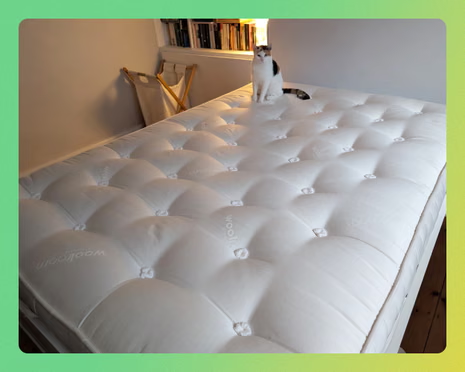
To understand how high-grade natural materials and rigid spring mechanics function in practice, it is worth looking at flagship British models built specifically around these principles. Examining the Hypnos Wool Ortho reviewed in detail reveals how heritage bed makers translate orthopaedic science into daily comfort. Constructed by a Royal Warrant-holding UK manufacturer, this model combines a dedicated ReActive 7-turn pocket spring core with generous layers of traceable British wool and sustainable eOlus support fibers.
The structural brilliance of this design stems from its balance of materials. The high-tension seven-turn spring unit provides the firm, buoyant uplift required to stabilize the spine, while the hand-tufted wool cushioning layer softens initial surface contact to protect delicate joints. Reinforced by genuine hand side-stitching to ensure edge-to-edge support, it demonstrates how combining natural wool upholstery over high-gauge pocket coils eliminates the need for harsh synthetic foams or unyieldingly hard padding.
Temperature Regulation and Long-Term Durability
Beyond immediate spinal alignment, temperature management plays a critical role in chronic muscle recovery. Pain receptors become far more sensitive when sleep is fragmented by overheating or excessive sweating. Synthetic foam layers retain body heat, causing thermal discomfort that triggers frequent position changes. Wool, by contrast, is inherently thermoregulating, capable of absorbing up to thirty percent of its own weight in moisture without feeling damp while facilitating continuous air circulation through the mattress depth.
Furthermore, natural wool hybrid construction excels in long-term structural resilience. While synthetic foams oxidize, soften, and develop permanent body impressions over time, hand-tufted wool layers anchored to heat-tempered steel springs maintain their loft and firmness for years. Regular rotation redistributes natural fiber compression evenly, ensuring that the mattress delivers the exact same level of calibrated orthopaedic push-back after thousands of nights of use.
Reclaiming Restful Sleep Through Smart Design
The debate between pure surface hardness and plush comfort has officially been resolved by modern sleep ergonomics. Achieving deep, pain-free sleep does not require sacrificing luxury for rigid support, nor does it mean sinking into heat-trapping synthetic foams. By uniting the natural resilience, pressure relief, and breathability of British wool with the targeted, high-tension uplift of advanced pocket springs, hybrid orthopaedic mattresses provide the ultimate compromise. Investing in a bed engineered around these proven physical principles ensures proper spinal posture, optimal temperature control, and lasting physical health every single night.