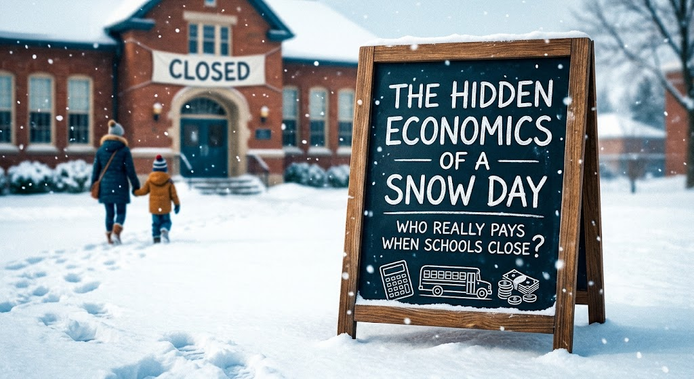

A snow day feels like a simple pause button no school, no buses, no homework due tomorrow. For kids, it’s a free day. For everyone else, it’s the start of a small but very real economic ripple effect that touches parents, employers, school districts, and even local municipal budgets. Few people stop to think about what a single school closure actually costs once every affected group is added up or how many households are quietly checking a winter closure forecast the night before, trying to get ahead of exactly this problem.
The Immediate Cost for Working Parents
The most obvious impact lands on parents who suddenly need childcare with little to no warning. This isn’t a minor inconvenience, it’s a real financial hit for a large share of the workforce.
- Emergency back-up childcare isn’t cheap: According to 2026 childcare industry wage data, back-up and emergency care rates start around $45 per hour in most regions, driven largely by exactly this kind of last-minute demand from school closures.
- Missing a full workday adds up fast: Research from Northeastern University found that during periods of widespread school disruption, working parents lost roughly eight hours per week on average due to childcare responsibilities essentially a full workday’s worth of lost productivity.
- The burden isn’t distributed evenly: That number climbs to around 10 hours per week for lower-income workers, who are more likely to hold in-person jobs that can’t be shifted to early mornings, late nights, or a laptop at the kitchen table.
- Some parents cut hours entirely: During periods of frequent closures, a meaningful share of working parents report reducing their hours, using paid time off, or in some cases stepping back from work altogether just to cover unpredictable school schedules.
Why Employers Feel It Too
Working parents make up roughly a third of the U.S. workforce, so when school closures pile up, the effects don’t stay contained to individual households.
- Return-to-office policies have made this worse, not better: As more employers pull back on remote-work flexibility, parents have fewer options to patch together a workday around a surprise closure.
- Productivity loss is invisible but real: Even parents who technically “work through” a snow day while supervising kids at home are rarely operating at full capacity split attention isn’t the same as a normal workday.
- Small businesses absorb this differently than large employers: A single working parent calling out unexpectedly hits a five-person office far harder than a five-thousand-person company with built-in coverage.
The Municipal and District-Level Costs
Snow days aren’t free for school districts or local governments either, and the costs go well beyond the obvious expense of running plows.
- Snow removal budgets get eaten alive: In heavy-snow years, it’s common for towns to blow through their entire annual snow removal budget before January even ends, forcing municipalities to dip into reserve funds or reallocate spending elsewhere.
- Districts pay staff regardless of closure: Teachers and staff are typically still paid on snow days, meaning payroll costs continue even though instruction doesn’t happen.
- Facilities work doesn’t pause: Parking lots and walkways still need to be cleared before students and staff can safely return, which means custodial and grounds crews are often working even when the building is empty.
- Missed instructional days can trigger make-up requirements: Depending on the state, too many closures can force districts to add days to the calendar, push back the last day of school, or in some cases request a state waiver each of which carries its own administrative cost.
A Cost That’s Easy to Overlook: Cabin Fever and Household Stress
Not every cost shows up on a balance sheet. Extended stretches of closures particularly during a rough winter with back-to-back storms create a quieter but very real strain on households. Parents juggling work calls with restless kids report rising stress levels the longer a closure streak goes on, and that kind of strain has its own downstream effects on productivity, mood, and even relationships within a household.
Why This Cost Rarely Gets Talked About
Most of the public conversation around snow days focuses on the fun side: the sledding, the hot chocolate, the unexpected day off. The economic side stays mostly invisible because the cost is spread thin across millions of individual households and small local budgets rather than showing up as one large, headline-worthy number.
That’s part of why the debate over remote learning days versus traditional closures has picked up so much attention in recent years. Districts weighing whether to keep a traditional snow day or shift to a remote instructional day aren’t just making an educational decision they’re indirectly deciding who absorbs the cost that day: working families scrambling for last-minute care, or students and teachers trying to make virtual learning function on short notice.
Why Some Regions Feel This More Than Others
The economic weight of a snow day isn’t distributed evenly across the country. A handful of factors determine whether a single closure is a minor blip or a genuine financial strain for a community.
- Snow-belt regions build in buffer days: Districts in areas that expect regular winter weather often plan several built-in snow days into the academic calendar, softening the blow of the first few closures each year.
- Districts unused to snow feel it harder: A single unexpected storm in a region that rarely sees snow can shut down an entire area for days, since there’s little existing infrastructure (plows, salt supplies, experienced road crews) to clear things quickly.
- Dual-income households absorb more risk: In areas with a higher share of two-working-parent homes, a sudden closure means both incomes are potentially disrupted rather than one parent simply staying home.
- Hourly workers face a harder trade-off: Salaried employees can often shift a workday around; hourly workers frequently lose wages outright if they can’t make it in or have to stay home with kids.
The Push Toward Remote Learning Days
A growing number of districts have started replacing traditional snow days with remote instructional days, largely as a way to avoid extending the school year. This shift changes the economics of a closure rather than eliminating them.
- The 180-day instructional requirement drives the decision: Most states require a minimum number of instructional days, and remote days offer a way to protect that count without physically holding class.
- It shifts the burden, rather than removing it: Parents may no longer need emergency childcare, but younger students often still need supervision to stay on task with schoolwork at home.
- Attendance can be inconsistent: Some districts have reported wide swings in remote-day attendance occasionally dropping well below in-person rates which raises separate questions about whether instructional time is actually being recovered.
- Not every family has equal access: Reliable internet, a quiet workspace, and an available device aren’t guaranteed in every household, which means remote days can unintentionally widen gaps between students rather than close them.
A Few Common Misconceptions Worth Clearing Up
- A snow day only costs a district money for plowing: Payroll, facilities work, and potential make-up day costs typically add up to far more than snow removal alone.
- Salaried parents don’t really lose anything: Lost focus and reduced output during a workday spent supervising kids is a real productivity cost, even without a direct pay cut.
- Remote learning days solve the economic problem: They shift who bears the cost from missed work and childcare, to supervision demands and access gaps rather than eliminating it.
What This Means for Families Heading Into Winter
None of this means snow days should disappear; plenty of research suggests a handful of them each year has little real impact on long-term academic outcomes. But understanding the actual cost helps explain why so many families feel genuine stress the moment a storm starts rolling in, and why a little advance planning goes a long way.
A few practical takeaways worth keeping in mind:
- Line up a backup childcare option before storm season starts: rather than scrambling the morning of
- Talk to employers early: about flexibility during high-closure months, especially for households with school-age kids
- Keep an eye on regional closure patterns: since checking the latest snow conditions the night before a storm can turn a stressful morning scramble into a planned one instead
- Budget mentally for a few “surprise” days each winter: the same way households budget for other seasonal costs
Conclusion
A snow day might look like nothing more than a quiet morning off school, but for parents, employers, and local governments, it’s a small, recurring economic event that quietly touches nearly everyone involved. Recognizing that cost doesn’t mean fighting to eliminate snow days, it means going into winter with a plan instead of a scramble, which is often the difference between an inconvenient morning and a genuinely stressful one.