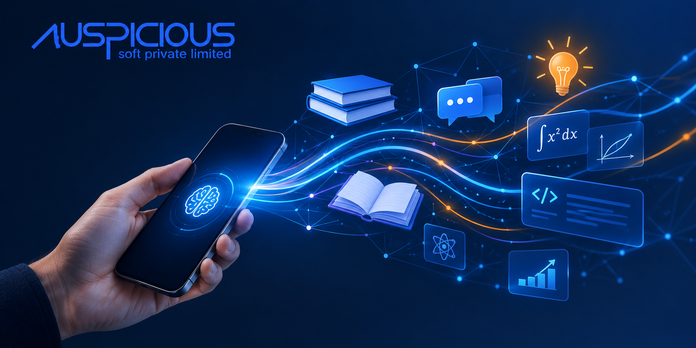

A few years ago, a “good” education app meant clean video lessons, a decent quiz engine, and maybe a progress bar. That was enough. It isn’t anymore.
Today’s learners are used to getting instant answers. They’ve grown up with search engines that complete their sentences and assistants that talk back. Handing them a static video and a multiple-choice test feels like handing someone a fax machine. The expectation has shifted — people want to interact with what they’re learning, not just consume it.
That’s why AI chatbots and conversational tutors have stopped being a “nice to have” in education apps and started becoming the core of the experience.
The Problem with Traditional Learning Apps
Most digital learning platforms follow a simple loop: watch a lesson, take a quiz, move to the next module. It’s tidy. It’s measurable. And for a lot of learners, it completely falls apart the moment they hit something they don’t understand.
Because here’s the thing — learners aren’t uniform. One person grasps a concept from a diagram. Another needs three different explanations and a worked example before it clicks. A traditional app delivers the same explanation to both, and if it doesn’t land, it just… moves on.
A conversational AI tutor doesn’t do that.
When a student asks “why is the answer 24?” they’re not looking for the answer repeated back to them. They want to understand why. A good AI tutor walks through the calculation step by step, checks whether the student followed, then asks a question back — not to quiz them, but to find out where the confusion actually lives.
That kind of responsiveness used to require a human tutor. Now it can happen at 11pm, on a phone, in the middle of a revision panic.
Chatbots vs. Conversational Tutors — They’re Not the Same Thing
This distinction matters, and a lot of education businesses blur it.
A chatbot handles logistics. It tells you where to find your course, what the submission deadline is, and how to reset your password. Useful, yes — but it’s essentially a FAQ page that talks back.
A conversational tutor is something else entirely. It participates in the learning itself.
Depending on how it’s built, a conversational tutor can explain complex ideas in simpler terms, generate practice questions on the fly, give hints rather than just handing over answers, evaluate written responses, simulate real conversations for language practice, identify knowledge gaps across sessions, and adjust its approach based on what’s actually working for that specific learner.
The chatbot supports your app. The conversational tutor supports your learner. Both have a place — but conflating them leads to underbuilding one and overestimating what the other can do.
What Modern Education Software Development Actually Involves
This is where a lot of businesses underestimate the work. “We’ll just add an AI chat feature” is usually where things start to go sideways.
Education software development today isn’t just a matter of dropping a language model into a chat interface and calling it a tutor. It requires thinking through the entire learning ecosystem — how content is structured, how learner data is used, how the AI behaves when it doesn’t know something, and how the whole system holds up at scale.
A few areas that tend to get underestimated:
Model selection and configuration — Different applications have different requirements around accuracy, response speed, cost, and privacy. The right LLM setup for a children’s literacy app looks nothing like what you’d build for a professional certification platform.
Retrieval-Augmented Generation (RAG) — If your platform has its own courses, textbooks, or proprietary training materials, you probably don’t want an AI answering questions purely from general internet knowledge. RAG lets the system pull from your approved content library before generating a response. For universities, certification providers, and corporate learning platforms, this isn’t optional — accuracy and source control are foundational.
Learner context and personalization — AI tutors become significantly more useful when they know something about the person they’re talking to. Previous assessment results, commonly missed concepts, course progress, interaction history — all of this can shape more relevant responses. A first-year student and a professional refreshing their knowledge shouldn’t receive the same explanation.
Safety and content controls — Educational AI needs real guardrails, especially for younger learners. Age-appropriate responses, content filtering, hallucination controls, and escalation paths to human educators aren’t extras. They’re requirements.
The companies that get education software development right treat AI as a product design challenge, not just a technical integration. The question isn’t “can we add AI?” — it’s “how does AI make this learning experience meaningfully better?”
Why Mobile App Development Is Central to This Shift
The smartphone made learning genuinely portable — not just theoretically, but practically. People have fifteen minutes on a train, thirty minutes before bed, ten minutes between meetings. The right mobile app turns those gaps into something productive.
This is why mobile app development has become one of the most consequential decisions an education business makes. A web platform might be where learners start, but the phone is often where they actually spend time. If the mobile experience is clunky, passive, or disconnected from where a learner left off, you lose them.
Conversational AI fits mobile naturally. Short exchanges, quick check-ins, voice interaction — these work well on a phone in a way that a forty-minute lecture video doesn’t. The best AI-powered mobile education experiences combine conversational tutoring with features like voice recognition, speech-to-text, personalized push notifications, offline resources, gamification, and progress dashboards built around the learner’s specific goals.
When mobile app development is done well in this context, the app stops feeling like coursework and starts feeling like having a patient study partner in your pocket.
A language learning app makes this concrete — instead of drilling flashcards, a learner has a real back-and-forth conversation with an AI, gets corrections in context, and builds vocabulary through actual use rather than rote memorization. That’s not just a better interface. It’s a fundamentally different kind of learning.
AI Won’t Replace Teachers — But It Can Make Them More Effective
This comes up constantly, and it’s worth being direct: conversational AI tutors are not going to replace teachers. That’s not what the technology does well, and it’s not what education businesses should be building toward.
What teachers actually spend time on includes a lot of repetitive, high-volume work — answering the same questions from different students, reviewing basic assignments, preparing practice materials, tracking who’s falling behind. These are exactly the areas where AI can provide real relief, freeing up teacher time for the things that genuinely require a human — mentorship, nuanced feedback, recognizing when a student is struggling emotionally, and responding to the unexpected moments that no algorithm anticipates.
There’s also a practical feedback loop worth designing for: an AI system that notices multiple students struggling with the same concept can surface that pattern to a teacher, who can then run a targeted session or adjust the curriculum. The AI catches the signal; the teacher decides what to do with it. That’s a collaboration, not a replacement.
The Right Question for Education Businesses
A lot of EdTech companies right now are asking “how do we add AI to our product?” That’s the wrong starting point.
The right question is: where does friction exist in our learners’ experience, and can AI meaningfully reduce it?
Sometimes the answer is a conversational tutor. Sometimes it’s automated feedback on written assignments. Sometimes it’s intelligent course recommendations that keep students from abandoning a program the moment they lose momentum. The use case should drive the solution — not the other way around.
Businesses that start with the technology and work backwards tend to build AI features that feel bolted-on. Businesses that start with a real learner problem tend to build things people actually use.
This applies equally to education software development decisions and mobile app development priorities. The AI layer only works as well as the product thinking behind it.
What’s Coming Next
The next generation of education apps is going to feel significantly more like a conversation and significantly less like navigating a content library.
Rather than clicking through menus to find a lesson, learners will simply say what they need:
“Teach me the basics of investing. I have 20 minutes.”
The app builds the session, adjusts difficulty based on responses, asks questions, and adapts in real time. Voice interaction makes this feel natural. Multimodal inputs — text, voice, images, diagrams — make it flexible enough to work across subjects and learning styles.
The goal isn’t a fancier interface. It’s personalized support that’s available whenever a learner needs it — not just during school hours, not just within a rigid course structure, but in the real moments when people actually want to learn something.
Final Thought
The gap that conversational AI fills in education isn’t a technology gap — it’s a human one. There aren’t enough tutors, enough hours, or enough teachers who can be available to every student at every moment of confusion.
AI doesn’t close that gap perfectly. But when it’s built with real attention to the learner’s needs — backed by thoughtful education software development, strong mobile app development execution, solid content foundations, and appropriate safety measures — it closes it meaningfully.
That’s the real opportunity. Not AI as a feature you ship to keep up with competitors. AI as a way to make learning actually work for more people, more of the time.
Frequently Asked Questions
1. What is an AI chatbot in an education app?
An AI chatbot is a built-in assistant that lets students, teachers, or parents interact with a learning platform using natural language — typing or speaking the way they normally would. At its most basic, it handles common questions: where to find a course, what’s due, how to navigate the platform. Done well, it removes the small frustrations that cause people to abandon learning apps before they’ve really started.
2. What’s the difference between an AI chatbot and a conversational tutor?
A chatbot is essentially a smart FAQ — it helps users find information and get things done inside the app. A conversational tutor goes deeper. It’s designed specifically around the learning process: explaining concepts in different ways, generating practice questions, giving hints before answers, evaluating responses, and adjusting based on what the learner actually understands. One supports the platform. The other supports the learner.
3. How does AI actually improve the learning experience?
The biggest improvement is responsiveness. Traditional education apps deliver the same experience to every learner regardless of where they’re struggling. AI changes that — it can identify where a student is getting stuck, explain the same concept multiple ways, recommend relevant material, and adapt the difficulty in real time. The result is a learning experience that feels less like following a script and more like working with someone who’s paying attention.
4. Is AI a good fit for mobile education apps?
It’s arguably the best fit. Mobile app development in education is most powerful when it turns short, scattered windows of time into genuine learning — commutes, breaks, evenings. Conversational AI works naturally in that context: quick exchanges, voice interaction, personalized check-ins. It doesn’t need a forty-minute block of focused time to be useful. That’s a significant advantage over traditional lesson formats.
5. How much does it cost to develop an AI education app?
It varies significantly depending on what you’re building. A simple AI-assisted learning app with basic chat functionality sits at a very different price point than an enterprise platform involving personalized tutoring, RAG integration, voice AI, analytics, and multi-system integrations. The most useful starting point isn’t a budget conversation — it’s a scope conversation. Define the learner problem you’re solving first, and the cost becomes much easier to estimate from there.
6. Will AI tutors replace teachers?
No — and the better education products aren’t trying to make that happen. AI handles the repetitive, high-volume parts of teaching well: answering common questions, providing practice, flagging where students are struggling. Teachers handle everything that actually requires human judgment: mentorship, emotional support, nuanced feedback, and the unpredictable moments that no algorithm can anticipate. The strongest implementations treat AI and educators as a team, not as substitutes for each other.
7. What is RAG, and why does it matter for education platforms?
RAG stands for Retrieval-Augmented Generation. Instead of relying purely on an AI model’s general training, a RAG system retrieves relevant information from your own content library — your courses, textbooks, documentation — before generating a response. For education platforms, this matters enormously. It means the AI answers questions using your approved materials rather than whatever it learned from the internet, which improves accuracy, relevance, and trustworthiness. It’s especially important for universities, professional certification platforms, and corporate learning systems where getting the answer right actually matters.
8. What should a business think through before building an AI education app?
Start with the learner problem, not the technology. From there, the key considerations are: which AI architecture fits your content and privacy requirements, how learner data will be used responsibly, what safety controls are needed for your audience, how the AI integrates with your existing systems, and how the product scales as your user base grows. Education software development done well treats AI as one layer of a broader product strategy — not a feature you bolt on at the end.
9. Who should build an AI-powered education app?
A team with experience across AI integration, education software development, and mobile app development — ideally all three. Building the AI component is one challenge. Building a product that learners actually want to use, that works well on mobile, that handles sensitive user data responsibly, and that scales without falling over is a different and larger challenge. Look for a development partner who thinks about the product and the technology together, not one in isolation from the other.