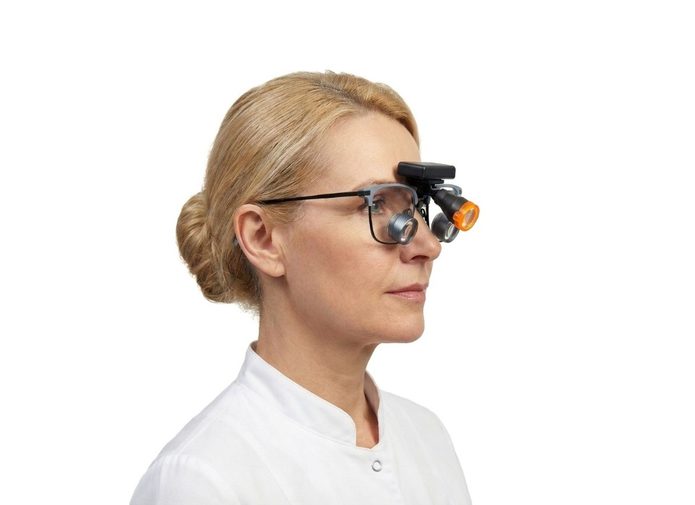

A dentist headlight can make a meaningful difference when overhead lighting does not adequately illuminate the treatment area. Dental procedures involve working inside small, shadowed spaces, where the clinician’s hands, instruments, and the patient’s anatomy can obstruct light.
The right illumination system should provide consistent light without adding unnecessary weight or discomfort. Brightness matters, but so do beam quality, colour accuracy, battery life, mounting, and how well the light works with magnification.
Why a Dentist Headlight Matters for Clinical Visibility
Overhead dental lights provide broad illumination, but they do not always follow the clinician’s exact line of sight. As the operator changes position, shadows can appear within the working field.
A head-mounted light addresses this by directing illumination from close to the clinician’s visual axis. This can make small details easier to distinguish, particularly during procedures that require sustained close observation.
The Problem With Inconsistent Illumination
Poorly positioned light can create:
- Shadows from hands and instruments
- Uneven illumination across the treatment field
- Glare from reflective surfaces
- Difficulty distinguishing fine details
- Frequent repositioning of the overhead light
A dedicated light should complement the existing clinical setup rather than require constant adjustment.
Key Features to Evaluate
Not every headlight is designed for the same clinical environment. A useful comparison should look beyond maximum brightness and consider how the system performs during actual procedures.
| Feature | Why it matters |
| Light intensity | Determines available illumination |
| Beam size | Affects how much of the treatment area is covered |
| Colour quality | Helps preserve natural visual appearance |
| Battery life | Determines practicality during a full schedule |
| Weight | Influences comfort during extended use |
| Mounting | Affects stability and alignment |
| Controls | Should be easy to operate during clinical work |
The best specification depends on the procedures being performed and how the light will be integrated with magnification.
How Bright Should a Dental LED Headlight Be?
Brightness is one of the most visible specifications when comparing a dental LED headlight, but maximum output is not necessarily the most useful measure. Excessive intensity can create glare or visual fatigue if the beam is poorly controlled.
The beam should provide enough illumination to reveal fine details while remaining comfortable for prolonged use. Consistency is also important because fluctuating output can become distracting during lengthy procedures.
Beam Quality Matters
A focused beam can direct light precisely toward the working field, while an overly narrow beam may illuminate only a small area. Conversely, a very broad beam may waste light outside the treatment area.
For clinical work, the ideal beam should align with the clinician’s viewing direction and provide even illumination without obvious hotspots or dark edges.
Colour Accuracy and Clinical Detail
Light colour can influence how tissues, materials, and surfaces appear. A headlight with good colour rendering can help preserve a more natural visual appearance instead of introducing an obvious colour shift.
This is particularly relevant when clinicians need to distinguish subtle differences in tissue or assess materials closely. Brightness alone cannot compensate for poor colour quality.
When comparing systems, colour rendering should therefore be considered alongside intensity rather than treated as a secondary specification.
Weight and Ergonomic Design
A headlight may remain on the clinician’s head for several hours. Even a small amount of additional weight can become noticeable when it is positioned toward the front of a loupe or frame.
Balance matters as much as total weight. A well-distributed system can feel more stable and comfortable than a lighter system that places most of its mass in one location.
The mounting system should also keep the light securely aligned. If the beam moves whenever the clinician adjusts position, the user may need to repeatedly correct it.
Battery Life for a Full Clinical Day
Battery performance is a practical consideration that can be overlooked when focusing on optical specifications. A system that requires frequent charging may be inconvenient in a busy practice.
Consider the expected operating time at the intensity normally used, rather than relying only on the manufacturer’s maximum runtime.
Practical Battery Questions
Before choosing a system, consider:
- How long does it operate at typical brightness?
- How quickly does the battery recharge?
- Is the battery removable or integrated?
- Can a spare battery be used?
- Is the charging system convenient for daily practice?
- Does output remain consistent as the battery drains?
A dependable power system helps keep illumination predictable throughout the working day.
Wireless Design and Freedom of Movement
Cables can add another consideration when using head-mounted illumination. They may need to be routed carefully to avoid interfering with clinical movement or other equipment.
Wireless systems can simplify movement by reducing cable management, although the battery then becomes part of the overall weight and balance calculation.
For clinicians considering a wireless setup, factors such as battery placement, operating time, charging routine, and frame compatibility should be evaluated together.
The practical considerations involved in selecting a wireless system are covered in greater detail in this wireless dental headlight buying guide, particularly when portability and daily workflow are important.
Compatibility With Dental Loupes
Many clinicians use illumination alongside magnification. In this situation, the headlight should work with the loupe frame without disrupting optical alignment or adding excessive front weight.
The light should ideally follow the clinician’s line of sight closely. This reduces the chance of shadows appearing when the clinician looks through the magnified optics.
Check These Compatibility Points
- Secure attachment to the frame
- Stable beam alignment
- Minimal interference with the optics
- Manageable front weight
- Comfortable fit during extended procedures
A technically strong headlight can still be unsuitable if its mounting system does not work with the clinician’s loupes.
How Surgical Headlights Compare With Dental Systems
The term surgical headlights covers a wider range of professional illumination systems, including equipment intended for procedures requiring concentrated, hands-free light.
Dental applications have their own practical requirements. The light needs to work within a relatively confined oral field while remaining comfortable enough for repeated clinical use.
The distinction is therefore less about which system is “brighter” and more about whether the illumination pattern, mounting, ergonomics, and controls suit the intended procedure.
A Simple Selection Framework
Rather than choosing a headlight based on one specification, evaluate the complete system against your daily workflow.
Clinical use
- What procedures will it support?
- How many hours will it be worn?
- Will it be used with magnification?
Optical performance
- Is the beam even?
- Is the colour rendering suitable?
- Is the intensity adjustable?
Ergonomics
- Is the weight balanced?
- Does the mounting remain stable?
- Can the light be positioned without repeated adjustments?
Power
- Does the battery cover a normal working session?
- Is charging straightforward?
- Is there a practical backup option?
Choosing a Headlight for Long-Term Use
A professional headlight should be viewed as clinical equipment rather than a simple accessory. Reliability, comfort, optical consistency, and compatibility can have a greater impact on everyday value than an impressive maximum brightness figure.
Schultz Loupes provides professional illumination and ergonomic solutions designed around the needs of clinicians who rely on clear visual access during detailed work. Evaluating the entire system helps ensure that the chosen headlight supports the clinician rather than becoming another source of distraction.
Final Thoughts
The right dentist headlight should deliver focused, consistent illumination while remaining comfortable and stable throughout clinical use. Brightness is important, but beam quality, colour rendering, battery performance, weight, mounting, and compatibility with magnification are equally relevant.
A thoughtful selection process starts with the clinician’s actual procedures and working habits. When illumination follows the line of sight, remains stable during movement, and provides comfortable visual conditions, it can make detailed clinical work easier to perform with confidence.