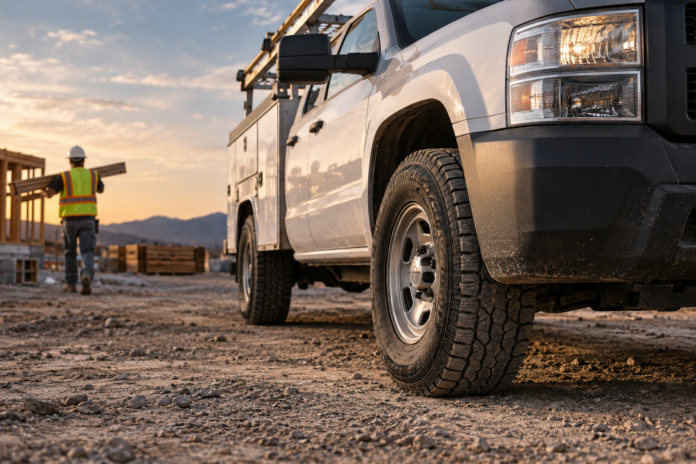

A commercial truck can spend its day doing things most personal vehicles rarely experience. It might leave the yard fully loaded, make a dozen stops in city traffic, sit idling at a job site, run down a rough access road, then head back on the highway before the day is over.
That kind of routine puts very different demands on tires.
For businesses that depend on pickups, cargo vans, service vehicles, and other light-duty work trucks, choosing tires isn’t only about finding the correct diameter. Load capacity, tread design, road conditions, driving patterns, and maintenance all affect how well a tire performs over its working life.
Start With the Work the Truck Actually Does
Two trucks of the same model can need very different tires.
A contractor carrying tools and building materials every day puts different stress on a tire than a delivery van that spends most of its time on paved city streets. A truck regularly traveling between farms, construction sites, and highways has another set of requirements.
Before comparing tread patterns, think about the truck’s normal week.
Ask a few practical questions:
- How much weight does it regularly carry?
- Is most driving highway, city, or mixed?
- Does the vehicle frequently travel on gravel or unpaved surfaces?
- How many stops does it make each day?
- Does it tow equipment or trailers?
- Is the truck usually loaded or frequently driven empty?
These details help narrow down the type of tire that makes sense.
Load Capacity Deserves Close Attention
Commercial vehicles often operate with tools, equipment, inventory, or cargo in the back. That extra weight matters.
A tire needs enough load capacity to safely support the vehicle under normal working conditions. The tire’s load index and load range provide information about how much weight it can carry when properly inflated.
Don’t assume that a tire fits simply because its physical dimensions match the wheel.
The vehicle manufacturer’s specifications should remain the starting point. When replacing tires, the new set should meet the required size, load capacity, and other specifications for the vehicle.
This becomes especially important for trucks that regularly operate near their payload limit.
Overloading a tire can increase heat and stress in its internal structure. Combine that with long highway runs, hot pavement, or incorrect inflation and tire wear can accelerate quickly.
Match the Tread to the Route
Tread design can have a noticeable effect on how a commercial truck behaves.
For vehicles that spend nearly all their time on paved roads, an on-highway tread may be the practical choice. These tires are generally designed around predictable road manners, stability, and long-distance use.
Mixed-service vehicles have different needs.
A landscaping truck, for example, might spend most of its day on pavement but regularly enter muddy properties or gravel work sites. A more aggressive tread can provide useful traction when the pavement disappears.
The trade-off is that aggressive tread isn’t automatically better.
A heavily patterned tire may create more road noise or behave differently on pavement than a highway-focused design. Choosing based on appearance alone can leave you with capabilities the truck rarely uses.
For fleets and individual operators comparing tires for Commercial Light Trucks, the better approach is to match the tire’s intended application with the vehicle’s actual workload rather than simply choosing the toughest-looking tread.
City Driving Can Be Hard on Tires
Low mileage doesn’t necessarily mean easy service.
Commercial vehicles operating in cities may spend their days accelerating, braking, turning, and maneuvering into tight spaces. Delivery trucks can repeat this cycle dozens of times during a shift.
That constant stop-and-go operation can contribute to uneven or faster tread wear.
Curbs are another problem. A tire that repeatedly rubs or strikes curbs can suffer sidewall damage even when plenty of tread remains.
Drivers should regularly look for cuts, bulges, exposed material, or unusual wear around the shoulders and sidewalls. Small problems are much easier to deal with when they’re spotted before the next fully loaded run.
Tire Pressure Becomes Even More Important
Checking tire pressure sounds basic because it is basic. It’s also one of the easiest maintenance jobs to neglect.
Commercial vehicles can experience significant changes in load during the week. Correct inflation helps the tire carry that weight properly and maintain the intended contact with the road.
Underinflation can create excess heat and increase wear around the tire’s shoulders. Overinflation may contribute to different wear patterns and can change how the tire responds to road surfaces.
The important number isn’t simply whatever pressure happens to be printed most prominently on the tire.
Follow the vehicle manufacturer’s recommended inflation guidance while accounting for the vehicle’s approved tire specifications and operating requirements.
For working trucks, pressure checks should be routine rather than something that happens only when a tire looks low.
Uneven Wear Is Trying to Tell You Something
Tread wear can reveal problems elsewhere on the vehicle.
If one edge wears significantly faster than the other, alignment may need attention. Irregular patches can point toward suspension, balancing, inflation, or mechanical issues.
Ignoring the pattern and replacing the tire alone may only reset the clock.
The replacement can begin wearing the same way because the underlying cause hasn’t changed.
This is why regular tire inspections can save more than the cost of one damaged tire. Finding an alignment or suspension problem early may prevent an entire set from wearing prematurely.
Rotation Can Help Extend Useful Tread Life
Commercial trucks don’t always wear every tire at the same rate.
Steering forces, drivetrain configuration, load distribution, and normal operating conditions can cause certain positions to wear faster than others.
A suitable rotation schedule can help distribute that wear.
The correct pattern and interval depend on the vehicle, tire setup, and manufacturer’s recommendations, so there isn’t one universal schedule for every commercial truck.
Fleet vehicles also benefit from recording mileage and tire service history. Even a simple record of installation dates, rotations, pressure checks, and unusual wear can reveal patterns that aren’t obvious when looking at one vehicle on one day.
Don’t Judge Replacement Time by Tread Alone
Tread depth is important, but it isn’t the only reason a commercial tire may need replacement.
Look at the entire tire.
Cuts, cracking, puncture damage, sidewall bulges, exposed cords, or unusual deformation deserve attention. Tires that have experienced severe impacts should also be inspected carefully.
Age matters too.
A truck that travels relatively few miles can still have tires exposed to sunlight, temperature changes, moisture, and long periods sitting under load. Low mileage doesn’t make a tire immune to aging.
Regular inspections are especially useful for seasonal or lightly used work vehicles because visible tread can create a false sense that the tire is still in ideal condition.
Think in Cost per Working Mile
Buying commercial tires purely by initial price can be misleading.
A cheaper tire that wears quickly, causes unnecessary downtime, or doesn’t suit the vehicle’s route may cost more over its service life than a tire that initially costs more.
For a working vehicle, downtime has a price.
A truck sitting at a tire shop isn’t delivering products, carrying equipment, visiting customers, or completing jobs. Reliability therefore becomes part of the financial calculation.
Consider expected service conditions, durability, maintenance requirements, and useful tread life together.
The goal isn’t necessarily to buy the most expensive tire available. It’s to choose a tire that fits the job well enough that you’re getting useful, dependable service from the money you’ve spent.
The Right Tire Is the One That Fits the Job
Commercial light trucks aren’t all doing the same work, so their tires shouldn’t be chosen as though they are.
Start with the vehicle manufacturer’s specifications, then consider payload, road surfaces, daily mileage, driving environment, and how often the truck leaves pavement. After installation, consistent pressure checks, inspections, rotations, and attention to unusual wear can help protect that investment.
A good commercial tire doesn’t need to be impressive sitting in the parking lot. It needs to keep doing its job after thousands of loaded miles, repeated stops, rough roads, and long working days.