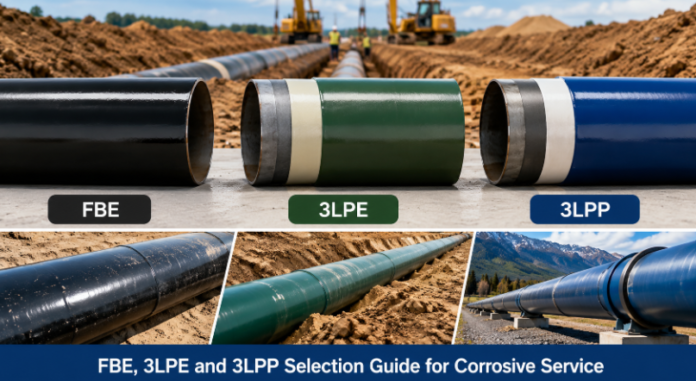

External coating protects steel pipe from soil, moisture, groundwater, and other corrosive environments, but FBE, 3LPE, and 3LPP do not provide exactly the same type of protection. The practical choice depends mainly on whether the project needs a bonded corrosion barrier alone, additional mechanical protection, or a three-layer system that can better tolerate elevated operating temperatures.
For buyers, the key is not simply to specify an “anti-corrosion coating,” but to match the coating structure to the conditions the pipe will actually face.
How Do Service Conditions Affect Coating Selection?
The first distinction is between corrosion protection and mechanical protection.
If the main requirement is a coating bonded directly to the steel surface and the risk of impact, abrasion, and indentation can be controlled during transportation and installation, Fusion-Bonded Epoxy (FBE) may provide the required corrosion barrier without adding a separate polyolefin outer layer.
If the pipe will be buried and exposed to more demanding handling, backfilling, or soil conditions, corrosion resistance alone may not be enough. In this case, a three-layer system becomes more relevant because the outer layer helps protect the underlying corrosion barrier from physical damage.
This is where three-layer polyethylene (3LPE) is commonly used. Its polyethylene outer layer adds resistance to impact, moisture penetration, and handling damage, making it suitable for buried pipelines where both corrosion protection and mechanical durability are important.
Where similar three-layer protection is required but operating temperature is higher, three-layer polypropylene (3LPP) becomes a stronger candidate. Polypropylene generally retains its mechanical properties at higher temperatures than polyethylene, so 3LPP is often specified when the temperature requirement exceeds the practical range of the selected 3LPE system.
The exact temperature limit should still come from the applicable coating grade and project specification rather than from a single universal value. Different formulations and coating classes can have different allowable service ranges.
When Does FBE Make More Sense Than a Three-Layer System?
FBE should not be treated as a lower-grade version of 3LPE or 3LPP. It serves a different coating requirement.
The epoxy layer bonds directly to the prepared steel surface and provides the primary corrosion barrier. Where the pipe can be handled and installed without severe abrasion or impact exposure, adding a thick external polyolefin layer may not be necessary.
FBE can therefore be a practical choice where corrosion protection is the main concern and mechanical damage can be controlled through handling procedures and installation conditions.
Its comparatively thin coating profile can also be useful where the project does not require the additional bulk of a three-layer coating.
However, if pipes will be dragged, repeatedly handled, backfilled with coarse material, or otherwise exposed to greater mechanical stress, the absence of a thick PE or PP outer layer becomes more significant. Under those conditions, 3LPE or 3LPP may provide a better balance of corrosion and mechanical protection.
When Should 3LPE or 3LPP Be Preferred?
The choice between 3LPE and 3LPP is mainly influenced by temperature and mechanical requirements.
Both systems typically use an FBE layer against the steel, followed by an adhesive layer and a protective polyolefin outer layer. This means both combine a bonded corrosion barrier with additional external protection.
For conventional buried pipeline service where operating temperatures remain within the selected polyethylene coating range, 3LPE is often sufficient. Its PE outer layer protects the underlying coating during handling, transport, and backfilling while also reducing direct exposure to moisture.
3LPP becomes more relevant when the pipeline operates at a higher temperature or when the project requires stronger mechanical performance from the outer layer. The PP layer offers greater heat resistance and can provide higher resistance to indentation and mechanical stress under demanding conditions.
This does not mean that every higher-temperature pipeline automatically requires 3LPP. The project should still verify whether the specified 3LPE grade already covers the required temperature range. The change to 3LPP becomes technically meaningful when the actual operating requirement exceeds what the selected PE-based system can reliably provide.
Available external coating pipe specifications can be reviewed against these service conditions before the final coating system is fixed.
What Coating Details Must Be Defined After the System Is Selected?
Choosing FBE, 3LPE, or 3LPP is only the first step. The coating name does not fully define the finished pipe.
The specification should also state the applicable coating standard, required thickness, surface preparation, pipe-end cutback, and relevant inspection requirements.
Coating thickness matters because it influences both barrier performance and mechanical protection. A supplier should therefore not be allowed to interpret “3LPE coated pipe” without a defined coating class or thickness requirement.
Surface preparation is equally important. FBE adhesion depends on the condition and profile of the prepared steel surface, and the performance of 3LPE and 3LPP also depends on the integrity of the underlying FBE layer.
Pipe-end cutback should be controlled where field welding is required. Too little cutback can interfere with welding and joint preparation, while excessive cutback increases the length of exposed steel that must later be protected by a field-joint coating.
What Inspection Confirms the Coating Is Acceptable?
Inspection should verify both coating continuity and conformity with the specified system.
Thickness measurement confirms whether the coating meets the required minimum or nominal value. Visual inspection can identify damaged areas, contamination, incomplete coverage, or surface defects.
Holiday detection is used to identify pinholes or discontinuities that may expose the steel substrate. This is particularly important because a coating can appear visually complete while still containing small defects that create a path for moisture.
Where required by the coating specification, adhesion and other performance tests should also be confirmed. The relevant production and inspection records should remain traceable to the coated pipe or production batch.
For an initial review of coated steel pipe capabilities and related product ranges, buyers can also refer to Baolai Steel before confirming project-specific coating requirements.
Conclusion
The choice between FBE, 3LPE, and 3LPP should follow the type of protection the pipeline actually needs. FBE is appropriate where a bonded corrosion barrier is the main requirement and mechanical damage can be controlled. 3LPE adds a protective polyethylene layer for buried pipelines exposed to greater handling and backfilling risks. 3LPP provides similar three-layer protection but becomes more relevant when higher operating temperatures or stronger mechanical performance are required.
After the coating system is selected, thickness, surface preparation, cutback, and inspection requirements should be defined separately. This turns a broad coating name into a complete technical requirement that can be consistently applied to the project.