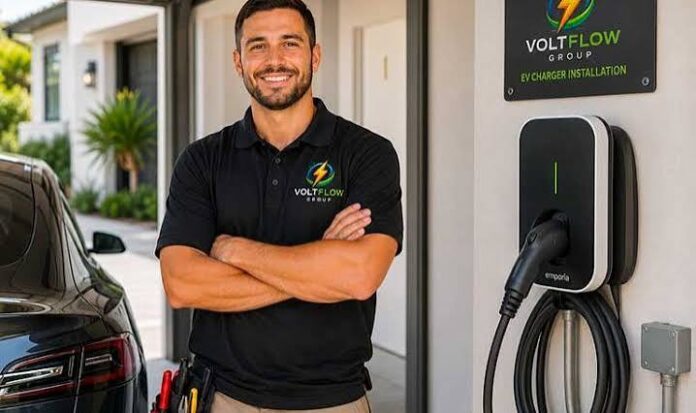

Electric vehicles have moved past the early-adopter phase. They’re parked in apartment garages, workplace lots, and retail centers across the country, and the people driving them are asking the same question of every property they visit: where do I plug in? For property owners, that question has quietly become one of the more important amenity decisions of the decade — right up there with high-speed internet and secure parking.
The shift isn’t just about keeping up with driver expectations. It’s about protecting long-term property value, unlocking a new revenue line, and avoiding the scramble that comes from retrofitting infrastructure years after demand has already outpaced supply.
The Business Case Has Changed
A few years ago, electric car charger installation was treated as a niche upgrade — something forward-thinking properties added mostly for PR value. That’s no longer the case. As EV adoption climbs, chargers are increasingly factored into how tenants choose where to live, how employees evaluate where to work, and how investors assess the long-term competitiveness of a commercial asset.
For multifamily buildings, this shows up directly in leasing conversations. Renters comparing similar units increasingly treat EV charging access the same way they treat in-unit laundry or a fitness center: a practical amenity that influences the decision, not a bonus feature. For HOA boards, the pressure often comes from residents already asking how shared electrical capacity and billing will be handled — questions that are much easier to answer with a plan in place than after installation demand spikes.
Workplaces face a parallel dynamic. Offering charging isn’t just a sustainability checkbox anymore; it’s become part of how companies compete for talent, particularly among employees who’ve already made the switch to electric vehicles and factor commute logistics into where they choose to work.
Retail and commercial properties see a more direct version of the same trend. Charging availability keeps visitors on-site longer, which tends to translate into more foot traffic and repeat visits — provided the chargers are placed somewhere visible and easy to use, not tucked into an overlooked corner of the lot.
Why the “Do It Later” Approach Gets Expensive
The instinct to wait — until more tenants ask, until costs come down, until the property has more capital on hand — is understandable, but it often backfires. Electrical capacity, panel upgrades, and trenching costs tend to be the most expensive part of any EV charging project, and prices rarely move in the property owner’s favor over time. Waiting also means competing against buildings that installed early and are already advertising the amenity.
There’s also a practical constraint that’s easy to underestimate: electrical infrastructure planning. A property that adds chargers reactively, one at a time as tenants request them, often ends up with a patchwork system that’s harder and more expensive to scale later. Planning for future expansion from the outset — even if only a portion of parking spaces get chargers on day one — tends to save significant money down the line.
What a Modern Installation Actually Involves
A proper EV charger installation is more involved than mounting hardware and running a cable. It typically includes:
- Site assessment — reviewing electrical panel capacity, parking layout, and where chargers will get the most use.
- Permitting and utility coordination — a step that varies significantly by municipality and can stall a project for months if it’s mismanaged.
- Electrical and construction work — trenching, wiring, and any panel upgrades needed to support the chargers.
- Charger installation and network configuration — connecting units to a monitoring platform so usage, uptime, and billing can be tracked.
- Ongoing operation and maintenance — the part property owners often forget to plan for until a charger goes down and nobody’s sure who’s responsible for fixing it.
That last point is where a lot of installations quietly fall short. Hardware that isn’t actively monitored and maintained tends to degrade in usefulness fast — a charger that’s frequently offline is worse for tenant satisfaction than no charger at all, because it creates the appearance of an amenity that doesn’t actually work.
The Capital Question
Cost remains the biggest hesitation for most property owners, and reasonably so. Depending on site conditions — trenching distance, existing electrical capacity, and the number of chargers being installed — costs can range widely. The good news is that this landscape has shifted meaningfully. Rebates, grants, and tax incentives are available in many regions specifically to offset EV charger installation costs, and some providers now offer installation models that require no upfront capital at all, instead operating on a revenue-share arrangement where charging fees generate ongoing income for the property.
This kind of model changes the calculus considerably. Instead of treating EV charging as a capital expense competing against other property improvements, it becomes closer to a new revenue stream — one that also happens to make the property more attractive to prospective tenants, employees, or customers.
What to Look for in an Installation Partner
Not all EV charger installation providers operate the same way, and the differences matter more than they might seem at first glance. Some coordinate installation but outsource the actual electrical work to third-party subcontractors, which can create confusion about who’s accountable when something goes wrong. Others handle installation but don’t offer any ongoing monitoring or maintenance, leaving property owners to manage repairs on their own down the line.
Property owners evaluating options are generally better served by providers that manage the full lifecycle — site assessment, permitting, licensed electrical work, and long-term operation — under one accountable team. It reduces the coordination burden and, more importantly, means there’s a single point of contact when a charger needs service instead of a runaround between hardware vendors, electricians, and software providers.
The Bigger Picture
EV adoption isn’t slowing down, and the properties that get ahead of charging infrastructure now are positioning themselves for a market where it’s simply expected. Just as buildings without reliable internet access became harder to lease a decade ago, properties without EV charging are likely to face the same disadvantage within the next few years — quietly losing out to comparable buildings down the street that made the investment first.
For property owners weighing the decision, the practical starting point is a site evaluation: understanding current electrical capacity, realistic installation costs, and what a phased rollout could look like. Providers like Ampaway specialize in exactly this kind of end-to-end planning, handling everything from permitting to long-term system operation, so property owners can add the amenity without absorbing the risk or complexity themselves.
Whether the goal is protecting occupancy rates, supporting a corporate sustainability commitment, or simply staying competitive in a changing market, EV charger installation has moved from “nice to have” to a genuine strategic decision — and one that rewards property owners who move on it early.