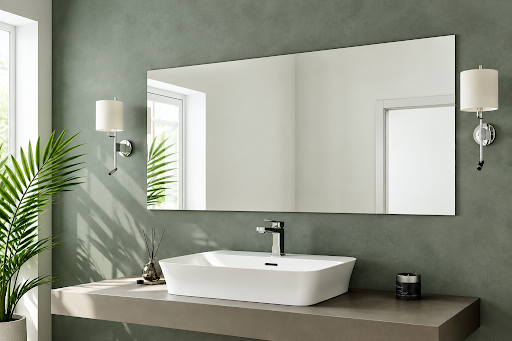

A living room mirror can do much more than provide a reflection. Used custom wall mirrors for living room thoughtfully, it can redirect natural light, create the perception of greater depth, balance a large wall, and act as a decorative focal point. That is why mirror placement has become an important part of modern living room design. Current interior-design trends increasingly treat mirrors as architectural and decorative elements rather than simple accessories. Oversized mirrors, arched silhouettes, organic shapes, mirrored panels, and gallery-style arrangements are among the formats appearing frequently in contemporary living spaces.
The challenge is that a mirror only works when its size, shape, position, and reflection make sense within the room. A beautiful mirror in the wrong location can emphasize clutter, reflect an unattractive view, or make a wall feel visually unbalanced.
For homeowners considering custom mirrors for living room spaces, the advantage is straightforward: the dimensions and design can be planned around the actual architecture instead of forcing the wall to accommodate a standard-size mirror.
What Size Mirror Should Go on a Living Room Wall?
There is no universal mirror size that works for every living room. The correct dimensions depend on the wall, furniture underneath it, ceiling height, viewing distance, and the visual effect you want.
For a mirror above a sofa or console, a useful starting point is to keep the mirror narrower than the furniture below it. A mirror that nearly spans the entire piece of furniture can sometimes work in contemporary interiors, but leaving visible wall space around it generally creates a more intentional composition.
Large wall mirrors are particularly effective when the wall itself is substantial. A small decorative mirror placed in the center of a very large wall can look disconnected from the rest of the room.
Scale matters even more with oversized mirrors. A large reflective surface can become the dominant feature of the room, so it should relate to the proportions of nearby furniture rather than simply being as large as possible.
Think About the Wall Before the Mirror
Measure the wall’s usable width and height first. Then consider obstacles such as windows, electrical outlets, wall sconces, fireplaces, shelves, and doors. If the wall has unusual dimensions, a custom-cut mirror can solve a practical design problem that an off-the-shelf product cannot. It can be shaped to fit between architectural features or designed to follow a particular furniture arrangement. The objective is not to maximize mirror area. It is to create visual balance.
Where Should a Mirror Be Placed in a Living Room?
Placement is arguably more important than the mirror itself. One of the most common locations is above a sofa or console table because the furniture provides a natural visual anchor. A mirror can also work above a fireplace mantel, on a feature wall, beside a seating area, or on a narrow wall that benefits from additional visual depth.
However, always check what the mirror will reflect before installing it. A mirror facing a window may bring more daylight into the room, while one facing an attractive artwork, plant arrangement, or architectural feature can effectively duplicate that visual element. On the other hand, reflecting a television, cluttered shelving, or an unattractive exterior view may make the room feel busier rather than better.
This is one reason designers increasingly approach mirrors as tools for controlling sightlines and proportions, not simply as wall decorations.
How Mirrors Make a Living Room Feel Bigger
Mirrors cannot physically increase a room’s dimensions, but they can change how the space is perceived. A strategically positioned reflective surface can extend an existing sightline and reflect portions of the room that would otherwise be visually hidden. In a smaller living room, that additional visual depth can make the space feel less enclosed.
Reflection of daylight can also make a darker room appear brighter. But there is an important distinction: mirrors redistribute existing light; they do not create additional light. If a room receives very little natural or artificial illumination, installing a mirror alone will not solve the underlying lighting problem.
For narrow rooms, a horizontally oriented mirror can emphasize width. A taller mirror can instead draw attention upward and make the ceiling appear higher.
The orientation should therefore support the room’s proportions rather than simply follow the latest trend.
Choosing the Right Mirror Shape
Shape strongly influences the personality of a living room.
Rectangular Mirrors
Rectangular mirrors are versatile and work especially well with sofas, consoles, fireplaces, and other linear architectural elements. Their straight edges complement modern and traditional interiors alike. They are also practical when you need to cover a broad wall area efficiently.
Round Mirrors
Round mirrors introduce softer geometry into rooms dominated by rectangular furniture. A circular mirror above a console, for example, can create contrast against the straight lines of the furniture beneath it.
This makes round designs particularly useful in contemporary spaces where softer forms are being introduced to balance structured layouts.
Arched Mirrors
Arched mirrors combine vertical emphasis with a softer upper edge. They can be especially effective when the goal is to add visual height without making the room feel overly rigid.
Arches and other curved silhouettes are increasingly prominent in contemporary mirror design, alongside organic and irregular shapes.
Organic and Asymmetrical Shapes
Freeform and irregular mirrors can function more like artwork than conventional reflective surfaces. They are best suited to rooms where the furniture and surrounding decor are relatively restrained.
If everything in the room already has a strong shape or pattern, adding another highly sculptural element can create visual competition.
Framed vs. Frameless Wall Mirrors
The frame changes how the mirror interacts with the rest of the room. Framed mirrors add another material, color, or texture to the wall. Wood can complement warm interiors, metal can introduce contrast, and darker frames can define the mirror against a light wall.
Frameless mirrors create a cleaner visual transition between the reflective surface and the surrounding wall. They can be especially useful when the goal is to emphasize the reflection itself rather than the border.
Neither option is inherently better. The right choice depends on whether the mirror should read primarily as decorative wall art or as an integrated architectural surface.
Mirror Panels for Large Walls
One large sheet is not the only way to create a substantial reflective installation. Multiple mirror panels can be arranged in a grid, separated by narrow joints, or combined with architectural elements. This approach can make a large wall feel more structured while allowing the reflective surface to follow the room’s geometry.
Panel layouts can also be useful when a single oversized piece would be difficult to transport, handle, or install. For homeowners considering a mirrored feature wall, the installation method should be considered during the design stage rather than after the glass has been fabricated.
How to Use Mirrors Without Making the Room Feel Overdone
More reflection is not automatically better. A common mistake is placing mirrors on multiple walls without considering what each surface reflects. When several mirrors reflect one another, the result can become visually confusing. Likewise, covering a wall with small mirrors simply to fill empty space can create clutter rather than sophistication.
A better approach is to give each mirror a specific purpose. One might brighten a dark corner. Another might emphasize a fireplace. A large statement mirror might anchor the sofa wall. The design becomes more cohesive when every reflective surface has a reason to be there.
The surrounding decor matters, too. If the mirror has a dramatic frame or unusual shape, simpler furniture and accessories can keep the composition balanced.
What Type of Glass Is Appropriate?
Mirror construction should be considered alongside appearance. For residential wall applications, the mirror should be suitable for its intended environment and installed according to the manufacturer’s recommendations. The substrate, backing, edge treatment, dimensions, and mounting method all influence the finished installation.
Large mirrors deserve particular attention because their weight increases with size and thickness. Proper mounting hardware must be selected for the mirror’s weight and the wall construction. Drywall, masonry, wood studs, and other substrates require different attachment approaches.
A large mirror should never be treated like lightweight wall art. If the installation is unusually large, heavy, or difficult to access, professional installation may be appropriate.
Common Mistakes to Avoid
One of the biggest mistakes is choosing the mirror before considering the room’s layout. The mirror should respond to the furniture, architecture, and lighting—not exist independently from them.
Another mistake is ignoring reflection. Before finalizing placement, stand where the mirror will go and identify what will appear in it. This simple step can prevent a surprisingly expensive design error.
Incorrect scale is another problem. A tiny mirror can disappear on a large wall, while an oversized mirror can overwhelm a small seating arrangement.
Finally, do not overlook installation. A mirror can be perfectly designed and still become a problem if the mounting system is inappropriate for its weight or wall type.
A Practical Way to Plan Your Mirror
Start by photographing the wall from the primary seating position. Measure the wall and the furniture that will sit beneath or beside the mirror.
Next, decide what you want the mirror to accomplish. Is the goal to reflect daylight, make the room feel wider, fill a blank wall, emphasize an architectural feature, or function primarily as decorative art?
Then choose the orientation and shape. Only after those decisions should you determine the exact dimensions, frame style, edge treatment, and mounting approach.
This order prevents a common mistake: selecting a mirror because it looks attractive on its own and then trying to force it into a room where it does not fit.
Final Thoughts
The best living room mirror is not necessarily the biggest, most expensive, or most fashionable option. It is the one whose proportions, shape, placement, and reflection make the entire room work better.
Custom sizing becomes particularly useful when a wall has unusual dimensions, when standard products leave awkward gaps, or when the design calls for a specific architectural shape. The goal should always be intentionality: the mirror should look as though it belongs in the room rather than being added simply because the wall was empty.
When planned around the room’s actual proportions and sightlines, custom wall mirrors for living room interiors can serve simultaneously as decorative features, light-reflecting surfaces, and tools for improving visual balance.