
Key Takeaways
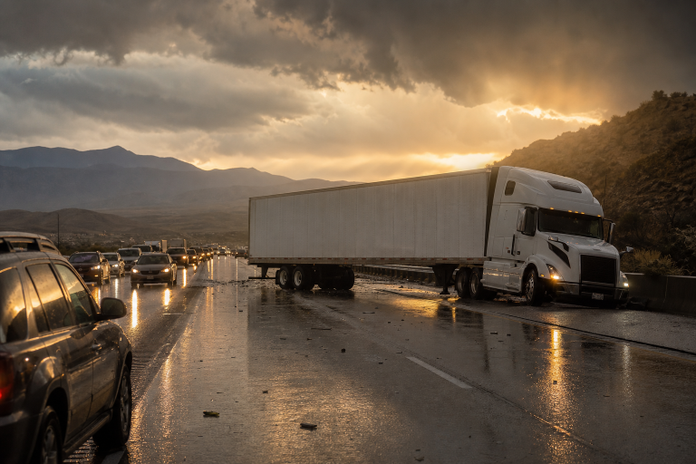
- A jackknife occurs when a truck’s trailer swings toward the cab, creating a dangerous folding angle that can block several lanes.
- Hard braking, excessive speed, wet pavement, steep grades, poor maintenance, and improperly loaded cargo can all contribute.
- Drivers should prioritize emergency care, a safe location, and a clear record of the collision.
- Evidence in truck cases may include electronic logs, maintenance records, dispatch messages, camera footage, and cargo documents.
- People injured in an I-15 jackknife crash may have claims against a driver, trucking company, cargo loader, maintenance provider, or another responsible party.
Interstate 15 carries heavy commercial traffic through California, Nevada, Arizona, Utah, Idaho, and Montana. A jackknife crash on this route can become catastrophic in seconds because the trailer may sweep across adjacent lanes, strike multiple vehicles, or leave motorists with little room to avoid the impact.
Conflicting accounts often make these cases more difficult. Concerns about inaccurate witness statements, including disputes about a rider’s speed, can arise after many types of roadway collisions. What to Do If Another Driver’s Witnesses Lie About Your Motorcycle Speed addresses why preserving objective evidence matters when the story of a crash is contested. Police reports, traffic-camera footage, vehicle data, and photographs may help establish what actually happened. These records can provide important context when witness accounts conflict or key details of the collision are disputed.
What Is a Jackknife Accident?
A jackknife accident involves an articulated commercial vehicle, usually a tractor-trailer. Instead of staying aligned with the cab, the trailer pivots outward, forming an angle with the tractor. The truck may spin, cross a median, strike nearby vehicles, or stop diagonally across the highway.
Jackknifing is particularly dangerous on I-15 near construction zones, sharp curves, mountain passes, interchanges, and areas with sudden congestion. A fully loaded trailer needs substantial distance to slow safely, while an empty or lightly loaded trailer may lose traction more easily under certain conditions.
Common Causes of Jackknife Crashes
Sudden or Improper Braking
Heavy braking can cause the tractor’s wheels or trailer wheels to lose traction. Once the trailer begins moving sideways, the driver may have limited ability to bring the vehicle back into line. Panic braking is especially hazardous on wet, icy, sandy, or oil-slick pavement.
Speed Too Fast for Conditions
A posted speed limit is not always a safe speed for a large truck. Rain, high winds, downhill grades, dense traffic, road work, darkness, and reduced visibility require more time and distance for a commercial vehicle to stop. Speed can also make it harder to recover when a trailer starts to swing.
Mechanical Problems and Poor Maintenance
Worn tires, defective brakes, brake imbalance, suspension problems, and neglected anti-lock braking components can increase the risk of a loss of control. Federal safety rules and routine inspections are intended to reduce these dangers, but records must be reviewed to determine whether a particular truck was maintained appropriately.
Unsafe Cargo Loading
Improperly secured cargo can shift during braking or turning. That shift changes the trailer’s center of gravity and may destabilize the vehicle. Overloaded trailers, uneven weight distribution, and unsecured freight can all become important issues during an investigation.
Driver Fatigue, Distraction, or Inexperience
A fatigued driver may react too late to slowed traffic or fail to recognize changing weather conditions. Distraction, aggressive lane changes, tailgating, and inadequate training can create the same dangerous sequence. Commercial drivers who must keep hours-of-service records may use electronic logging devices to track driving time and related information, which can become relevant evidence after a serious crash.
How Truck Drivers and Car Drivers Can Help Prevent Jackknives
Prevention starts with cautious operation and realistic stopping distances. Truck drivers should reduce speed early for traffic, curves, downhill grades, and bad weather. They should brake smoothly, inspect tires and braking systems, secure freight properly, and avoid driving when fatigue affects alertness or judgment.
Passenger vehicle drivers also have a role in reducing risk. Avoid cutting closely in front of a tractor-trailer, lingering in blind spots, or stopping abruptly after merging. Give trucks extra space in rain, snow, and road construction zones. If a trailer begins to swing, move away from its path if doing so can be done safely, rather than trying to pass alongside it.
What to Do After a Jackknife Crash on I-15
- Move away from active traffic, leaking fuel, fire, smoke, or spilled cargo if it is safe to do so.
- Call 911 and report injuries, blocked lanes, hazardous conditions, and the location as precisely as possible.
- Accept medical care and describe all symptoms, including dizziness, headache, numbness, confusion, neck pain, or back pain.
- Take photographs of vehicle positions, damage, skid marks, lane markings, weather, debris, truck markings, and road conditions when safe.
- Get the truck driver’s name, employer, insurance information, license plate, trailer number, and U.S. DOT number if available.
- Collect witness contact information and ask responding officers how to obtain the crash report.
- Do not speculate about fault, apologize, sign broad releases, or provide a recorded statement before understanding the request.
Evidence That May Matter in a Truck Accident Claim
Truck collisions usually involve more potential evidence than ordinary car crashes. In addition to photographs and witness accounts, an investigation may examine electronic driving records, dispatch communications, GPS data, dash-camera footage, inspection reports, maintenance invoices, driver qualification files, cargo manifests, and, where applicable, post-crash drug or alcohol testing.
Federal research into large-truck crash causation shows why investigators may need to examine driver, vehicle, roadway, and environmental factors together. A jackknife can result from a chain of decisions or failures, not one isolated mistake.
Legal Rights After an I-15 Jackknife Accident
An injured person may seek compensation for medical expenses, rehabilitation, lost income, reduced earning ability, vehicle damage, pain and suffering, and other losses recognized under the law where the crash occurred. Families who lose a loved one may also have wrongful death rights, depending on the facts and the applicable state law.
Potentially responsible parties can include the truck driver, motor carrier, trailer owner, freight broker, cargo loading company, maintenance contractor, vehicle manufacturer, or another motorist. Responsibility depends on the evidence. For example, a driver may have braked too late, while a carrier may have failed to maintain equipment or pressured a driver into an unsafe schedule.
Why Prompt Action Matters
Trucking companies and insurers may begin investigating immediately. Important records can be overwritten, repaired, moved, or lost over time. Preserve your own photos, medical records, repair estimates, work-loss documents, and communications. Because filing deadlines and insurance rules differ by state, it is wise to obtain legal advice promptly after a serious I-15 crash.
Conclusion
Jackknife accidents on I-15 can cause severe injuries because a single tractor-trailer may suddenly occupy multiple lanes of travel. Careful driving, safe loading, regular maintenance, and adequate rest can reduce the risk. After a collision, safety and medical care come first. Clear documentation and timely action can then help protect the facts and preserve the legal rights of everyone affected.