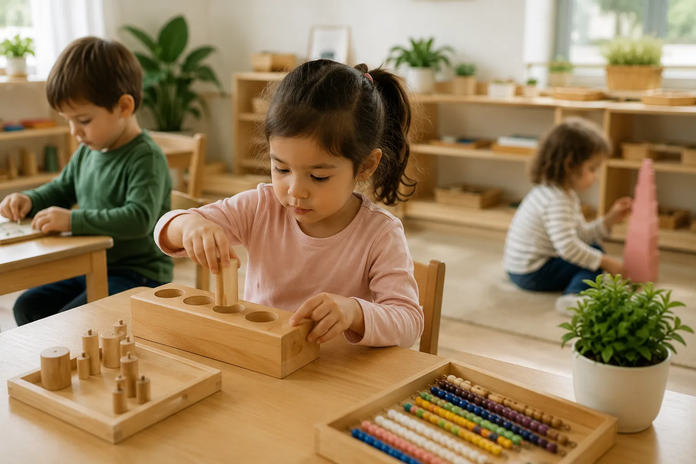

Tell a young child that one container holds more water than another and they may understand what you’re saying. Give them two containers, some water and the chance to pour it themselves, though, and the idea suddenly becomes something they can see, touch and explore.
That’s the basic appeal of hands-on learning. Rather than only listening to an explanation, children actively interact with materials and discover how things work. It’s an approach often associated with early learning environments, including programs based on Montessori principles. Parents exploring options such as Montessori Ryde may therefore come across activities designed to turn abstract ideas into practical experiences.
For young children, this can be particularly valuable because many concepts that adults take for granted — size, quantity, weight, texture, sequence and cause and effect — are still completely new.
Children Learn by Doing
Imagine trying to explain the idea of “heavy” and “light” without letting a child pick anything up.
You could describe the difference, show pictures and provide examples. But hand them two objects with noticeably different weights and the concept becomes much more immediate.
The same applies to countless early learning experiences.
A child can explore size by arranging objects from smallest to largest. They can investigate balance by building a tower. They can discover volume by pouring water between containers.
They’re not simply being told the answer. They’re experiencing the idea behind it.
Abstract Ideas Become More Concrete
Numbers provide a good example of why physical experiences can help.
The symbol “5” is abstract. A young child needs to understand that it represents a quantity, not simply recognise its shape.
Giving them five physical objects allows them to connect the symbol with something tangible. They can count the objects, move them around and see that there are still five whether they’re arranged in a straight line or scattered across a table.
Hands-on activities can support similar connections in areas such as:
- Shapes and spatial awareness
- Comparing sizes and quantities
- Sorting and classification
- Patterns and sequences
- Early measurement
- Language and vocabulary
- Cause and effect
The activity itself may look simple, but the thinking happening behind it can be surprisingly complex.
Mistakes Become Part of the Learning
Hands-on learning also gives children opportunities to discover when something doesn’t work.
Suppose a child is building a tower and places a large block on top of several smaller, unstable pieces. The tower falls.
An adult could immediately rebuild it correctly. But giving the child an opportunity to try again allows them to investigate the problem.
They may experiment with a wider base, change the order of the blocks or build more carefully.
That process introduces an important lesson: getting something wrong doesn’t mean the activity is over.
Children can adjust, experiment and try another approach.
It Encourages Active Attention
Young children aren’t always suited to sitting still while someone talks for extended periods.
An activity that requires them to sort, pour, stack, match, count or construct gives them something purposeful to do while learning.
That doesn’t mean every lesson needs to become an elaborate game. Often, simple materials are enough.
A collection of buttons can become a sorting activity. Measuring cups can introduce differences in capacity. Preparing a snack can involve counting, sequencing and practical life skills.
The learning happens through participation rather than observation alone.
Everyday Tasks Are Full of Learning Opportunities
Parents don’t necessarily need specialised educational materials to encourage hands-on learning at home.
Ordinary routines contain plenty of opportunities.
While cooking, a child might count spoonfuls, compare ingredients or follow steps in sequence. Folding laundry can become an exercise in matching colours and identifying pairs. Gardening introduces ideas about growth, weather, soil and responsibility.
Even setting the table involves counting and matching: one plate, one cup and one set of cutlery for each person.
The key is allowing children to participate rather than automatically completing every task for them.
Adults Can Guide Without Taking Over
Hands-on learning doesn’t mean leaving children entirely on their own.
Adults still have an important role in preparing appropriate activities, demonstrating how materials are used, answering questions and keeping children safe.
The challenge is knowing when not to intervene.
If a child is concentrating on fitting pieces together, immediately showing them the solution may end the very problem-solving experience that makes the activity valuable.
Instead, give them time.
If they’re becoming frustrated, a small prompt can help without providing the entire answer. Asking “What else could you try?” encourages them to keep thinking.
Repetition Helps Build Confidence
Adults can become bored watching a child repeat the same activity over and over. The child may have a very different perspective.
Repetition gives young learners opportunities to practise movements, notice details and become more confident with a task.
Pouring water between two small containers may seem repetitive, for example, but the child could simultaneously be developing coordination, concentration and an understanding of volume.
Once an activity becomes familiar, they may begin experimenting with it in new ways.
Learning Doesn’t Always Look Like a Lesson
One of the most useful things for parents to remember is that meaningful learning can look remarkably ordinary.
A child arranging objects, carrying a carefully filled cup or trying repeatedly to complete a puzzle may appear to be simply playing. Yet these experiences can involve observation, memory, coordination, reasoning and problem-solving.
Young children have an enormous amount to discover about how the world works. Giving them appropriate opportunities to touch, move, build, sort and experiment helps make those discoveries more concrete.
Sometimes the best explanation isn’t another explanation at all. It’s putting something safe and interesting in a child’s hands and giving them the time to work it out.