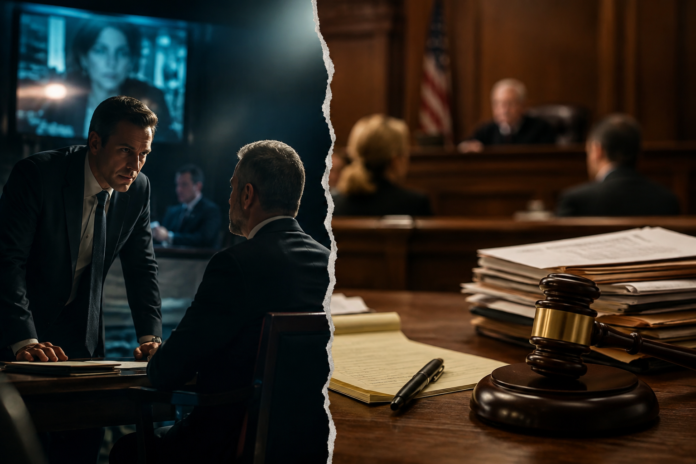

Millions of Americans binge crime dramas every week, and most of them walk away feeling like they have a law degree. They don’t. The gap between what plays out on screen and what actually happens in a real courtroom is wider than most people realize, and that gap has real consequences, for jurors, for defendants, and for the public’s entire understanding of justice. Here are five things crime TV consistently gets wrong about criminal defense, and why it matters more than you might think.
The “Confession in the Hallway” Myth
On TV, defense attorneys seem to crack cases wide open in the corridor outside the courtroom. They confront witnesses, extract surprise admissions, and deliver dramatic reversals with about 30 seconds of screen time to spare. Real criminal defense work looks nothing like that.
Most of a defense attorney’s heavy lifting happens long before anyone sets foot in a courtroom. It’s case review, evidence analysis, witness interviews, motion practice, and negotiation with prosecutors that often stretches across months. The dramatic hallway confession is a storytelling shortcut, not a legal strategy. If you hired an attorney expecting that kind of theatrics, you’d be spending money on someone performing for an audience that isn’t there.
The “Hollywood Defense Gap” is my term for the distance between the defense tactics you see on screen and the methodical, paperwork-heavy reality of building an actual defense. That gap is enormous, and it shapes how clients, jurors, and even some defendants think about what a good defense is supposed to look like.
The Evidence Always Exists Problem
Crime dramas almost always hand the defense (and the prosecution) clean, decisive forensic evidence. DNA results come back overnight. Surveillance footage is crystal clear. Digital records are pulled up on a tablet in seconds. In reality, evidence is messy, incomplete, and frequently contested.
Research published by Claremont Colleges found that jurors exposed to forensic-heavy crime dramas develop heightened expectations for the availability, precision, and decisiveness of forensic methods in real trials. When that evidence isn’t there, or when it’s ambiguous, jurors often don’t know what to do with that uncertainty. The result is what researchers call the CSI Effect, a documented courtroom problem where jurors apply a fictional standard to actual evidence.
This matters enormously for defense strategy. A real defense attorney doesn’t just argue facts; they often argue the absence of clean facts. That’s a subtle, skilled job that TV turns into a liability by making juries expect a smoking gun that was never going to exist.
Defense Attorneys Are Not Investigators
In show after show, the defense attorney is also the investigator. They’re out in the field, tracking down witnesses, finding security cameras the police missed, and personally uncovering the evidence that exonerates their client. It makes for great television. It’s also not how the legal profession works.
Attorneys build legal arguments. When investigation is needed, they work with private investigators, paralegals, and forensic consultants who specialize in exactly that. Expecting your attorney to personally surveil a building or dig through public records the way network TV suggests they do sets up an unrealistic client-attorney relationship from day one.
If you’re searching for a criminal attorney in columbus, ohio, for instance, you should be looking for someone with deep knowledge of Ohio statutes, local court procedure, and prosecutorial strategy, not someone who looks good running across a parking lot in the rain. The investigative glamour is entirely fictional. The legal craft is not.
How TV Warps Public Perception of Crime Itself
Here’s a finding that should genuinely surprise you. Purdue University research, covered by ScienceDaily in 2009, found that heavy TV crime viewers estimated two and a half times more real-world deaths due to murder compared to people who watched little or no crime television. That’s not a rounding error. That’s a fundamentally broken understanding of how dangerous the world actually is.
Crime drama also distorts perceptions of how many attorneys and law enforcement officers exist in the general population. Lawyers make up less than 1% of the American workforce, but survey respondents estimated the figure at over 16%. That misperception shapes everything from how people choose to interact with police to how they think about their own rights when actually charged with a crime.
Imagine you’re sitting on a jury in Franklin County, Ohio. You’ve watched a hundred episodes of procedural crime drama. You expect DNA evidence, a dramatic eyewitness, and a clear villain. The case in front of you has none of that. It has phone records, a contested timeline, and competing expert opinions. The temptation to fill in the TV-shaped gap with gut instinct rather than legal reasoning is exactly what defense attorneys have to fight against in real trials.
The Reality of What Criminal Defense Actually Defends
TV defense attorneys almost always represent obviously innocent people facing a corrupt system. Occasionally they represent a morally gray antihero. Almost never do they represent the messy, complicated reality of most criminal cases: people who made bad decisions under pressure, people caught up in circumstances they didn’t fully understand, or people facing charges that don’t neatly fit the crime they’re accused of committing.
A 2024 analysis published by the Cornell Undergraduate Law & Society Review noted that crime-themed TV shows have developed into a massive market, outnumbering every other drama subgenre. With that scale comes enormous influence over how ordinary people understand what a defense attorney’s job actually is.
The job is to ensure that the government meets its burden of proof. That’s it. That’s the whole constitutional guarantee. It doesn’t require the defendant to be a sympathetic hero. It doesn’t require a dramatic reversal in the final act. It requires the state to prove every element of the charge beyond a reasonable doubt, and it requires a skilled attorney to hold that standard in place when the pressure is on to just accept a plea and move on.
“These fictitious depictions build on false perceptions of the criminal justice system and how it intersects with race and gender while ignoring many important realities,” according to the Color of Change report, Normalizing Injustice, which analyzed 353 episodes across 26 scripted crime series from 2017 to 2018.
A Quick Reality Check: TV vs. The Courtroom
| What TV Shows | What Actually Happens |
| Defense cracks the case with a dramatic confrontation | Defense builds arguments through motions, discovery, and pretrial hearings |
| Forensic evidence is clean, fast, and decisive | Evidence is often incomplete, delayed, and contested by experts on both sides |
| Attorney personally investigates the crime scene | Attorneys work with licensed investigators and forensic specialists |
| Cases resolve in dramatic courtroom speeches | Most cases resolve through negotiation, plea deals, or pretrial motions |
| Defendants are innocent heroes or obvious villains | Real clients are complex people navigating a system built on legal standards, not narrative arcs |
What to Actually Look for in a Defense Attorney
Skip the checklist of TV-lawyer qualities. Here’s what actually matters when someone’s freedom is on the line.
- Knowledge of local court practice. Procedure varies significantly by jurisdiction. An attorney who knows the local prosecutors, judges, and procedural norms is not a luxury.
- Clear communication under pressure. Not dramatic speeches. Calm, honest assessments of risk, evidence, and strategy.
- Experience with the specific charge. Drug charges, federal offenses, and DUI cases each carry their own procedural landscape.
- Willingness to fight at trial if needed. Most cases settle, but the credible threat of trial changes the entire negotiation dynamic.
Crime dramas will keep running because audiences love them, and honestly, some of them are exceptional storytelling. But the next time a jury member, a defendant, or even a casual viewer walks out of a binge session thinking they understand how defense attorneys work, the reality check is worth having. The gap between what’s on screen and what’s in the courtroom is where real people’s lives play out, and it’s too important to leave to scriptwriters.