A few years back, I called my bank and got stuck in a phone menu for close to 10 minutes. Press 1 for this. Press 2 for that. We value your call, so please wait.
I had almost forgotten why I had phoned by the time someone did answer.
This type of annoyance is diminishing. Today’s AI voice systems don’t sound or behave like the phone systems of the past. They listen, interpret what someone is asking, and often resolve the issue without human intervention.
Companies are talking to customers and their own staff differently because of this. It’s already running in call centers, dental offices, banks, and even the pizza place on the corner that could never afford to have someone answering calls all night.
Here’s what these tools look like, why so many companies adopted them so quickly, how they are transforming businesses across industries, and more.
What Exactly Are AI Voice Agents?
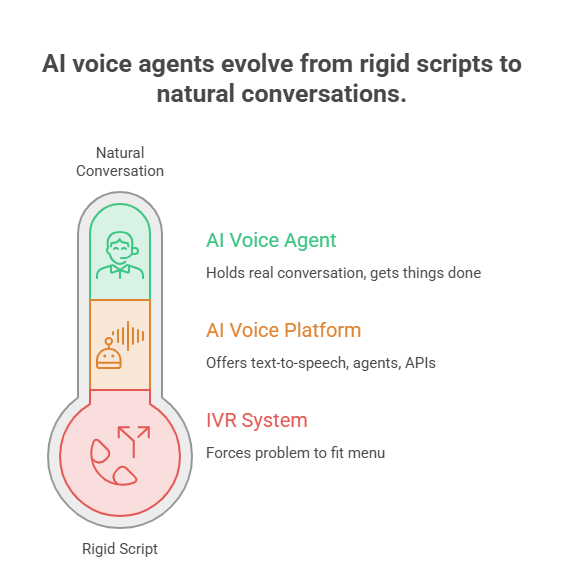
AI voice agents are software systems built to hold a real conversation with a caller and get something done, not just react to pre-loaded phrases as the old systems did. The category has shifted quickly: tools that started as narrow text-to-speech engines now bundle several capabilities into one layer:
- Speech synthesis — natural-sounding voices with real pacing
- Live dialogue handling — interruptions, follow-ups, back-and-forth flow
- API access — hooks into CRMs, booking systems, internal tools
- Conversational AI — reasoning about intent, not matching keywords
Murf is one example of that shift. It covers text-to-speech, voice agents, conversational AI, and voice APIs under one roof. A handful of other platforms have moved the same way, and the practical win for businesses is fewer vendors to stitch together and faster setup across support, sales, and internal workflows.
Old phone systems ran on a rigid script. Say “billing,” or the system won’t know what you mean. That is not how voice agents operate. A few components come together to give the conversation a sense of normalcy:
- Speech recognition converts spoken words into text.
- Slangs, interruptions, incomplete sentences, and everything else are all picked up by natural language understanding.
- What to reply is determined by a reasoning layer, which is typically a huge language model.
- Text-to-speech turns that reply into a voice, pauses included, that sounds close to a real person.
Put those together, and an agent can take a food order, move a dentist appointment, walk someone through resetting a password, or figure out if a caller’s even worth passing to sales. No human needed on the other end for any of it.
The gap between this and an old IVR (interactive voice response) system is huge. IVR forces your problem to fit its menu. A voice agent tries to meet you wherever you are, in whatever words you happen to use.
Self-Generated
Why Businesses Are Rushing to Adopt AI Voice Agents
This isn’t just because it’s the latest thing to try. There are real reasons behind it:
- People expect an answer right away, not during “business hours, Monday through Friday.” A voice agent doesn’t clock out at six.
- Hiring is a constant headache in support work. Turnover runs high and training someone new eats up time and money every single round. A voice agent, once it’s built and running, doesn’t quit on you.
- Call spikes hit without warning: a product launch, a billing error, a storm knocking out power somewhere. You can’t hire temp staff fast enough to keep up, but a voice agent just scales.
- The tech finally works. Early voice bots were clunky; people spotted them in two seconds flat. The current system, which is based on far more robust language models, sounds natural enough that most callers just converse rather than immediately requesting a human.
Here is a table showing the real changes from the old systems:
| Feature | Traditional IVR/Call Menus | Modern AI Voice Agents |
| Mode of interaction | Press buttons or say fixed keywords | Speak naturally in your own words |
| Understanding | Limited to pre-set options | Understands context, intent, and follow-up questions |
| Availability | Often business hours only | 24/7, no breaks, no holidays |
| Personalization | None, same script for everyone | Can pull customer history and tailor responses |
| Handling complexity | Struggles, transfers to human quickly | Handles multi-step tasks independently |
| Tone | Robotic, scripted | Conversational, close to natural speech |
How Are AI Voice Agents Transforming Businesses Across Industries?
Self-Generated
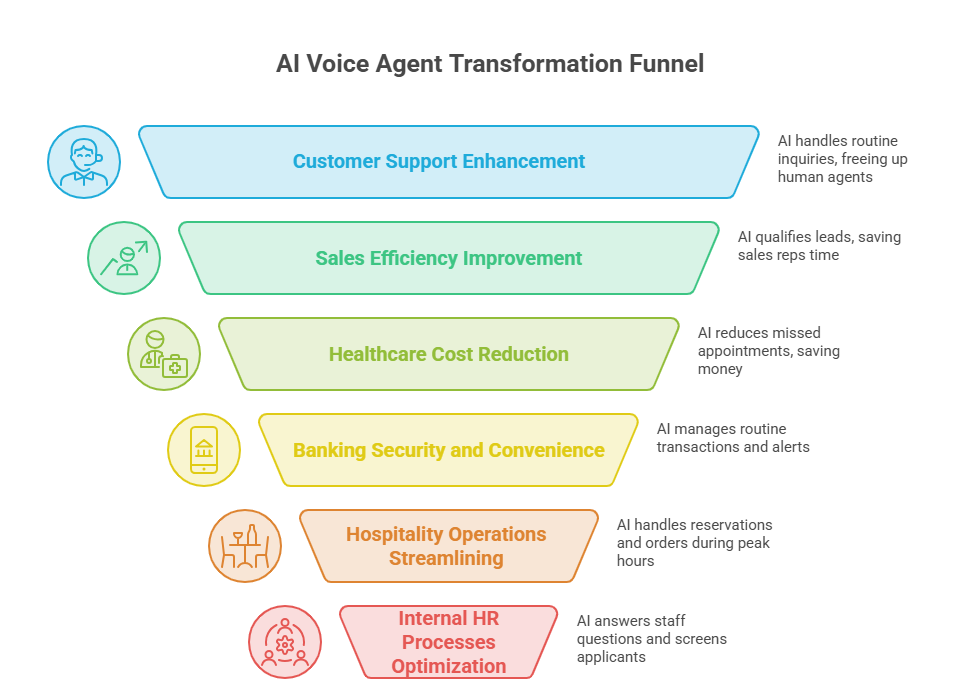
Customer Support
This one is the obvious case. Voice agents already handle:
- Order tracking and delivery updates
- Password resets and account verifications
- Basic troubleshooting for tech products
- Returns, refunds, and exchanges
- FAQs that used to eat up half a support team’s day
The point isn’t cutting every support job. It’s pulling human agents off the same dozen repeat questions so they’ve got time for the messy or emotional calls that need a person’s judgment.
Sales and Lead Qualification
Sales teams now let a voice agent take the first call, not the closing one. It asks a few basic questions, works out whether someone’s a real buyer or just curious, and only books time with a human rep when it’s worth their while.
That alone saves reps from wasting hours chasing leads that were never going anywhere.
Healthcare
Clinics employ voice agents to make minor scheduling changes, remind patients to take their medications, and confirm appointments. Although it might not seem like much, providers lose money every year due to missed appointments, and most customers are unaware of how much a simple reminder call lowers no-shows.
Mental health practices see this even more sharply. A patient managing panic attacks or working through structured programs like dialectical behavior therapy for anxiety often needs consistent weekly sessions. A friendly reminder call the day before makes the difference between showing up and slipping backwards.
Voice agents handle those touchpoints without adding to the front desk’s load.
Banking and Finance
Banks lean on voice agents for:
- Balance checks
- Fraud alerts
- Transaction verification
- General account questions
Anything sensitive still goes to a human. But the routine stuff like checking whether a charge went through gets handled right away.
Restaurants and Hospitality
Ever called a restaurant during dinner rush and just got silence?
Voice agents now take reservations and phone orders even when every staff member is buried on the floor. Fewer missed bookings. Fewer lost orders.
Tourism operators can use voice agents to handle routine questions outside normal business hours. For example, someone planning a weekend in York using a hop-on hop-off bus might call to check pickup times, ticket options, or whether a particular stop is operating that day.
A voice agent can handle these inquiries after hours and help smaller tour operators respond to potential customers even when their teams are offline.
Human Resources and Internal Operations
The use cases of AI voice agents go beyond customer service. Companies use voice agents internally too, for things like answering staff questions about benefits, setting up interviews, or running first-round screening calls with job applicants.
Self-Generated
The Challenges of Using AI Voice Agents in a Business
While we are talking about all the advantages of AI voice agents, it’s also important to acknowledge its shortcomings:
- An agent may still trip over accents and background noise, particularly in noisy settings or with strong regional accents
- Emotional situations still need a real person. If someone’s furious or dealing with something genuinely upsetting, no agent, however well-built, is right for that moment
- Trust matters. Most people want to know whether they’re talking to an AI or a human, and companies that try to hide it usually lose more trust than they save time
- Data privacy is a real concern, since these agents often deal with account numbers, medical details, and other sensitive information
- A poorly built agent can do more harm than good. One that keeps misreading requests or loops the same question is worse than no automation at all
A quick look at where each side has the edge:
| Task Type | Better Suited For AI Voice Agent | Better Suited For Human Agent |
| Order status checks | Yes | No |
| Appointment scheduling | Yes | No |
| Password/account resets | Yes | No |
| Angry or upset customers | No | Yes |
| Complex technical troubleshooting | Partially | Yes, for deeper issues |
| High-stakes financial decisions | No | Yes |
| Repetitive FAQs | Yes | No |
| Emotional or sensitive conversations | No | Yes |
How AI Voice Agents Will Reshape Business Roles
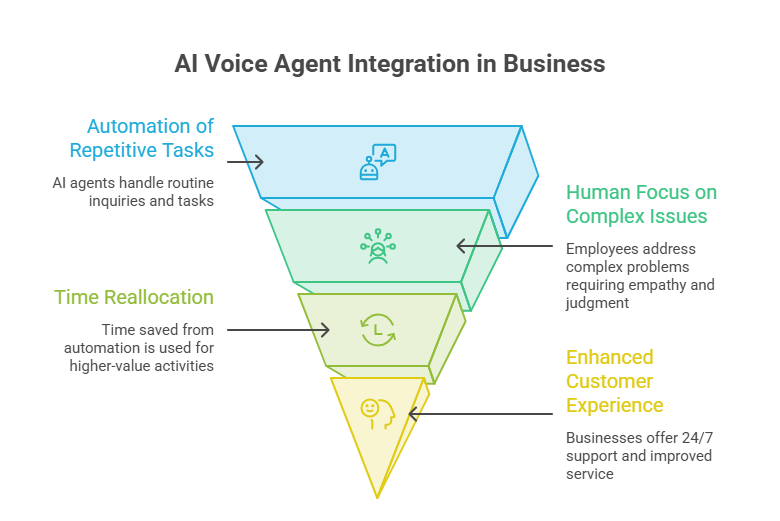
Voice agents aren’t wiping out jobs in customer service, sales, or support, not any time soon. What’s happening is the roles themselves are changing shape:
As AI-powered voice technology becomes more common, businesses also need to pay attention to Voice Search SEO. People are increasingly using conversational voice queries to find products, services, businesses, and answers. Optimizing content for natural-language questions, local searches, and conversational phrases can help businesses stay visible as voice search continues to evolve.
- Repetitive and predictable work drifts toward machines
- Conversations that need empathy or real judgment stay with people
- Time gets moved around, not eliminated
For example, a support staff that used to dedicate the majority of their day to “where’s my order” may now devote that same time to issues that truly require human intelligence.
It’s easy to underestimate how much this could change the way businesses operate. But the market for AI voice agents is expected to increase at a 39.0% CAGR from its 2025 valuation of $2.5 billion to $35.2 billion by 2033. Customer support automation will be accounting for the greatest portion of that expenditure. This kind of growth curve doesn’t happen unless businesses see real returns on the ground.
Small businesses might get the biggest win out of all this, honestly. A single-location shop that could never afford round-the-clock phone coverage can offer it now through a voice agent, going up against much bigger companies on customer experience without matching their budget.
Self-Generated
Final Thoughts
AI voice agents went from being a novelty to an immensely useful corporate tool. Without the constraints of hiring staff for each shift, they are taking calls, scheduling appointments, qualifying leads, and resolving issues around the clock.
They are not attempting to take the place of excellent customer service. They are just a means of improving the consistency and accessibility of excellent customer service. When implemented properly, they let employees concentrate on the jobs that call for human connection while the machines take care of the rest.
Businesses will succeed if they identify that balance early. This technology keeps improving. At this point, the question isn’t whether voice agents belong in your business. It’s how well you end up using them.
Want more insights into where automation and business technology are headed next? Visit latemagazine.com for the latest updates.