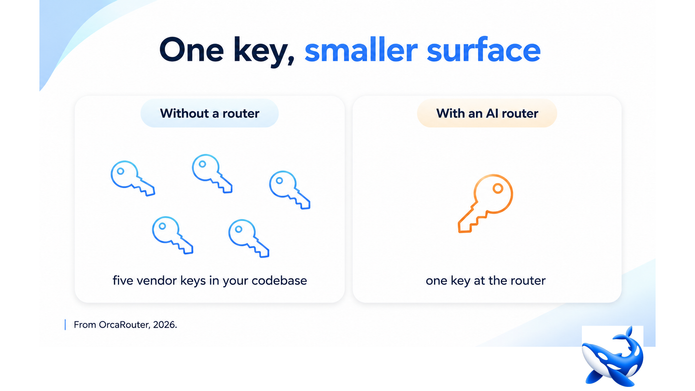

Security in LLM production is mostly about surface area: how many keys, how much prompt data, how many endpoints. An AI router shrinks that surface — one key instead of five, one endpoint instead of several, and a layer where you can see and control what is sent where. OrcaRouter is one platform built around this pattern.
Fewer keys, smaller blast radius
The multi-model setup without a router spreads vendor keys across your codebase and your team’s machines. Each key is a credential to protect, and each leak is a risk. With a router, the application holds one key to the router; the vendor keys live behind it, at the routing layer. Your developers no longer need five sets of credentials to build against five models.
That is a real reduction in attack surface: fewer keys to leak, fewer places to rotate, and one place where you can revoke access when a team or a contractor leaves.
Visibility and control
A router is a chokepoint, which is also a control point. Every request passes through it, so you can see what is being sent to which model, enforce rules about where data can go, and log without bolting on a separate observability layer. For teams with compliance or data-handling requirements, the ability to see and constrain every model call in one place is the difference between auditable and not.
A practical note on prompt data
The other security question teams ask is about the prompts themselves: what happens to the data your application sends. With a router, the prompts pass through the routing layer to the chosen provider, and the router’s own handling of that data is part of what you are buying. Teams with compliance requirements should verify the router’s data-handling commitments — what is stored, what is logged, what is forwarded — before adopting it. The one-key model and the control chokepoint are the structural wins; the data-handling terms are the ones to read in the fine print. For most teams, the single biggest improvement is simply that fewer credentials exist to leak, and that every call is visible in one place.
The audit story
For teams that answer to compliance or security review, a router changes the conversation. Instead of “we have vendor keys in five places and no single view of what is sent where,” it becomes “one key, one chokepoint, every call logged.” That is a materially better position in an audit, because the questions auditors ask — who has access, what data leaves, what is logged — all have answers that live in one place. The routing layer turns LLM security from a sprawl into a surface you can describe and constrain, which is worth more than any single control in isolation.
The questions to ask a router vendor
Before adopting a router, ask four questions: what is logged and for how long, is prompt content stored or just passed through, how are keys held and rotated, and what happens to data when a provider handles it. The structural wins — one key, one chokepoint, every call visible — are the reason the router is a security improvement in the first place. The answers to the four questions are the fine print that determines whether it fits your compliance posture. For most teams the answer is straightforward; for teams with hard data requirements it is the difference between adoptable and not. Ask them before you commit, not after.
A practical security posture
The security value of a router is easiest to see in the concrete changes it makes to your posture. Before a router, a multi-model application carries several vendor keys, each with its own rotation cycle, its own leak risk, and its own place in the codebase. After a router, the application holds one key to the routing layer, and the vendor credentials live behind it where only the router needs them. When someone leaves or a contractor finishes, revoking their access is one operation at the router instead of several across vendors. That is a measurable reduction in both the number of credentials and the blast radius if one leaks.
The router is also the natural chokepoint for data governance. Every request passes through it, so it can enforce rules about where data is allowed to go — which providers are acceptable for which payload types, which regions, which retention. For a team with compliance obligations, that single point of enforcement is the difference between an auditable pipeline and a hope that every code path happens to be compliant. The request log the router keeps is simultaneously the audit trail: what was sent, to which model, with which tokens, at which cost.
None of this replaces the basics — least-privilege keys, secret rotation, network controls. It makes them smaller and more tractable. The security question is not whether a router is perfectly secure; it is whether a router is a safer place for your credentials and your data-flow control than a sprawl of direct vendor integrations. For most teams it clearly is, and the routing layer is where their LLM security posture should start rather than an afterthought.
The takeaway
Security in LLM production is surface area, and an AI router shrinks it: one key instead of five, one endpoint, and a layer where every call is visible and controllable. Fewer credentials to leak, fewer places to rotate, and one chokepoint where you can enforce where data goes. For teams running multiple models, the routing layer is not a convenience — it is where the security posture lives.
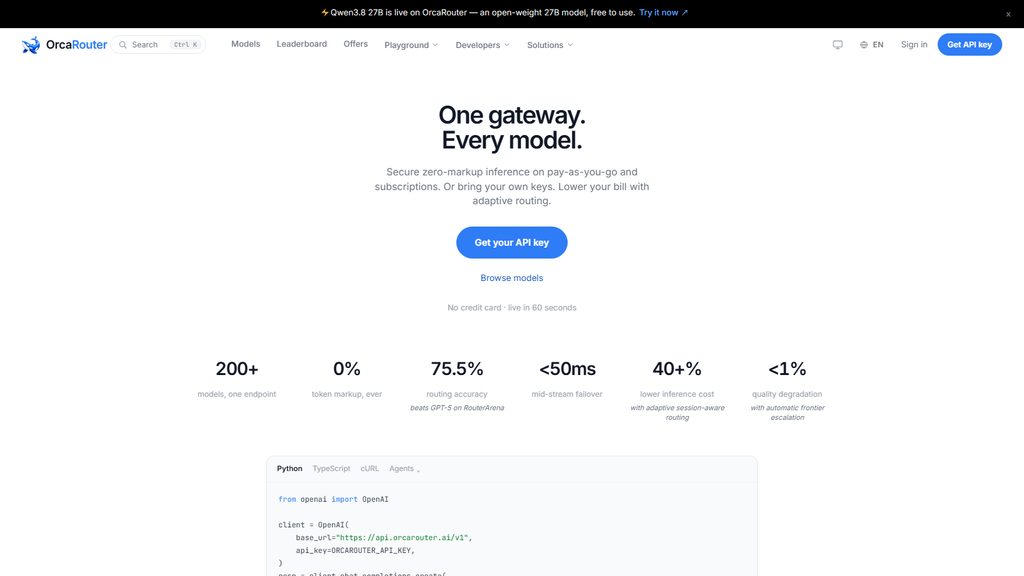
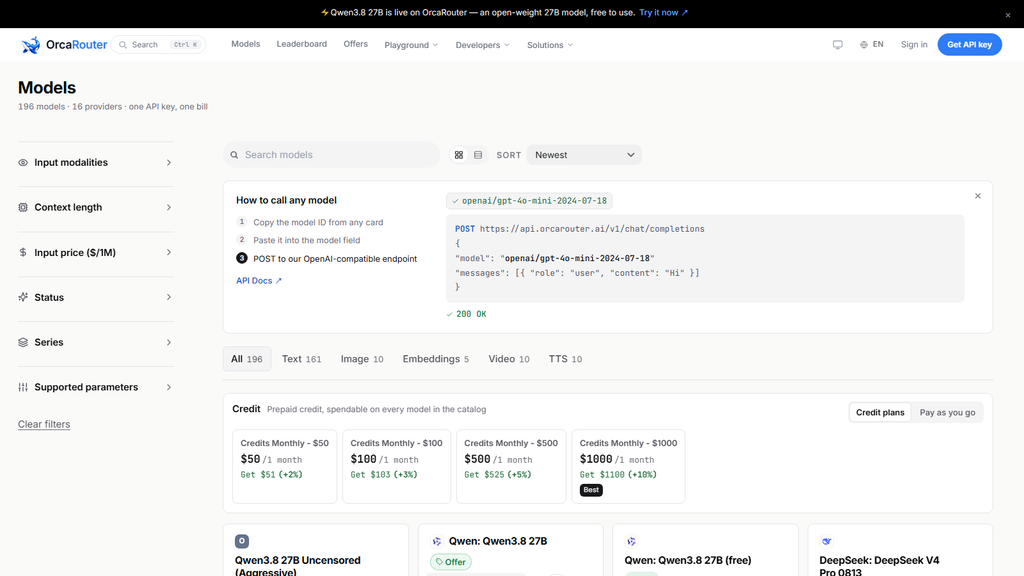
Sourcing note: this article describes the AI-router category and OrcaRouter’s implementation. The single-key model, request visibility and the control layer are OrcaRouter’s own published descriptions, checked August 2026.