
Table of Contents
- Why Streaming TV Planning Needs a New Approach
- Set Clear Campaign Goals Before Buying Inventory
- Define the Audience With More Than Demographics
- Choose the Right Mix of Streaming Inventory
- Build a Budget That Balances Reach and Frequency
- Plan Creative for the Streaming Environment
- Coordinate Streaming TV With Other Channels
- Measure Performance Beyond Completed Views
- Avoid Common Streaming TV Planning Mistakes
- Use a Streaming TV Planning Checklist
Streaming TV can deliver the scale of television with more flexible audience selection, creative testing, and performance visibility. But a successful campaign is not created by simply adding more apps or publishers to a media buy. It starts with a clear business objective and a plan for how streaming TV will work alongside every other channel.
Modern CTV advertising platforms can help advertisers activate campaigns across premium streaming, free ad-supported channels, and other video environments. The real advantage comes from using that access strategically: selecting the right audience, managing frequency, and measuring outcomes that matter to the business.
Why Streaming TV Planning Needs a New Approach
Viewers now divide their time among subscription services, broadcaster apps, live sports, news streams, and free ad-supported channels. A connected TV can also include smart televisions and devices that bring streaming apps to the largest screen in the home. That variety creates opportunity, but it also makes fragmented buying, duplicated reach, and inconsistent reporting more likely.
Streaming TV should not be treated as an automatic replacement for every linear TV buy or as a stand-alone tactic. The strongest plans begin with the customer, the business goal, and the measurement rules. Inventory choices should follow those decisions, not lead them.
Set Clear Campaign Goals Before Buying Inventory
Every campaign needs one primary outcome. Awareness campaigns may prioritize qualified reach, completed views, and brand lift. Consideration campaigns may focus on site engagement, branded search activity, or video retargeting pools. Performance-oriented campaigns can also track leads, appointments, sales, store visits, or sign-ups.
Ask These Questions First
- What business result should this campaign support?
- Which audience is most likely to respond?
- How long is the buying cycle?
- When will performance be reviewed?
- What result would justify expanding the budget?
A local home services company, for example, may use streaming TV to build familiarity in a service area while measuring calls and quote requests over a longer period. A national retailer may care more about reach and sales lift across priority markets.
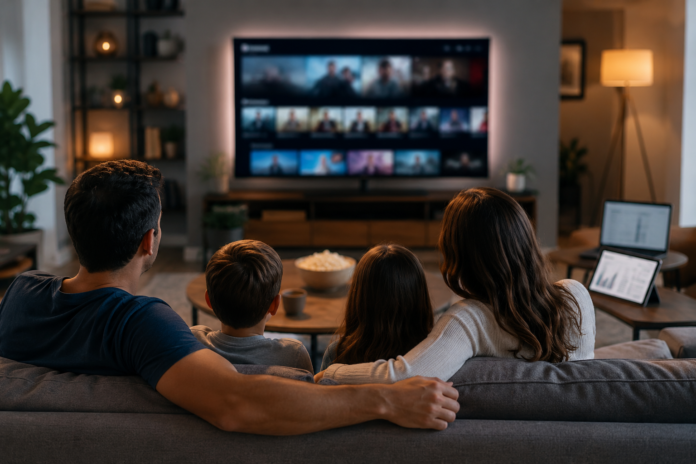
Photorealistic wide establishing shot of a contemporary family living room at night, with people watching streaming television on a large screen, surrounded by the broader home environment and subtle digital media planning elements such as a laptop and tablet in the background, natural lighting, realistic scale, no isolated close-up.
Define the Audience With More Than Demographics
Age and household income can be useful starting points, but they rarely tell the full story. Build audience groups around the characteristics that relate directly to the offer and the customer journey.
- Location, service area, or priority markets
- Household characteristics and life stage
- Past customers, high-value segments, and website visitors
- Recent purchase intent or research behavior
- Interests, viewing context, and content preferences
Audience precision should not become over-targeting. A group that is too narrow can limit scale, drive up cost, and make results difficult to interpret. Instead, create a few meaningful audience segments and give each one a clear reason to care about the message.
Choose the Right Mix of Streaming Inventory
Compare inventory based on more than projected impressions. Review whether each environment fits the brand, supports the intended audience, provides placement transparency, and offers reporting that can be used in campaign decisions.
Inventory Categories to Review
- Ad-supported subscription streaming services
- Free ad-supported streaming television channels
- Broadcaster and network streaming environments
- Live programming, including sports and news
- Local and regional streaming opportunities
Consider content quality, ad load, brand safety controls, geography, and access to cross-channel measurement. A mixed approach often gives the campaign more reach than relying on one environment, while still allowing the team to protect context and manage delivery.
Build a Budget That Balances Reach and Frequency
Budget decisions should balance how many qualified households see the message with how often they see it. In marketing, frequency capping refers to setting limits on the number of ad exposures during a defined period. It is an important control, but the right level depends on the campaign, creative, audience size, and campaign length.
A Simple Budget Process
- Estimate the size of the qualified audience.
- Set a realistic reach goal for the campaign period.
- Choose a starting frequency range and cap.
- Reserve budget for creative and audience testing.
- Review early delivery before making major budget shifts.
A campaign can waste money by reaching a small audience too often or by spreading too little budget across too many markets. Keep enough investment behind each priority audience to give the message a fair chance to register.
Plan Creative for the Streaming Environment
Strong media placement cannot rescue a vague message. Streaming TV creatives should establish the brand and core benefit quickly, use text that is readable from a distance, and make the next step easy to understand. Sound can add impact, but the ad should still communicate visually when viewers are distracted.
Use more than one version when practical. A 30-second spot can introduce a problem and explain the value proposition. A shorter 15-second version can reinforce the brand, offer, or location for viewers who have already been exposed to the longer message.
Coordinate Streaming TV With Other Channels
Every channel should have a role. Streaming TV can create attention and demand. Search can capture people actively looking for a solution. Display and online video can reinforce the message, while email can support retention among known customers.
- Align offers, landing pages, and calls to action across channels.
- Use search trends and customer questions to inform TV messaging.
- Retarget qualified website visitors with supporting media.
- Review reach and timing across video, social, and display buys.
Measure Performance Beyond Completed Views
Completed views help confirm that ads were delivered, but they do not prove business impact. Evaluate reach, frequency, cost per completed view, website traffic, branded search, lead quality, conversion rate, sales lift, and results by audience, geography, creative, and time period.
Whenever possible, compare platform reporting with first-party conversion data, lift studies, holdout groups, or geographic comparisons. Use an attribution window that reflects the actual buying cycle instead of expecting every viewer to convert immediately.
Avoid Common Streaming TV Planning Mistakes
- Buying maximum reach without defining a qualified audience.
- Ignoring frequency patterns across platforms and locations.
- Using one creative message for every audience.
- Relying on a single dashboard without checking definitions.
- Measuring too soon to identify meaningful trends.
- Separating streaming TV from search, social, display, and email.
- Skipping a test budget for audiences, creative, and inventory.
Use a Streaming TV Planning Checklist
Before Launch
- Document the primary campaign goal and conversion events.
- Confirm that audience segments are specific but scalable.
- Review inventory quality, context, and reporting capabilities.
- Set budget, frequency, testing, and measurement rules.
- Check that the creative is clear, readable, and aligned with the landing page.
After Launch
- Compare delivery against the original plan.
- Review frequency by audience, market, and creative.
- Assess streaming TV alongside other active media channels.
- Shift budget based on evidence, not assumptions.
- Record learnings for the next campaign.
A smarter streaming TV media plan connects audience selection, inventory quality, creative, budget control, and outcome-based measurement. The goal is not to appear in the most places. It is to reach the right people with a useful message at a sensible frequency, then use reliable evidence to improve the next decision.