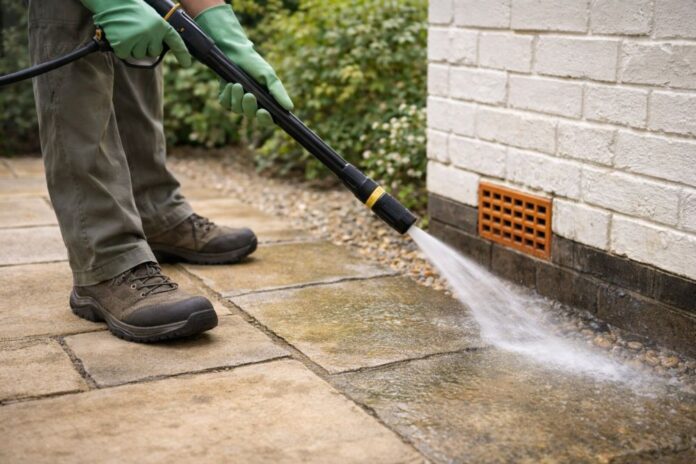

Every spring, the same thing happens across the country. Someone drags a pressure washer out of the shed, points it at a green patio, and spends a satisfying afternoon carving clean stripes into the slabs.
Then, a few weeks later, the moss comes back. Or the sand has washed out of the block paving and the whole thing has gone loose underfoot. Or the sandstone has a permanently etched pattern where the lance was held too close.
Cleaning a patio is not difficult, but there is a right order and a few surfaces that will punish you for getting it wrong. Here is how to do it properly.
First, work out what you actually have
The single most important step happens before you touch anything. Different materials tolerate very different treatment.
Concrete slabs and concrete block paving. Hard wearing and tolerant of pressure washing. The most forgiving surface on this list.
Clay pavers. Durable, but the colour sits in the clay rather than on it, so they cope well with washing.
Indian sandstone. Extremely common in British gardens and much softer than people assume. High pressure at close range will pit the surface and leave permanent marks.
Limestone, travertine and other soft natural stone. Handle with care. Low pressure and chemical cleaning is usually the safer route.
Porcelain. Very hard and non porous. Easy to clean, though the grout between the slabs is more vulnerable than the tile.
Imprinted or pattern imprinted concrete. Usually sealed. Aggressive washing strips the sealer, after which the surface deteriorates quickly and needs resealing.
Decking and timber. Wood fibres tear at high pressure. Use a wide fan, low pressure and work along the grain.
If you are not sure what you have, test in a hidden corner before committing to the whole area.
Step one: clear and prepare
- Move furniture, pots, the barbecue and anything else off the surface
- Sweep thoroughly, and pull weeds from the joints by hand or with a weeding knife
- Cut back overhanging plants that drip onto the area, since they cause a lot of the regrowth
- Cover or wet down nearby plants if you are using a chemical cleaner
- Check drains and gullies are clear, because you are about to send a lot of dirty water somewhere
- Close nearby windows, and warn the neighbours if the washing will spray
Step two: treat the green before you wash it
This is where most people go wrong. Blasting moss and algae off with water removes what you can see and leaves the spores behind. That is why it returns within weeks.
The better approach is to apply a proper patio cleaner or a moss and algae killer first, leave it to work for the time the instructions specify, and then wash. Some products are designed to be applied and left, with rain doing the rinsing over the following weeks.
Points worth knowing:
- Household bleach is harsh on plants, can damage some stone and mortar, and is not a substitute for a product designed for the job
- Products vary in whether they are safe for pets, ponds and lawns, so read the label rather than assuming
- Timing matters. A dry, still, mild day gives the product time to work without being washed off or blown about
- Patience beats pressure. A treated surface washes clean far more easily, with far less force
For grease and oil stains, use a dedicated degreaser or a poultice product rather than water, which spreads oil rather than lifting it.
Step three: wash, with the right settings
If the surface can take it, a pressure washer is efficient. Use it sensibly.
Nozzle. A 25 or 40 degree fan tip for general work. Avoid the zero degree pencil jet on paving. It cuts.
Distance. Keep the lance a consistent distance from the surface, generally around 20 to 30cm, and adjust after testing on a hidden area.
Angle and technique. Work in overlapping passes at a steady speed, keeping the lance moving. Stopping in one spot for a second longer than the rest is how you get stripes.
A rotary surface cleaner is the attachment that makes the biggest difference on patios. The enclosed rotating head gives a much more even finish than a hand held lance and reduces overspray substantially.
Direction. On block paving, wash across the blocks rather than along the joints where possible, to reduce how much jointing sand you pull out.
Work methodically from one end to the other, pushing the dirty water towards the drain rather than back over cleaned areas.
Step four: the bit everyone forgets on block paving
Washing block paving removes the kiln dried sand from the joints. That sand is not decorative. It locks the blocks together and stops them shifting.
Once the paving has dried completely, brush fresh kiln dried sand across the surface, working it into every joint with a soft broom. Do it in dry conditions, because damp sand bridges the joint instead of filling it. Then compact or simply let it settle and top up again after a week, because it always drops.
Skipping this step is the reason so many freshly cleaned driveways start rocking and spreading within a season.
Step five: consider sealing
Sealing is optional and not right for every surface, but it has real benefits on the right one.
What it does: reduces staining, makes future cleaning easier, slows down moss and algae, and can enhance colour depending on the product.
What to consider: the surface must be completely clean and completely dry first, which in Britain means picking your week carefully. Different sealers give different finishes, from invisible matt to a wet look. Sealers wear and need reapplying every few years. And a sealer applied over a dirty or damp surface traps the problem underneath.
Porous natural stone, imprinted concrete and block paving are the usual candidates. Porcelain generally does not need it.
Surfaces to be careful with
There is a category of jobs where a pressure washer is the wrong tool entirely. Render, painted masonry, roof tiles, lime mortar, older brickwork and some soft stone are all better handled by soft washing, which uses low pressure and appropriate cleaning solutions to kill growth rather than blast it off.
Getting this wrong is expensive. Water forced into render or behind pointing causes damp problems that cost far more than the cleaning saved. If the surface is delicate or you are not confident, this jet washing team and others like them will assess the material first and choose between pressure washing and soft washing accordingly.
Practical points people overlook
Water use. During a hosepipe ban or temporary use ban, pressure washing from a mains supply is usually restricted. Check with your water company before planning the job.
Drainage. Large volumes of dirty water plus chemical cleaner should not go into a drain that leads to a watercourse. Direct runoff to a foul drain or to soil where appropriate.
Neighbours. Overspray travels much further than you expect. Washing near a boundary on a windy day is how disputes start.
Safety. Wear eye protection and sturdy footwear. Pressure washers can cause serious injury at close range, and wet paving is slippery while you work.
Keeping it clean for longer
- Sweep leaves off promptly in autumn, since decaying leaf matter feeds moss
- Cut back plants that keep the surface permanently shaded and damp
- Apply a moss and algae treatment once or twice a year rather than waiting for full regrowth
- Top up jointing sand annually on block paving
- Clear gullies and drains so water does not sit on the surface
A patio that gets a light treatment twice a year rarely needs the full afternoon with the pressure washer. Which, when you think about it, is the whole point.