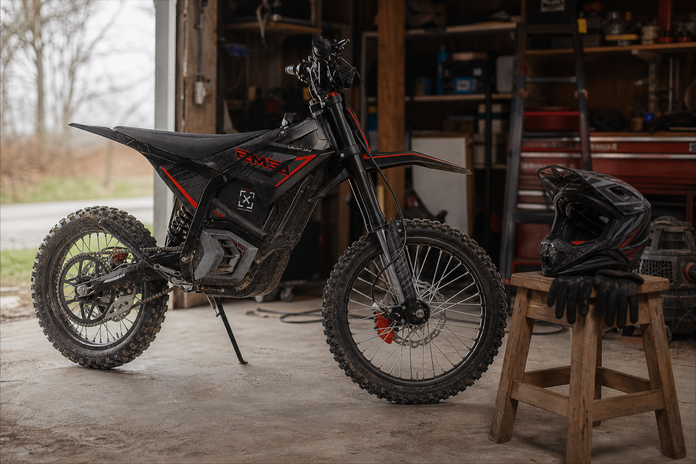

An electric dirt bike battery does not age only while the motorcycle is moving. It also changes while it is charging, cooling after a ride or sitting unused. Heat, time, state of charge, high current demand and physical damage all influence the pack, which is why battery care is better understood as a series of small decisions than as one perfect charging rule.
The most useful rule is model-specific: use the current owner’s manual, the supplied or manufacturer-approved charger, and the battery’s published temperature and storage limits. Lithium-ion packs can differ in cell chemistry, battery-management logic, enclosure design and standby draw. A percentage copied from a phone, car or unrelated e-bike is not automatically the correct storage instruction for an electric dirt bike.
Within those boundaries, riders can reduce avoidable stress. Let a hot pack cool before charging, keep charging equipment dry and undamaged, avoid unnecessary time at charge extremes, store the battery in a suitable environment, and investigate unusual behavior instead of treating every range drop as normal aging.
Battery Life Has Two Clocks
“Battery life” can mean three different things. Runtime is how long one ride lasts. Service life is how long the pack remains useful before capacity or performance falls below the rider’s needs. Safety condition is whether the pack remains fit to charge, transport and operate. These are related, but they are not interchangeable.
Battery aging is often separated into two overlapping processes:
- Cycle aging accumulates through charging and discharging. Depth of discharge, current, temperature and cell chemistry affect the stress created by a cycle.
- Calendar aging continues while the battery rests. Research on lithium-ion cells shows that temperature and state of charge can materially influence this time-based degradation.
A low-mileage pack can therefore age poorly if it spends months hot or at an unsuitable storage state. A frequently used pack may remain useful when it operates within its intended limits and is stored correctly. Odometer distance or charge-cycle count alone cannot establish battery health.
The goal is not to stop aging; that is impossible. The goal is to avoid conditions that add stress without adding useful riding.
Use a Four-Question Check Before Every Charge
Charging should begin with the battery and environment, not with the wall outlet. The following sequence creates a repeatable safety check without pretending that every model uses the same connector or procedure.
1. Is the battery cool enough to charge?
Hard acceleration, long climbs, deep sand and low-speed high-load riding can leave the battery warmer than the surrounding air. Surface temperature is not a perfect measure of cell temperature, so a case that feels merely warm does not prove the pack is ready.
Follow the manual’s cooldown instruction. If the model does not provide a clear interval, do not invent one; ask the manufacturer. Do not accelerate cooling with ice, water or a refrigerator. Rapid temperature changes can create condensation, while water can reach areas that must remain dry.
2. Is the battery dry and undamaged?
Inspect the housing, mounting interface and charge port within the owner-accessible limits. Do not charge if you find swelling, leakage, cracking, impact deformation, unusual odor, hissing, smoke or abnormal heat. A wet charge port should be handled according to the manual rather than dried with metal objects, compressed air at close range or an improvised heater.
3. Is the charger approved for this exact battery?
A matching plug is not proof of compatibility. Charging voltage, current limits, connector pinout, communication and shutdown behavior all matter. The U.S. Consumer Product Safety Commission advises micromobility owners to use the supplied charger, follow the manufacturer’s instructions and use only approved replacement batteries.
Use the original charger or a replacement explicitly approved for the exact model and battery revision. Do not use universal chargers, improvised adapters, modified plugs or chargers that are merely described as suitable for the same nominal voltage.
4. Is the charging area appropriate?
Park the motorcycle on a stable surface in the dry, ventilated location specified by the manufacturer. Keep the charger and cable away from water, heat sources, flammable clutter, vehicle traffic and places where the cable can be pinched or tripped over. Do not cover the charger or battery in a way that blocks heat dissipation.
CPSC guidance says to remain present while micromobility products charge and not to charge while sleeping. Protective electronics are important, but a battery-management system cannot repair damaged cells, make an incompatible charger safe or remove hazards from the room.
The Valtinsu electric dirt bike lineup should be the starting point for identifying the correct model before checking its supplied manual. The current manual and warranty terms control the connection sequence, temperature limits, approved equipment and long-term storage procedure.
Charging to 100 Percent Is a Planning Decision, Not a Moral Rule
Advice such as “always stop at 80 percent” or “always charge to 100 percent” is too absolute for a category that includes different cells, pack designs and battery-management systems.
Charging fully can be appropriate when the manufacturer permits it and the next ride requires the energy. The avoidable condition is leaving a pack at a high state of charge for longer than necessary—especially in heat—without a riding reason or a model-specific instruction. At the other extreme, storing a nearly depleted battery can leave too little buffer for self-discharge or standby draw.
Use three time horizons:
- Ride soon: Charge to the level needed for the planned route within the manual’s limits.
- No immediate ride: Avoid automatically topping up after every short outing if the manual and upcoming use do not require it.
- Longer storage: Set the manufacturer-specified storage state and follow its inspection or recharge interval.
This is why there is no universal “20–80 rule” for every electric dirt bike. A percentage becomes useful only when it belongs to the exact battery’s documentation.
Temperature Can Age a Parked Battery Faster Than Expected
Heat accelerates unwanted reactions inside lithium-ion cells. It can come from riding, charging, direct sunlight, a closed vehicle or a poorly ventilated shed. Combining high state of charge with high temperature can be particularly unfavorable for calendar aging.
Avoid leaving the motorcycle or removable pack in a sealed car or trailer, in direct summer sun, beside a heater or in an enclosure that traps heat. The pack’s permitted storage range—not human comfort—sets the boundary.
Cold creates a different set of concerns. Available power and capacity may temporarily decrease, and charging below the permitted battery temperature can cause damage. Do not use the charger as a heater. Allow the pack to enter the approved charging-temperature range gradually, and watch for condensation when moving a cold bike or battery into warm, humid air.
“Cool and dry” is a useful summary, but it is not a specification. The manual’s actual range and procedure take priority.
Build Storage Around Time, Temperature and Standby Draw
Putting an electric dirt bike away does not pause the battery. The pack continues to self-discharge, and the motorcycle may draw a small amount of energy even when switched off. Storage conditions can also change across a season.
Overnight or between frequent rides
Switch the motorcycle off using the correct procedure, disconnect the charger when charging is complete, and leave the bike in an approved dry location. Check that the charge port cover and battery retention system are secure. Avoid leaving the pack in a hot vehicle simply because the next ride is soon.
Several weeks without riding
Review the storage section of the manual rather than defaulting to a full top-up. Check the pack’s state periodically at the specified interval. Inspect the area for water intrusion, condensation, pests, cable damage or objects that could strike the motorcycle.
Seasonal storage
Use a deliberate checklist:
- Clean and dry the motorcycle according to the manual.
- Inspect the battery housing, mount, cable and charge port without opening sealed components.
- Set the manufacturer-specified storage state.
- Choose a stable, secure and ventilated location within the published temperature range.
- Record the storage date and next required inspection or recharge date.
- Protect the motorcycle from impact, water, extreme temperatures and unauthorized access.
If the battery is removable, follow the official lifting and disconnection procedure. A heavy pack can suffer internal damage in a drop even when the casing appears intact. Keep exposed terminals away from metal objects, and never open the pack for cell-level inspection.
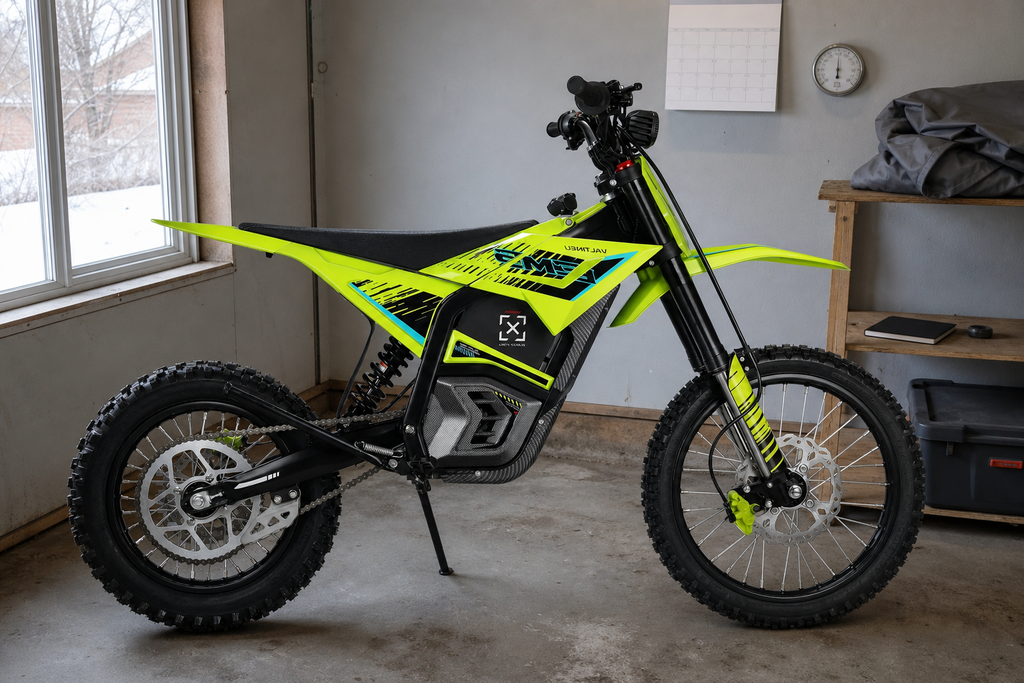
Long-term storage is an active maintenance period: record the battery state, inspect at the published interval and keep the motorcycle within its documented environment.
Riding Habits Affect Battery Stress After the Charger Is Unplugged
Battery care does not require timid riding, but it does require recognizing high-demand conditions. Repeated full-throttle acceleration, deep soft ground, steep low-speed climbing, heavy loads and wheelspin can increase current demand and heat. When the motorcycle has worked hard, allow the required cooldown and inspect for abnormal behavior before connecting the charger.
Mechanical drag matters too. Low tire pressure outside the intended window, a rubbing brake, a tight or poorly maintained chain, a damaged bearing or a misaligned wheel can consume energy that never reaches the trail. The EM-5 Ultra electric dirt bike page gives riders a model-specific reference for published battery, wheel, brake and chassis details before inspection or service.
Avoid repeatedly running the pack into an emergency low-charge state merely to test maximum range. Plan a reserve appropriate to the route, temperature, terrain and available recovery options. If the manual specifies a low-charge procedure, follow it rather than repeatedly powering the motorcycle back on after shutdown.
Diagnose a Range Drop Before Blaming Battery Aging
A shorter ride does not automatically mean the cells are worn out. Observed range changes with air temperature, elevation, surface softness, rider pace, total load, tire pressure, wind and mechanical condition. State-of-charge displays may also be nonlinear under load.
Use a comparison that controls as many variables as practical:
- Repeat a familiar legal route at a similar pace.
- Record start and end state of charge rather than relying on memory.
- Note temperature, elevation, surface condition and rider load.
- Check tire pressure, chain condition and brake drag.
- Record battery or controller warnings and any recent impacts.
A gradual decline across comparable rides may justify a qualified capacity or diagnostic assessment. A sudden decline calls for inspection of the entire motorcycle as well as the battery. Do not buy a replacement pack solely because one cold, muddy or fast ride ended earlier than expected.
Know the Warning Signs That End DIY Troubleshooting
Stop using or charging the battery if it shows swelling, leakage, cracking, impact damage, smoke, hissing, unusual odor, rapidly rising temperature or repeated charging faults. Follow the manufacturer’s emergency instructions and contact qualified support. If there is an immediate fire risk, move people away and contact emergency services; do not take personal risks to move a failing pack.
Never puncture, open or attempt cell-level repair on a traction battery. Do not bypass interlocks, modify connectors, combine used cells or install a pack that merely fits the mounting space. Replacement requires exact electrical, mechanical and communication compatibility, plus the approved charger and service route.
Lithium batteries must not go into household trash or general recycling. Use the manufacturer’s return route or an authorized battery recycler or hazardous-waste program, following applicable local requirements.
Keep a Battery Log That Separates Evidence From Guesswork
A simple log makes gradual change easier to see. Record the route, distance, starting and ending state of charge, temperature, terrain, load and any unusual charging behavior. Add storage dates, impacts and service events.
The log is not a laboratory health test, and dashboard percentages do not justify decimal-level precision. Its purpose is pattern recognition. If similar rides at similar temperatures steadily require more energy, the records give qualified support a better starting point. If the change is sudden, the same record can reveal a new route, cold weather or mechanical problem.
Frequently Asked Questions
How long does an electric dirt bike battery last?
There is no responsible universal lifespan in years, miles or cycles. Service life depends on cell chemistry, pack design, temperature, charge pattern, depth of discharge, storage, load and the point at which reduced capacity no longer meets the owner’s needs.
Use manufacturer warranty and capacity criteria for the exact pack. Track comparable rides and obtain a qualified assessment when performance changes persist.
Should I charge an electric dirt bike battery after every ride?
Charge when the next ride and the manufacturer’s instructions require it; an automatic full top-up after every short ride is not a universal rule. First allow the pack to cool, inspect it and confirm that the charge port is dry.
If the motorcycle will sit unused, follow its storage procedure instead of assuming full charge is best.
Should the battery cool before charging?
Yes, when the manual specifies a cooldown or the battery is hot from riding. Charging adds heat, and the outside of the case may cool before the cells inside.
Let the battery cool naturally in a suitable environment. Do not use ice, water, refrigeration or an improvised fan aimed into electrical openings.
Can I leave an electric dirt bike charging overnight?
Do not charge while sleeping or when you cannot monitor the area. CPSC guidance recommends being present while micromobility products charge, using the supplied charger and unplugging when charging is complete.
The owner’s manual may add model-specific limits, but protective electronics do not make an unattended or damaged charging setup risk-free.
What charge percentage is best for long-term storage?
Use the percentage or voltage range specified for the exact battery. There is no storage number that is correct for every electric dirt bike pack.
Also follow the stated inspection or recharge interval, because self-discharge and standby draw can reduce the state of charge during storage.
Can cold weather permanently reduce battery capacity?
Cold commonly causes a temporary reduction in available power and range. Permanent damage becomes a concern when a pack is charged or operated outside its permitted temperature limits.
Bring a cold battery into the approved charging range gradually and prevent condensation. Do not assume a short winter ride proves permanent capacity loss.
When should an electric dirt bike battery be replaced?
Replace it when qualified diagnosis and the manufacturer’s criteria show that capacity, power, compatibility or safety condition is no longer acceptable. Swelling, leakage, impact damage, abnormal heat, odor, hissing, smoke or repeated faults require immediate attention, not continued use until range becomes inconvenient.
Final Takeaway
Extending electric dirt bike battery life is less about chasing one ideal percentage and more about controlling avoidable stress. Use the approved charger, respect temperature limits, let a hard-used pack cool, store it at the model-specific state, inspect it on schedule and keep the rest of the motorcycle free from energy-wasting drag.
Those habits cannot prevent normal cycle and calendar aging. They can, however, reduce needless heat, time at unsuitable charge states, charging errors and delayed responses to damage. That makes battery performance safer, easier to diagnose and more predictable across the ownership life of the motorcycle.
Technical References
U.S. Consumer Product Safety Commission, “Micromobility Battery Charging Safety” and Micromobility Information Center.
National Renewable Energy Laboratory, research on lithium-ion battery calendar aging and state-of-charge effects.
Lam et al., “A Decade of Insights: Delving Into Calendar Aging Trends and Implications,” Joule.