
You followed the recipe exactly. So why does it taste flat? Often it comes down to one ingredient nobody thinks about.
You know the feeling. You followed the recipe carefully, used decent ingredients, didn’t cut corners. And the food is… fine. Perfectly edible. Just a little flat, a little forgettable, missing whatever it is that makes restaurant food taste like restaurant food. So you add more salt. Then a squeeze of lemon. Maybe more pepper. It gets saltier and more sour, but it never quite comes alive.
Here’s a possibility worth considering before you blame your cooking: the problem might be that jar of pre-ground pepper that’s been open in your cabinet since last year.
Go grab it and take a sniff. Really smell it. Chances are it smells like… not much. A little dusty. Vaguely peppery. Now picture the sharp, almost floral burst you get the moment you crack a fresh peppercorn. That bright, resinous smell that makes you want to sneeze and lean in at the same time.
Same spice. Two completely different experiences. And if you’ve been seasoning with that jar for the past year, here’s the uncomfortable truth: you’re not really tasting pepper. You’re tasting what’s left of it.
Who This Actually Matters For
Not everyone needs to care about this. But if any of these sound like you, it’s probably the cheapest upgrade available to your cooking:
You cook regularly and your food tastes “fine” but never exciting: You’ve plateaued, and you’re not sure why.
You’ve been adding more and more salt: You try to make food taste like more of itself, and it isn’t working.
You bought good ingredients and they didn’t taste like much: A nice cut of meat, fresh vegetables, and somehow the dish still fell short.
You’ve noticed restaurant food tastes different: You assume it was butter, salt, or some technique you don’t have.
Your spice jars have been in the cabinet longer than you’d like to admit: Most of us have a jar or two we can’t remember buying.
If none of that applies and you’re happy with how your food tastes, carry on. If a few of them hit, keep reading.
Why Pepper Fades?
A peppercorn holds two separate things. There are aromatic oils, which give pepper its smell and its complexity: bright citrus notes, something piney and resinous, a warmth underneath. And there’s piperine, which is the heat, the bite, the thing that makes you sneeze.
The hard shell keeps both sealed inside, which is why whole peppercorns stay good for years sitting in your pantry. Grind it, and the seal breaks. Those aromatic oils hit the air and start evaporating almost immediately. The piperine doesn’t. It’s stable, and it stays put. Which gives you the whole story in one line: the aroma leaves, the heat stays. That’s why old pre-ground pepper tastes harsh and one-note rather than interesting.
How Fast Does It Fade?
Cooks and spice specialists generally agree the decline starts almost immediately. Within roughly a day of grinding, a significant share of those aromatic oils is already gone. Within a week or so, the smell is noticeably flatter. Give it a month and you’re mostly left with heat and not much else.
Now run the timeline on the jar in your cabinet. It was ground at a facility, packed, shipped, warehoused, and sat on a shelf, often for weeks or months, before you ever picked it up. Then it sat open in your kitchen for however long it’s been.
So when you twist off that cap and shake some over dinner, you’re seasoning with a spice that peaked before you owned it. It isn’t that you bought a bad product. It’s that ground pepper was never going to survive that journey with its flavor intact. Whole peppercorns, meanwhile, sit patiently in their shells and stay good for a very long time.
It’s Not Just Pepper. Salt Matters Too
Salt works differently. It doesn’t lose aroma the way pepper does, so an old box of salt isn’t going stale on you.
What you gain by grinding it is control over crystal size, and that turns out to matter more than people expect. Coarse flakes sit on top of food and give you little bursts of salinity plus a bit of crunch, which is why finishing salt exists. A fine grind dissolves evenly, which is what you want in a sauce or a dough. Standard table salt gives you exactly one option, along with whatever anti-caking agents came in the box.
This is also why salt and pepper grinders come as a pair. They’re the two things you reach for on nearly every dish, so they’re where the effort pays off most.
The Mistake Almost Everyone Makes
Switching to whole peppercorns solves half the problem. Here’s the other half, and it’s the part that separates food that tastes seasoned from food that tastes finished.
Grind size and timing change how pepper behaves. Most home cooks use one grind for everything and add it whenever they happen to think of it. That’s why pepper sometimes turns bitter on a seared steak, and why it sometimes disappears entirely into a sauce. Here’s the fix.
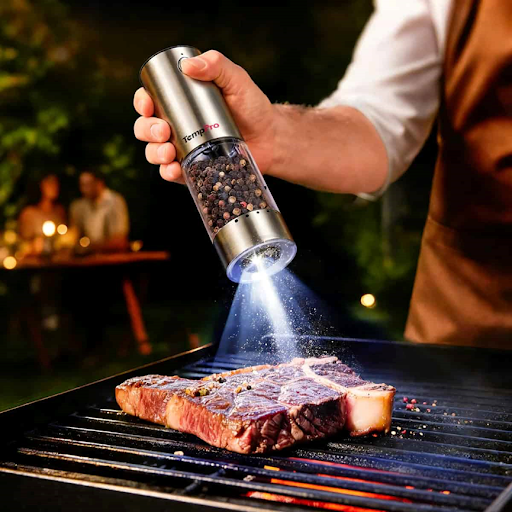
Going on before cooking? Go coarse: Rubs, marinades, anything hitting a hot pan or grill. Big craggy pieces survive the heat instead of scorching into bitterness, and they build a crust with little pops of flavor. This is the mistake to fix first: fine powder on high heat is where that acrid, burnt-pepper taste comes from.
Everyday cooking? Medium: Soups, stews, sautés, roasted vegetables, pasta. Enough presence to taste, fine enough to spread evenly.
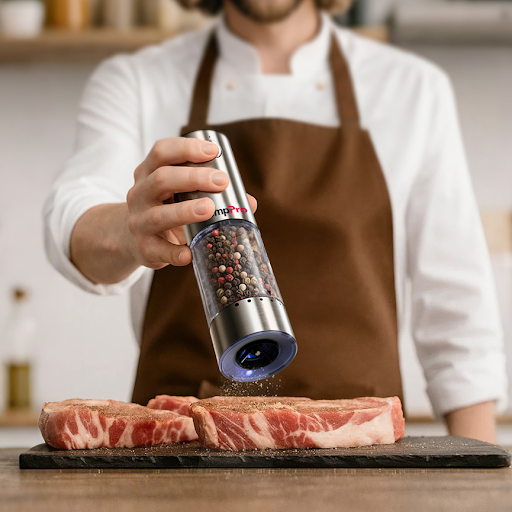
Finishing a plate? Go fine, and go last: Sauces, dressings, eggs, and that final pass over food right before it hits the table. This is the one almost nobody does at home, and it’s the single biggest difference between home cooking and restaurant cooking. That last grind lands with its aromatic oils completely intact, so you smell the pepper as the plate arrives. Half of what we call flavor is actually aroma, which is why this tiny step lands so hard.
The catch is that doing this properly means switching grind settings mid-cook, which is exactly where a pre-filled jar or a single-setting mill gives up. A TempPro electric salt and pepper grinder set has six coarseness settings, so coarse for the rub and fine for the finish is a quick twist rather than a reason to own two mills. It runs one-handed with a single button, which matters more than it sounds when your other hand is holding a pan. There’s a built-in LED so you can see how much you’re actually adding instead of guessing in a dim kitchen, a ceramic mechanism that won’t add the metallic edge cheap steel mills develop, and USB-C charging instead of a drawer full of batteries.
ThermoPro has rebrand as TempPro, and its products and service remain the same. You can continue to enjoy the same quality and support you’ve always trusted.
Tips That Actually Change the Result
A few tips that make the switch worthwhile:
l Grind what you need, when you need it: Batch-grinding a week’s worth defeats the purpose. If you do grind ahead, keep it airtight and use it within a day.
l Store whole spices properly: Airtight, away from light, and (importantly) not in a rack directly above your stove. Heat is the enemy of volatile oils.
l Manual mills are fine too: There’s nothing wrong with a good hand-cranked mill. The case for electric is one-handed operation and consistent grind size, useful when you’re mid-cook with a pan in the other hand, or seasoning a lot of food at once.
l Buy better peppercorns: Since you’re grinding fresh anyway, it’s worth trying a quality variety like Tellicherry, which has noticeably more citrus and floral character.
l Don’t stop at pepper: Once you have a grinder on the counter, whole cumin, coriander, and dried chilis are the natural next step. Rubs and spice blends built from freshly ground seeds taste like a different recipe entirely.
The Easiest Upgrade in Your Kitchen
Most cooking upgrades are expensive, slow, or require learning a new skill. This one takes a few seconds and costs less than a decent bottle of olive oil.
Just buy whole peppercorns. Grind them when you cook. Go coarse when you’re building flavor, fine when you’re finishing a plate. That’s the entire technique, and you’ll taste it on the first dish.
Formerly known as ThermoPro, TempPro makes kitchen tools built around exactly this idea: small, precise upgrades that make ordinary cooking taste better. Browse the full range of kitchen and grilling accessories to see what else earns a spot on your counter.