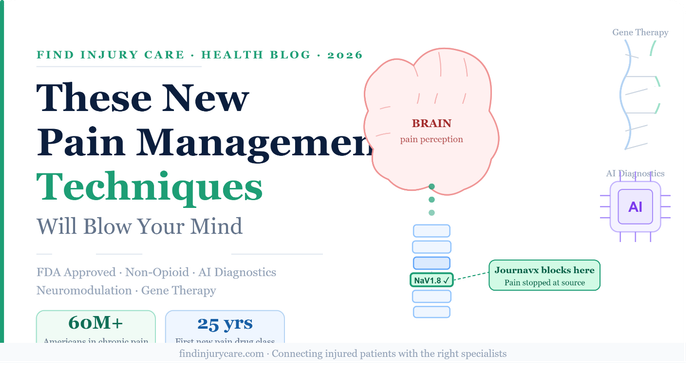

The CDC ran its National Health Interview Survey in 2023, and the numbers were startling 60 million Americans are dealing with chronic pain. That’s not a rounding error. That’s 1 in 4 adults waking up every single day in some level of persistent pain.
21 million of those people aren’t just dealing with soreness. Their pain is the kind that costs them jobs. Ends relationships. Makes showering feel like a project. And what did medicine offer for most of that time? The same three things it always has a pill, some rest, and a follow-up appointment that went nowhere.
But 2025 and 2026 have quietly changed things. Some of the biggest breakthroughs in pain science in over two decades happened in the last 18 months and most people scrolled right past them.
So what’s actually changed? And more importantly does any of it matter to someone dealing with a real injury right now? Let’s get into it.
1. The First Non-Opioid Pain Drug in 25 Years Just Got FDA Approved
January 30, 2025. Vertex Pharmaceuticals. FDA approval. Most people scrolled past it. They probably shouldn’t have because what got approved that day was the first genuinely new category of pain medication since before most people owned a smartphone. Twenty-plus years of the same drug classes, recycled and repackaged. Then this.
The FDA didn’t drag its feet either. Fast-tracked. Because when 80,000 Americans a year are dying from opioid overdoses, waiting around for normal review timelines isn’t really an option anymore.
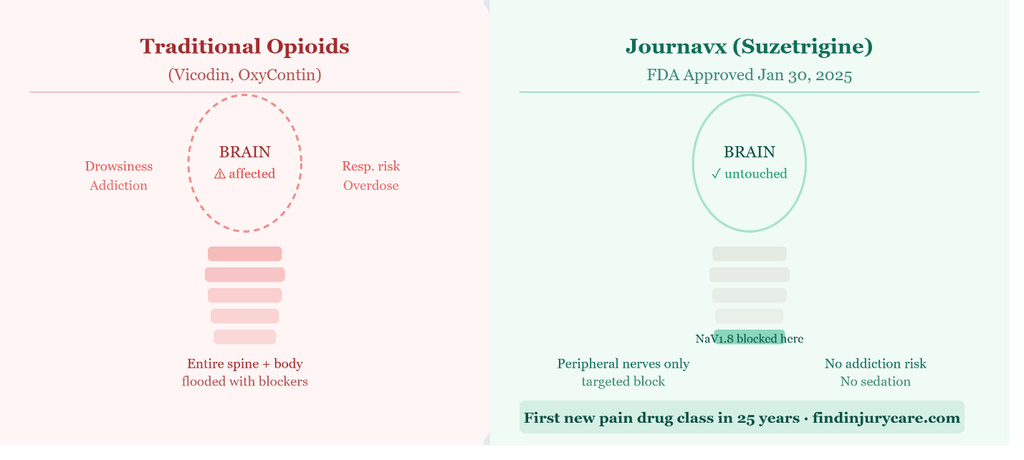
Now, every painkiller before this worked the same basic way. Opioids like Vicodin or OxyContin don’t target your injury they flood your whole nervous system. Brain included. That’s why people get drowsy, why breathing slows down, why addiction happens. The drug has no idea where your pain is coming from. It just shuts down everything.
Journavx works differently. It selectively targets a sodium channel called NaV1.8, which exists only in peripheral pain-sensing neurons the nerves in your body’s outer tissues, not your brain. The pain signal gets stopped before it ever reaches your brain. Central nervous system stays untouched.
Clinical trials ran with roughly 1,000 post-surgical patients. Journavx matched Vicodin on pain relief no addiction risk, no sedation, none of the respiratory dangers opioids carry. Yale Medicine called it “proof of concept” that this sodium channel strategy can actually reduce pain in humans, and noted that next-generation versions are already in development.
Source: FDA Press Release, Jan 30 2025 | Vertex Pharmaceuticals | Yale Medicine | Dove Medical Press (Journal of Pain Research, 2025)
2. Spinal Cord Stimulation Has Been Completely Reinvented
Spinal cord stimulation has been around since Nixon was president. The original version wasn’t complicated send a small electrical current near the spinal cord, scramble the pain signal before it climbs up to the brain, patient feels better. Rough around the edges, constantly buzzing, results all over the place. But the core idea worked. What’s changed is everything built around it.
What’s happening in 2025 and 2026 is a different level entirely. Closed-loop SCS systems now being deployed clinically monitor your body’s nerve responses in real time and automatically adjust the electrical impulse to match what your nervous system needs at that moment. Your old thermostat ran on a timer. This one reads the room.
In 2025, ECRI one of the most respected independent health technology safety organizations in the country went through five separate randomized controlled trials, 678 patients total. Their conclusion? Modern SCS systems beat conventional medical management on every major metric: pain reduction, physical function, and getting patients off opioids. That’s not a small finding.
Alongside that, Dorsal Root Ganglion (DRG) stimulation has emerged as a more targeted option. Instead of stimulating the whole spinal cord, DRG zeroes in on the exact nerve cluster responsible for pain in one specific body region particularly useful for localized injury pain in the legs, feet, or groin.
Source: NIH StatPearls, Dec 2025 | ECRI Clinical Evidence Assessment 2025 | Frontiers in Pain Research, 2025 | Brain Sciences Journal, June 2025
3. Transcranial Magnetic Stimulation Pain Relief Without a Single Pill or Needle
Most people haven’t heard of this one. And it’s now being covered by major insurance providers.
No needles. No surgery. No pills. TMS works by sending magnetic pulses through the skull into targeted brain regions specifically the primary motor cortex, which plays a major role in how the brain processes pain. Patients sit in a chair. A device is held near their head. That’s really it.
A 2026 review in the Capain Institute reported that multiple randomized controlled trials showed 30 to 45% pain reduction in neuropathic pain patients who responded to TMS. Several major U.S. insurers have started covering it for chronic pain conditions.
What makes TMS especially relevant for injury victims is what it actually addresses: central sensitization. After a serious injury, the nervous system can get stuck in alarm mode kept firing pain signals even after the original tissue has healed. TMS targets that at the brain level. No pill has been able to reliably do that.
Source: Capain Institute, Jan 2026 | Frontiers in Pain Research 2024/2025 | Clinical Pain Advisor, June 2026
4. Artificial Intelligence Is Now Predicting Your Pain: Before You Even Feel It
Pain management has always been reactive. You feel it, you describe it, a doctor makes a guess, and you hope it works. That model is breaking down.
Here’s what chronic pain treatment has looked like for most patients: try medication A, wait six weeks, doesn’t work. Try medication B, different side effects, still doesn’t work. Get referred to a specialist. Wait three months for the appointment. Start over.
AI is starting to break that cycle not in a sci-fi way, but in a very practical, already-happening way. Models trained on thousands of real patient cases can look at someone’s biological profile, their reported symptoms, their history, and narrow down which treatment is actually likely to work for them specifically before they waste months finding out the hard way.
McGill University researchers laid this out in a 2025 systematic review published in the European Journal of Pain. They found AI being used to predict how much pain someone will have after surgery, catch injury patients headed toward chronic pain before it locks in, and adjust medication doses in real time based on how a patient is actually responding not how the average patient responds.
A separate 2026 study in Neurosurgery journal took it further. Using machine learning trained on imaging data and patient-reported outcomes, they could predict before implantation which patients would actually respond to spinal cord stimulation. Fewer failed procedures. Faster recovery. Better outcomes overall.
For injured workers navigating workers’ comp or no-fault insurance systems, this shift matters a lot. AI-guided treatment means faster diagnosis, less guesswork, and stronger medical documentation of injury and recovery which matters when a claim is on the line.
Source: European Journal of Pain, March 2025 (McGill University) | Clinical Pain Advisor, June 2026 | Neurosurgery Journal, April 2026
5. Gene Therapy for Pain Relief: No Addiction, No Side Effects
This one’s still in clinical trial phases. But it’s close enough to reality that it deserves a spot here.
What researchers are working toward is a gene therapy that goes straight to the pain centers in the brain without touching the reward system at all. That distinction matters enormously. Morphine works because it hits both. That’s also why people get addicted to it. This approach is being designed to get the relief without ever activating the part of the brain that creates dependency.
A January 2026 review by the Capain Institute noted that this therapy is supported by advanced brain imaging and AI-driven pain assessment, and is currently advancing toward U.S. clinical trials. Think of it as the logical step beyond Journavx instead of taking a pill twice a day to block a pain channel, a single genetic intervention changes how the pain system works at a biological level.
Source: Capain Institute, Jan 2026 | ScienceDaily, Nov 2025 | Frontiers in Pain Research 2026
What This Means for Injured Workers and Accident Victims in New York
Getting hurt at work or in a car accident isn’t just a physical thing. There’s the insurance claim sitting on someone’s desk. There’s the treatment window you didn’t know existed. There’s a medical system that genuinely wasn’t designed to be easy to navigate especially when you’re already in pain and just trying to figure out your next move.
The good news specialists who use these newer techniques are more accessible than most people realize. In New York, No-Fault insurance means your medical treatment gets covered regardless of who caused the accident. You have the right to see a specialist quickly. The bad news is that most injured people still waste weeks going from office to office trying to find a doctor who actually accepts workers’ comp or no-fault losing treatment time they can’t afford to lose.
That’s what Find Injury Care was built to fix. If you’re looking for a pain specialist in Queens or anywhere across New York, Find Injury Care connects you directly with board-certified injury doctors chiropractors, pain management specialists, orthopedic surgeons, physical therapists who accept workers’ comp and no-fault insurance. No runaround. No wasted trips. The right doctor, in your area, ready to treat you.
Sources
1. CDC National Health Interview Survey, 2023: Chronic Pain and High-Impact Chronic Pain in U.S. Adults (NCHS Data Brief No. 518)
2. FDA Press Announcement: “FDA Approves Novel Non-Opioid Treatment for Moderate to Severe Acute Pain,” January 30, 2025
3. Vertex Pharmaceuticals Press Release: JOURNAVX Approval, January 30, 2025
4. Dove Medical Press: “Suzetrigine Approval Breaks a 25-Year Silence,” Journal of Pain Research, June 2025
5. Yale Medicine: “New Non-Opioid Pain Pill” (Suzetrigine/Journavx explainer)
6. NIH StatPearls: “Spinal Cord Stimulation,” updated December 2025
7. ECRI Clinical Evidence Assessment 2025: Senza SCS system review
8. Frontiers in Pain Research: “Spinal Cord Stimulation Combined with Physiotherapy,” July 2025
9. Brain Sciences Journal: “Predictive Factors of Successful SCS,” June 2025
10. Capain Institute: “6 Innovative Chronic Pain Management Techniques to Try in 2026,” January 2026
11. European Journal of Pain: “Moving Towards the Use of AI in Pain Management,” Antel et al., McGill University, March 2025
12. Clinical Pain Advisor: “AI in Medicine: Pain Experts Discuss Applications in Practice,” June 2026
13. Neurosurgery Journal: “Prediction of Response to SCS Using Machine Learning,” April 2026
14. University at Buffalo / UBNow: “Chronic Pain Surged in U.S. Adults After Pandemic,” August 2025
15. ScienceDaily: “Breakthrough Brain Discovery Reveals a Natural Way to Relieve Pain,” November 2025
Find Injury Care is a medical directory connecting injured workers and accident victims with board-certified injury specialists across New York. Find Injury Care does not provide medical advice. Always consult a licensed physician for diagnosis and treatment.
READ ALSO: What You Should Know About Braces and Early Orthodontic Care for Kids