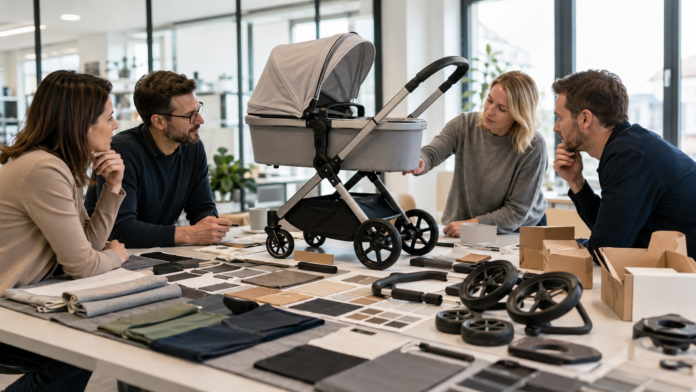

Creating a successful baby or children’s product is often a balancing act. Brands want products that look attractive, offer useful features, feel well made, and remain competitive in price. At the same time, adding too many features or unnecessarily complex materials can make production harder and increase costs without providing meaningful value to customers. Good product development is therefore about making thoughtful choices rather than simply adding more.
Working with an experienced baby product OEM ODM factory can give brands access to manufacturing knowledge while they develop these choices. A structured OEM or ODM process can help turn an initial concept into a sample, review possible changes, prepare the final specifications, and move toward production. The manufacturer’s official process also includes design discussion, sample development, pre-production approval, mass production, and delivery preparation.
Start With the Product’s Main Purpose
Before discussing colors, accessories, or advanced features, a brand should clearly define what the product is meant to do.
A stroller designed mainly for everyday city use may have different priorities from one intended for families who frequently travel. A balance bike designed for simple everyday riding may not need the same features as a more specialized product.
Starting with the basic purpose helps the development team separate essential features from optional ones.
Brands should think about the customer’s normal routine. Where will the product be used? How often will it be carried or stored? Which parts will customers interact with most frequently?
When those questions are answered first, later design decisions become easier.
Choose Features That Solve Real Problems
Adding features can make a product appear more advanced, but more is not always better.
Every additional component can influence production time, assembly, weight, packaging, sourcing, and cost. If customers rarely use that feature, the added complexity may provide little value.
A more practical approach is to prioritize features according to how useful they are.
Brands can divide ideas into three simple groups:
- Essential features: Functions customers are likely to expect from the product.
- Helpful additions: Features that improve convenience or product appeal without making the design unnecessarily complicated.
- Optional extras: Ideas that may look impressive but should be included only when they provide enough customer value to justify their cost and complexity.
This process can help the brand create a clearer product instead of trying to include every possible feature.
Materials Influence More Than Appearance
Material selection is another important part of product development.
Brands often begin by considering how a material looks, but appearance is only one factor. Different materials can influence weight, texture, durability, manufacturing methods, cleaning, packaging, and overall product positioning.
The material should make sense for the intended product.
For example, components that are frequently handled may need different characteristics from decorative areas. Fabrics may need to be selected according to how and where they will be used. Structural parts need to be considered in relation to the overall product design.
This does not necessarily mean choosing the most expensive material available. The goal is to select materials that are appropriate for the product and its intended market position.
Avoid Selecting Materials Only by Price
Cost matters in manufacturing, especially when a small difference in component price is multiplied across a large production order.
However, selecting every material based only on the lowest available price can create other problems.
A less suitable material may affect appearance, consistency, customer experience, or the way different components work together.
At the same time, unnecessarily expensive materials can push the final product beyond the price range its customers are willing to pay.
Brands should look for balance.
A useful material decision considers cost alongside function, appearance, manufacturing practicality, and the overall position of the product.
This helps control the budget without making cost the only priority.
Keep Product Design Easy to Understand
Good products are often easier to understand than complicated ones.
Customers should not need to study a product for a long time before understanding its basic functions.
This is particularly important for products that may need folding, adjustment, assembly, or regular handling.
During development, brands can review whether:
- Controls and adjustments are positioned logically.
- Frequently used parts are reasonably easy to reach.
- Assembly steps can be explained clearly.
- Unnecessary components can be removed without reducing usefulness.
- The overall design still feels consistent after features are added.
A cleaner design may also help with manufacturing because fewer unnecessary parts can mean fewer components to source, assemble, and manage.
Use Samples to Evaluate Materials and Features Together
A material or feature should not be judged only from a specification sheet.
Once different elements come together in a physical sample, the brand can see how they work as one complete product.
A color may look slightly different when applied to the actual component. A handle may look attractive in a rendering but feel different when physically used. An accessory may seem useful during planning but make the product too bulky once attached.
Sampling gives brands an opportunity to review these issues before production.
The official OEM/ODM information from the manufacturer also describes prototype development and pre-production sampling as stages before mass production.
A sample should therefore be evaluated as a working product rather than treated only as a visual presentation piece.
Think About the Relationship Between Features and Cost
Every product feature has a cost beyond the visible component itself.
A new feature may require an additional part, different tooling, more assembly time, revised packaging, or a change in another part of the product.
This is why feature decisions should be made in the context of the complete product.
When developing with a baby product OEM ODM factory, brands can discuss which design ideas are practical to manufacture and which may add unnecessary complexity.
Instead of asking only, “Can this feature be added?” it is often more useful to ask, “Does this feature add enough value to justify what it changes?”
That question encourages more thoughtful product development.
Build Around a Realistic Target Price
Product development becomes much more focused when the brand understands its intended market position.
A company planning an accessible everyday product will make different choices from a brand developing a higher-priced model with additional finishes or features.
The expected selling price can influence materials, packaging, included accessories, and the level of customization.
Brands should therefore consider cost early rather than designing the complete product first and thinking about price at the end.
A practical planning process may consider:
- Expected retail price and wholesale structure
- Manufacturing and packaging costs
- Shipping and logistics expenses
- Number of features included in the base product
- Which upgrades could be reserved for another version
This approach can also make it easier to create different product levels within the same collection.
Consider Creating Core and Premium Versions
Not every customer wants exactly the same product.
For some brands, creating more than one version can be more effective than trying to put every feature into a single model.
A core version might focus on the most important functions at a more accessible price. Another version could add selected materials, accessories, finishes, or convenience features.
This approach can provide customers with clearer choices.
It may also help the brand reach different price points while maintaining a recognizable product identity.
However, the versions should remain different enough to justify their existence. Creating several models with only tiny differences can make inventory and manufacturing unnecessarily complicated.
Do Not Forget About Weight and Product Size
Additional features can affect more than manufacturing cost.
They may also make a product heavier or larger.
For items that parents frequently carry, fold, move, transport, or store, these changes can influence everyday convenience.
Product size also affects packaging.
A larger folded product may require a bigger carton, which can affect warehouse space and transportation planning.
Brands should therefore review weight and dimensions each time a major feature is added.
A useful feature may still be worth including, but its effect on the complete product should be understood before approval.
Packaging Should Match the Product Design
Packaging decisions should develop alongside the product.
If a product’s size, accessories, or components change, the packaging may also need to change.
A well-planned carton should hold the product securely and provide appropriate internal protection without becoming unnecessarily large.
Packaging also needs to present the product clearly.
Instructions, branding, labels, and product identification should be considered before final production rather than being added at the last moment.
This is another reason to avoid constant late-stage feature changes. Even a relatively small product modification can sometimes require adjustments to packaging layouts or internal protection.
Review the Complete Product Before Approval
Before mass production, brands should stop looking at each feature individually and review the complete product.
Does everything work together?
The product should have a clear purpose, consistent appearance, reasonable feature set, suitable materials, practical packaging, and an appropriate cost position.
This final review can reveal areas where the design has become unnecessarily complicated.
Sometimes removing one feature improves several other areas at once. The product may become lighter, easier to manufacture, simpler to package, and more affordable.
Product development is not always about adding more. Refinement often comes from deciding what the product does not need.
Leave Room for Future Product Development
A brand does not have to include every possible idea in its first model.
Some features can be saved for future versions or related products.
This creates room for the product range to develop over time.
Customer feedback from the first model may also provide better information about which improvements actually matter.
Instead of guessing what buyers might want, the brand can use real market experience to guide future development.
This approach can reduce unnecessary complexity in the first production run while creating opportunities for future launches.
Balance Brand Identity With Manufacturing Practicality
Customization remains important because customers should be able to recognize the brand’s style.
Colors, finishes, fabrics, accessories, logo placement, and packaging can all contribute to that identity.
However, good branding does not require changing every component.
Brands can select a smaller number of visible details that create a distinctive look while keeping the underlying product practical to manufacture.
This balance becomes especially valuable when the company later introduces related products. Consistent design choices can connect the collection without requiring every item to be developed completely differently.
Better Product Decisions Create a Stronger Foundation
Successful product development often comes from choosing the right combination of features rather than the largest number of them. Brands that carefully consider usefulness, materials, weight, cost, packaging, and manufacturing complexity can create products with a clearer purpose. Companies exploring customized development for strollers, tricycles, balance bikes, ride-on products, and related categories can review the OEM and ODM manufacturing services presented by bebeluxbaby.com as part of their supplier research.
A strong baby product should make sense as a complete package. Features should provide real value, materials should suit their purpose, pricing should match the intended market, and customization should strengthen the brand without creating unnecessary complexity. By making these decisions carefully before mass production, brands can develop products that are easier to manufacture, easier to position, and more practical for customers.