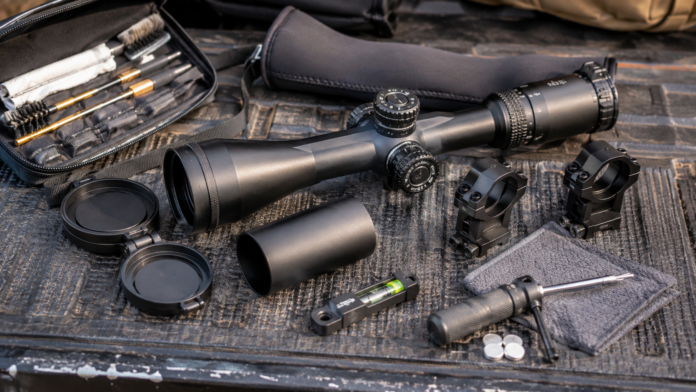

A great scope is only part of the equation. The accessories you pair it with can meaningfully improve how consistently and comfortably you shoot, sometimes making a bigger practical difference in the field than upgrading the optic itself would. Yet accessories are often the last thing hunters think about, purchased as an afterthought if at all, rather than treated as part of a complete, functional setup.
This matters more than most hunters realize, because even glass from a well-regarded hunting rifle scope manufacturer can be held back by poor supporting hardware or a missing accessory that would have made a real shot noticeably easier. Here’s a rundown of the accessories worth considering and what each one actually solves.
Quality Scope Rings and Bases
This is the accessory that matters most, and it’s also the one most frequently underfunded. Rings and bases are what physically hold your scope to the rifle, and if they’re low quality or mismatched to your setup, no amount of money spent on the optic itself will compensate.
A few things worth prioritizing:
- Match ring height to your scope’s objective lens size, since an objective lens that’s too large for low rings will contact the barrel, while rings that are too high force an uncomfortable, unstable cheek weld.
- Choose rings rated for your rifle’s recoil level, particularly for larger calibers, since undersized rings can shift slightly under repeated heavy recoil.
- Consider one-piece versus two-piece bases based on your rifle’s action type and personal preference, understanding that one-piece bases generally offer slightly more rigidity.
Bubble Levels
A small bubble level, either built into the scope or added as a separate mount, solves one of the most common and least obvious accuracy problems: a canted rifle. Even a slight tilt that feels natural to your body position can cause meaningful horizontal drift at longer distances, and this error is nearly invisible without a reference point.
For hunters taking shots beyond 200 yards, a bubble level is a low-cost addition that removes a surprisingly common source of missed shots, particularly from field positions where your natural stance might not be perfectly vertical.
Some scopes now come with an integrated level built directly into the reticle or turret cap, and checking whether a given hunting rifle scope manufacturer offers this as a built-in feature can save you from needing to add a separate accessory later.
Lens Cleaning Kits
A dedicated lens cleaning kit, kept either in your range bag or your hunting pack, ensures you always have the right tools on hand rather than relying on whatever happens to be nearby. A basic kit typically includes a soft brush or air blower for loose debris, a microfiber lens cloth, and a small bottle of optical-grade cleaning solution.
Keeping a compact version of this kit in your field pack, separate from your main cleaning supplies at home, means you’re never stuck trying to clean a dirty lens with an improvised solution mid-hunt. This is a small investment that pays off any time weather or dust conditions leave your lens compromised in the field.
Sunshades and Lens Caps
A sunshade, which extends slightly in front of the objective lens, reduces glare and prevents stray light from washing out your sight picture during bright conditions or when shooting toward a low sun. It’s a simple accessory but genuinely useful for hunters who frequently find themselves shooting in difficult lighting angles.
Flip-up or snap-on lens caps protect the glass during transport and while moving through brush, and quick-release versions let you open them silently and quickly when an animal appears, without fumbling or making noise that could spook your target.
Throw Levers for Magnification Rings
For scopes with variable magnification, a throw lever attached to the power ring makes quick adjustments faster and easier to manage by feel, especially when wearing gloves or when you need to make a rapid change in low light. This becomes particularly valuable for hunters who regularly need to zoom out quickly for a fast-moving target after having dialed in higher magnification for a stationary one.
It’s a small, inexpensive accessory, but for hunters who frequently adjust magnification in the field, it noticeably speeds up the process compared to trying to grip a smooth ring with cold or gloved hands.
Turret Caps and Covers
If your scope has exposed target turrets rather than capped hunting turrets, protective covers help prevent accidental adjustment while moving through brush or during transport. An unintentional bump against a branch or a pack strap can shift your zero without you noticing until you’re already lining up a shot, so covers offer a simple layer of protection against this.
For hunters who prefer to dial elevation for longer shots, some turret covers are designed to be quickly removable rather than fully screwed on, balancing protection with fast access when needed.
Rangefinders as a Companion Tool
While not attached to the scope itself, a rangefinder works closely alongside it, particularly for hunters using ballistic reticles or dialing turrets for elevation. Knowing your exact distance to target removes guesswork from holdover calculations, which becomes increasingly important as shot distance increases.
Some hunters prefer rangefinding binoculars that combine glassing and ranging into one tool, while others prefer a compact standalone rangefinder. Either option pairs well with a scope setup built around precise holdover or turret adjustments.
Slings and Carrying Solutions
While a sling supports the rifle rather than the scope directly, the right sling setup affects how steady you can get into position quickly, which indirectly affects how well you use your optic in a rushed field situation.
A sling that allows for a quick, stable shooting position, rather than one designed purely for comfortable carrying, can make the difference in getting a scope’s crosshairs settled quickly on a target that isn’t going to wait long.
Building a Setup That Actually Works Together
Rather than buying accessories individually as afterthoughts, it helps to think through your typical hunting scenario and identify which of these actually solve a problem you regularly encounter. A hunter who mostly still-hunts in thick timber has very different accessory priorities than someone glassing open country and taking longer shots, so it’s worth being selective rather than assuming every accessory listed here applies equally to your situation.
Brands like billingsoptics.com that focus specifically on hunting optics often design their scopes with compatibility for these common accessories in mind, from standard turret sizing to objective lens dimensions that work well with widely available sunshades and lens caps, which can simplify building out a complete setup.
Final Thoughts
The scope itself gets most of the attention when hunters think about their optics setup, but the accessories supporting it play a real role in how consistently and comfortably that scope performs in the field. Quality rings and bases form the non-negotiable foundation, while additions like bubble levels, sunshades, and throw levers solve specific, common problems that many hunters simply learn to work around rather than fix. Taking the time to build out a complete, thoughtful setup pays off in fewer frustrations and more confident shots when it counts.