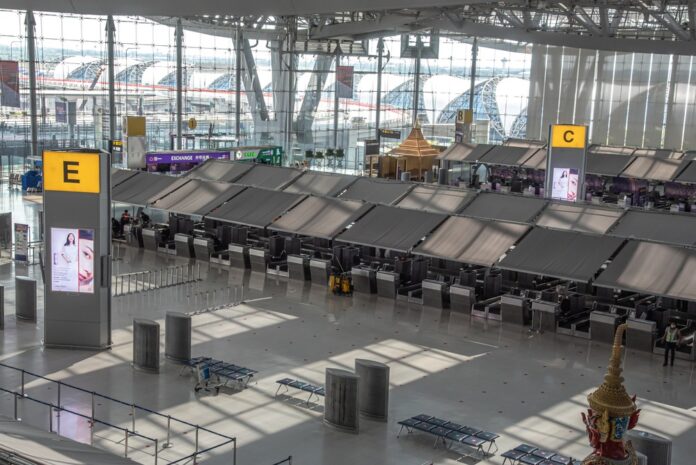

Airlines stripped millions of seats out of the region in a matter of weeks. For travelers, the question has suddenly become simple: is there still a flight?
Millions of seats, gone in weeks
Air travel across Southeast Asia has tightened sharply, and it happened fast. In the space of a few weeks, airlines pulled millions of scheduled seats out of the region — the kind of change that normally takes a year to unfold, compressed into the middle of a single season.
The cause came from far away. A crisis in the Middle East pushed up the cost of fuel, one of the biggest expenses any airline carries. When flying a route costs more than it earns, airlines stop flying it, and this time they did not wait for the usual planning cycle to make the cut.
According to schedule data from OAG, a company that tracks flights, airlines usually move their capacity by only about one percent from month to month. This time the reductions ran far deeper and arrived far faster, with the sharpest cuts landing first. Thailand and Malaysia lost some of the largest numbers of seats, each shedding more than a million, and most of the cuts fell on the shorter flights within Asia that carry the bulk of the region’s travelers. A season that was set to grow has ended up flat, or slightly smaller than the year before.
For anyone with a trip to plan, the effect is immediate and concrete: on many routes there are simply fewer flights than there were a month ago, and the ones that remain are filling up faster.
The question is no longer price — it is whether a flight exists
When a market loses this many seats this quickly, the traveler’s problem changes shape. In a normal season the question is which flight is cheapest. In this one, on a growing number of routes, the first question is simpler and more anxious: is there a suitable flight at all?
That question is harder to answer than it looks, because the flights that remain are not where a traveler expects them. When airlines cut capacity, they rarely cut evenly — one carrier drops a route while another keeps it, a direct flight disappears while a one-stop survives, a busy airport thins out while a smaller one nearby holds on. The options do not vanish so much as scatter, and a traveler checking only their usual airline can easily conclude the trip is off when it is not.
What actually helps, and why
This is the problem Airpaz’s breadth of airline relationships is meant to answer, and Wesley Wijaya, its Chief of Partnership, is direct about why it matters more now than in an ordinary year.
“When lots of flights are cut, the traveler’s real question is simple — is there another option or not,” he says. “The answer depends almost entirely on how much of the market they can see. That is why we work with more than 450 airlines, budget and full-service together. If a budget carrier drops a route between two cities, often a full-service airline still flies it, or another budget carrier picks it up, or there is a one-stop that keeps the trip alive. Working with that many airlines is how we make sure those scattered survivors actually show up in front of you.”
He frames it as the difference between a dead end and a set of choices.
“On a single airline’s website, a cut route just looks empty, and you give up,” he says. “What we are trying to do at Airpaz is catch the flights that are still out there but hidden — the unfamiliar carrier, the different routing, the nearby airport. In a full season you would barely notice the breadth. In a season like this one, it is often the whole reason a trip is still possible.”
What breadth cannot do
It would be dishonest to suggest any of this makes the squeeze painless. It does not. If Thailand loses a million seats, those seats are gone, and prices will rise no matter how many airlines a traveler can see. A wide search cannot undo the cuts, and it cannot bring back a route that every carrier has abandoned.
What it can do is narrower, and still worth a great deal: it makes sure that when a traveler comes to book, they are not staring at one expensive flight with nothing beside it, but at the full set of options that genuinely survived. As the region’s schedule keeps shifting, that is the part a traveler can still control — not how many flights exist, but how many of the ones that do they actually manage to see.