
Reliable access to stored water is an important consideration when planning homes, apartment buildings, commercial properties, and industrial facilities. While storage equipment may not be the most visible part of a building, choosing the right system can influence daily convenience, maintenance requirements, available space, and long-term operating costs.
A good storage plan involves more than selecting a container based on capacity. Property owners should consider expected consumption, installation location, construction material, access for cleaning, environmental exposure, and how the system connects with the building’s plumbing.
Start With Actual Storage Requirements
One of the most common planning mistakes is choosing capacity without first considering how the property will use the stored supply.
A small household has very different requirements from a hotel, warehouse, residential tower, factory, or educational facility. Daily consumption, number of occupants, peak demand, and the reliability of the main supply should all influence capacity planning.
Before choosing a water tank, property owners should consider:
- Average daily consumption
- Number of occupants or users
- Available installation space
- Expected periods of high demand
- Emergency reserve requirements
- Future expansion of the property
Choosing an appropriate capacity can prevent both insufficient storage and unnecessary use of valuable installation space.
Location Can Influence the Entire Installation
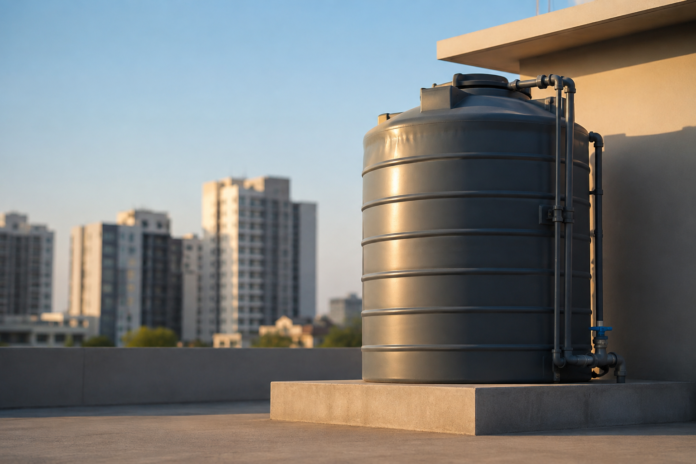
Storage systems can be positioned at ground level, on rooftops, inside dedicated service areas, or below ground depending on the property and system design.
Each location creates different requirements.
A rooftop installation must account for structural loading and accessibility. Ground-level installations need a suitable foundation and adequate space around the unit. Systems located inside technical areas must allow enough room for inspection, cleaning, and repairs.
Planning these details before installation can prevent expensive modifications later.
Material Selection Deserves Careful Attention
Storage systems are manufactured from materials such as polyethylene, fiberglass-reinforced composites, stainless steel, and concrete. There is no single material that is automatically suitable for every project.
The best choice depends on capacity, location, intended use, environmental exposure, maintenance expectations, and project budget.
For example, a GRP tank can be considered for projects where modular construction, corrosion resistance, and the ability to assemble a larger system at the installation site are important factors.
Smaller residential properties may have very different requirements and can often use simpler pre-manufactured solutions.
Think Beyond the Purchase Price
Comparing systems based only on their initial cost can lead to poor long-term decisions.
The total cost of ownership may also include:
- Transportation
- Foundation preparation
- Installation
- Plumbing connections
- Cleaning
- Inspections
- Repairs
- Replacement of components
A slightly higher initial investment may be worthwhile when a system offers easier maintenance or better suitability for the installation environment.
Access for Cleaning Should Be Planned Early
Storage infrastructure requires ongoing care. Designers should therefore consider maintenance access during the planning stage rather than after installation.
Technicians should be able to reach inspection points, fittings, covers, drainage connections, and other serviceable components without unnecessary difficulty.
Good accessibility makes routine inspection easier and can help maintenance teams identify leaks, damaged fittings, sediment accumulation, or other problems before they become more serious.
Pay Attention to the Foundation
When filled, storage systems can place considerable weight on their supporting structure. A stable, level, and appropriately designed base is therefore an essential part of installation.
Foundation requirements depend on system dimensions, total filled weight, installation location, and structural design. Large commercial installations may require engineering assessment before construction begins.
Poor foundation preparation can contribute to uneven loading, connection problems, or structural stress over time.
Protect Stored Supply From External Contamination
Properly designed storage should limit opportunities for dust, insects, debris, and other contaminants to enter.
Covers and access points should remain secure, while overflow and ventilation arrangements should be designed appropriately for the application. Regular cleaning is also important because sediment can gradually collect inside storage systems.
For potable applications, owners should follow applicable local requirements for materials, installation, inspection, and cleaning.
Include Maintenance in the Long-Term Plan
Even a high-quality water tank requires periodic attention. A sensible maintenance program should include visual inspection, cleaning when required, checking fittings and connections, and looking for signs of leakage or physical deterioration.
The appropriate maintenance frequency depends on the application, local requirements, environmental conditions, and manufacturer guidance.
Keeping basic inspection and maintenance records can also be useful for commercial properties where multiple teams may be responsible for facility management.
Plan for Future Changes
Buildings rarely remain exactly as they were originally designed. A commercial property may expand, a residential building may accommodate more occupants, or an industrial facility may increase production.
Storage requirements can change along with these developments.
Considering potential expansion during the initial planning stage can make future upgrades easier. This is particularly valuable for commercial and industrial properties where replacing an entire system may disrupt normal operations.
Final Thoughts
Effective water storage planning combines capacity, location, material selection, structural support, hygiene, accessibility, and maintenance into a single decision-making process.
Rather than focusing only on purchase price or maximum capacity, property owners should consider how the system will perform throughout its service life. A solution that matches actual demand, fits the available installation area, and can be maintained conveniently is more likely to provide dependable long-term performance.
For larger or technically complex projects, involving experienced installers and relevant engineering professionals during the planning stage can help ensure that the final system is appropriate for the building and its intended use.