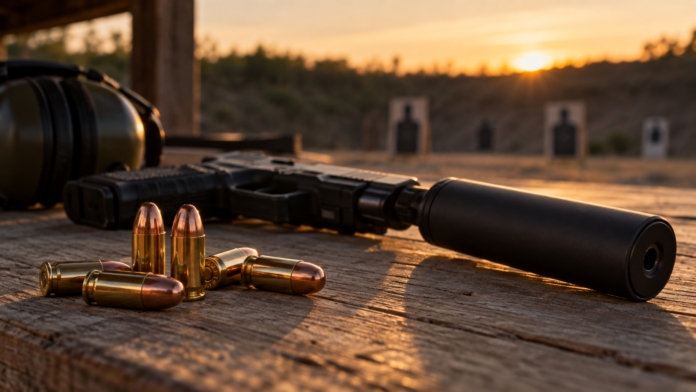

Roughly two-thirds of the 9mm ammunition sold in America is loaded to run supersonic, which is why the guy in the next lane flinches every time you touch off a magazine. Nothing about that is wrong. It’s just loud, and loud gets old fast when you’re running a few hundred rounds on a Saturday morning.
Subsonic 9mm ammo flips one variable and leaves almost everything else alone. If you’ve been told it turns a pistol into a mouse fart or ruins your accuracy, both stories are wrong, and the real answer is a lot more interesting than either one.
Here’s the short version: subsonic ammunition keeps the bullet under the speed of sound so the round never cracks the air. You still get recoil, you still get muzzle flash, and you still get a bullet that punches paper. What changes is the noise signature, the ballistic curve, and how your pistol or carbine cycles. Shops like 9mm subsonic ammo stock rounds built specifically around that job instead of just downloading a standard load.
What “subsonic” actually means in numbers
Sound travels at roughly 1,125 feet per second at sea level on a standard day, though that figure shifts with air temperature and altitude. The accepted baseline comes from standard reference data published by the National Institute of Standards and Technology, and it’s the same number engineers use across acoustics work.
So a subsonic 9mm load keeps its bullet under that line, typically somewhere in the 950 to 1,050 feet per second range depending on the manufacturer and bullet weight. Standard pressure 9mm, by contrast, often pushes a 115-grain bullet past 1,150 feet per second, which means it crosses the sound barrier the moment it leaves the muzzle.
That crossover is the whole story. A bullet breaking the sound barrier produces a small sonic boom that travels with it downrange, and a suppressor cannot do anything about that crack. Suppressors tame the expanding gas at the muzzle, which is the other half of the noise. Quiet a supersonic round and you’ve still got a sharp snap trailing the bullet. Quiet a subsonic round and both halves go away. This is why anyone running a suppressor reaches for subsonic loads first, and it’s not a preference thing.
Why heavier bullets do the work
Lower velocity without a heavier projectile means a weak round, so subsonic 9mm leans on bullet mass to compensate. Common weights run 147 grains, 158 grains, and occasionally up to 165 grains. Heavier bullets carry momentum better at reduced speed, so you don’t lose as much energy as the velocity number alone would suggest.
There’s a practical tradeoff buried here that nobody mentions enough. A 147-grain subsonic round out of a typical pistol drops more at distance than a 115-grain range load does, but it also drifts less in a crosswind because the heavier slug has more inertia to push through moving air. If you’re shooting inside 25 yards, you won’t notice either effect. Stretch it to 50 and the holdover starts to matter.
Bullet shape matters too. Most subsonic 9mm ships as a round nose or a flat point, which feeds reliably in a wide range of pistols and carbines. The tradeoff is that flat points sometimes hang up on feed ramps that were cut for round nose ammunition, so it’s worth running a couple of magazines before you commit to a case.
Does your pistol actually cycle it?
This is where subsonic ammo earns its reputation for being finicky, and the reputation isn’t entirely undeserved. A pistol recoil spring is tuned to a certain range of momentum, and a slower, heavier round delivers its push in a different shape than a fast, light one.
A lot of modern 9mm pistols cycle 147-grain subsonic without complaint. Some of the tighter, competition-tuned guns with reduced-power springs start short-stroking, which means the slide doesn’t travel far enough back to strip the next round cleanly. If that happens, you’ve got two options: run a softer recoil spring, or pick a hotter subsonic load. The second option is easier and cheaper.
Carbines are a different animal. A longer barrel gives the powder more time to burn, so a load that measures 1,000 feet per second from a four-inch pistol barrel might clock 1,150 out of a 16-inch barrel. That extra 150 feet per second can push a borderline subsonic round right over the sound barrier, and you’ll hear the crack come back. Unfortunately, the fun is gone.
My read on it: if you’re running a pistol, buy 147-grain subsonic and don’t overthink it. If you’re running a carbine, chronograph your load before you buy a case of anything.
A quick range checklist before you commit
You don’t need a lab to figure out whether a subsonic load works in your gun. You need about twenty minutes and a bench.
- Load one magazine with five rounds. Fire them one at a time and listen for a crack. A sharp snap means you’re still supersonic.
- Watch where your brass lands. If it’s dropping two feet from your feet instead of six, you’re undergassed for that spring.
- Shoot a five-shot group at 25 yards, then a five-shot group at 50. Note the holdover difference against your usual range ammo.
- Check the ejection port for soot buildup after 50 rounds. Subsonic loads often burn dirtier because they use faster powders to hit pressure with less velocity.
- Run one magazine of your standard carry ammo last, so you know both loads group to the same point of aim if that matters to you.
That last check catches more problems than any spec sheet will. If your subsonic practice round and your defensive round land in different places on the paper, you’ve got a training problem you didn’t know about.
The energy question
People assume a slower bullet means dramatically less energy, and the physics is more forgiving than that. Kinetic energy scales with the square of velocity, so dropping from 1,150 to 1,000 feet per second does cost you, but the heavier bullet claws a lot of it back. A 147-grain subsonic load at 1,000 feet per second carries energy in the same neighborhood as a 115-grain standard load at 1,180 feet per second. The gap is real but narrower than most shooters expect.
Ballistic behavior gets explained in detail through resources like The Physics Classroom, which breaks down how mass and velocity interact in projectile motion if you want the math. The takeaway for your range session is simpler: energy on paper is not the same as terminal performance, and subsonic rounds are built for a different job than defensive hollow points.
Where subsonic loads shine is everything that isn’t a gunfight. Steel plates, paper, indoor ranges where you’d rather not get a headache, and any setup running a suppressor. Where they don’t shine is hunting scenarios or anything where expansion at reduced velocity matters, because most hollow points need a certain impact speed to open up reliably.
Cost, availability, and what to actually buy
Subsonic 9mm used to sit at a price premium over standard range ammo. That’s softened as more manufacturers added subsonic lines, and in a lot of calibers the gap is now small enough that it barely matters for practice volume. Buying in bulk tins or 500-round cases usually closes the difference entirely.
Across the broader ammunition manufacturing sector, production has scaled considerably, and the National Aeronautics and Space Administration is a genuine example of how engineering agencies handle velocity and atmospheric data at scale, though ammo pricing itself tracks raw material costs more than anything else.
What I’d tell a friend: buy a 50-round box of two different subsonic loads, shoot both, and pick the one your gun likes. Don’t buy 1,000 rounds on somebody’s forum recommendation. Your pistol’s spring weight, your barrel length, and your suppressor (or lack of one) all change the answer.
One last thing worth knowing. Subsonic ammunition is not quieter in a bare pistol by a huge margin. The muzzle blast is still substantial, and the difference is more noticeable with a suppressor or a longer barrel. Anyone who tells you a bare pistol shooting subsonic ammo is quiet is describing something else. It’s softer, not silent, and that distinction is the one that keeps people from being disappointed at the range.
So if you’ve been putting off trying subsonic because the internet told you it’s complicated, grab a box, run the five-round check, and find out what your gun actually does. The answer usually takes one range trip, and it’s rarely the answer you expected.