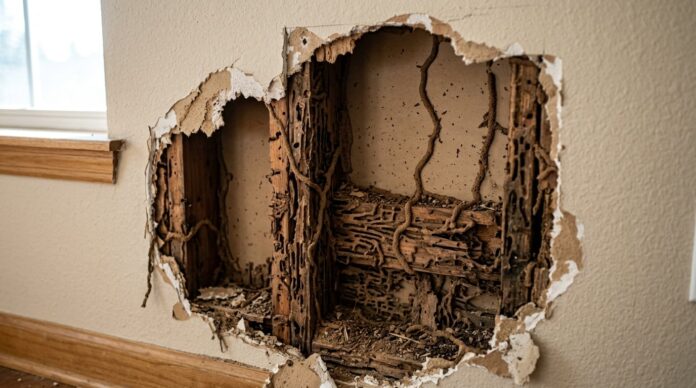

The signs of termites are subtle, easy to rationalise away, and almost always present long before the damage becomes obvious. That’s exactly what makes termites the most expensive pest a homeowner can ignore — they work quietly and continuously, and by the time the damage is visible to a casual glance, it’s usually structural. Learning to read the early warning signs turns a catastrophic discovery into an early, manageable one. Here are the seven to watch for, plus the seasonal habit that keeps them in check.
The 7 early signs of termites
1. Mud tubes. Pencil-width tunnels of dried mud running along foundations, walls or piers. Termites build them to travel between soil and timber while staying hidden. They’re the single most reliable sign.
2. Hollow-sounding timber. Tap skirting boards, door frames and structural timber. Termites eat wood from the inside out, leaving a thin shell — so healthy timber sounds solid while infested timber sounds hollow or papery.
3. Discarded wings. After a warm, humid evening, winged termites swarm to start new colonies, then shed their wings. Small piles of identical discarded wings near windowsills or light fittings are a strong signal.
4. Blistered or rippled paint. Paint that looks subtly bubbled or uneven can indicate moisture and termite activity working just beneath the surface.
5. Frass (termite droppings). Drywood termites push out tiny, ridged pellets that resemble sawdust or coffee grounds, often in small mounds below infested timber.
6. Tight-fitting doors and windows. As termites consume timber and introduce moisture, frames warp — so doors and windows that suddenly stick can be more than humidity.
7. Faint clicking in the walls. Soldier termites bang their heads against tunnels when disturbed; in a quiet room you can sometimes hear it.
Where to check, and when
A seasonal habit of checking the obvious spots beats a once-a-year blitz. Focus on:
- Skirting boards and door frames
- The base of timber posts and anywhere timber meets soil
- Subfloor and foundation lines
- Damp zones — kitchens, bathrooms, under leaking outlets
Warm, humid weather is peak termite season, so step up checks as the season turns. Moisture is the common thread: standing water and damp timber are what draw termites in the first place, so fixing leaks and clearing pooling water is prevention as much as detection.
Because the early signs are so easy to miss, spotting the early signs of termites is a skill worth deliberately building — it’s worth more than any spray on the shelf, because spray treats the symptom while early detection protects the structure.
Why DIY isn’t enough for termites
Routine vigilance handles detection, but termites are not a DIY treatment job. The colony is usually nowhere near the visible damage, and surface sprays can scatter a colony into new areas rather than eliminate it. Any genuine sign of activity should go to a professional inspection, because the cost of being wrong is measured in structural timber and insurance gaps — most home policies exclude termite damage.
A professional inspection also catches what an untrained eye misses: the colony’s entry point, the moisture source feeding it, and the extent of damage behind finished surfaces. Operators offering pest control in Blacktown and similar local coverage typically build termite inspection into a seasonal schedule precisely because catching activity early is what keeps treatment small and contained.
A four-times-a-year habit
The cleanest way to handle termites is to stop treating it as an emergency and start treating it as maintenance. Four short seasonal passes — checking the spots above, fixing damp, and looking for the seven signs — handle the vast majority of what would otherwise become a structural repair. Termites aren’t really attracted to your home; they’re attracted to the moisture, the soil contact and the accessible timber. Close those off, season by season, and most of the risk never arrives.
FAQ
What are the first signs of a termite infestation? The earliest signs are usually mud tubes along foundations, hollow-sounding timber, and small piles of discarded wings after a warm evening. These appear well before any visible structural damage.
Can I treat termites myself? No. The colony is rarely where the damage shows, and surface sprays can spread it. Any sign of termite activity should be confirmed and treated by a professional, because the structural and insurance stakes are high.
How often should I check for termites? At least quarterly, stepping up checks in warm, humid weather. A professional inspection once a year — or immediately if you spot any of the seven signs — is cheap insurance against structural damage.
Termites reward early attention more than any other household pest. Learn the seven signs, check four times a year, and call a professional the moment something looks off — that habit is the difference between a quick treatment and a structural repair.