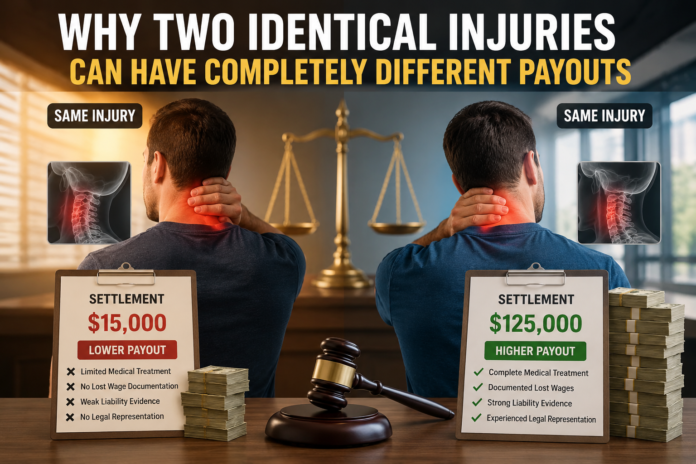

On paper, a fractured tibia is a fractured tibia. The medical coding is the same, the orthopedic cast looks identical, and the healing timeline generally spans the same six to eight weeks. Yet, in the civil justice system, if two different people suffer that exact same fracture in two separate accidents, their final financial recoveries might differ by tens of thousands or even hundreds of thousands of dollars.
This disparity often confuses people who assume that personal injury compensation is based on a fixed medical tariff. In reality, the legal system does not compensate the injury itself; it compensates the specific, real-world impact that the injury imposes on an individual’s life.
The Bifurcation of Damages: Economic vs. Non-Economic Impact
To understand why payouts diverge, one must look at how courts and insurance companies calculate losses. Compensatory damages are split into two primary categories: objective economic losses and subjective non-economic losses.
The Professional Ripple Effect
Economic damages cover quantifiable financial harm, most notably medical bills and lost wages. This is where the baseline occupation of the injured party radically alters the valuation. If an assembly line worker suffers a severe wrist fracture, they may be entirely unable to perform their job for months, racking up massive lost wage claims. If a software engineer suffers the same injury, they might miss only a few days of work before returning to a modified keyboard setup, resulting in a much smaller lost wage component.
The Eggshell Skull Rule and Pre-Existing Vulnerabilities
An important legal doctrine known as the “eggshell skull rule” states that a defendant must take the plaintiff as they find them. If an identical minor car accident causes a mild neck strain in a healthy twenty-year-old, the payout will reflect minimal treatment. If that exact same impact occurs to an elderly individual with pre-existing degenerative disc disease, it could trigger a catastrophic, permanent loss of mobility, drastically driving up the non-economic “pain and suffering” valuation.
Critical Variables Outside the Medical Chart
Beyond the individual attributes of the plaintiff, several external structural factors dictate the eventual financial recovery in a personal injury claim.
- Insurance Policy Caps: A claim is frequently limited by the amount of available insurance coverage. If a negligent driver has only a state-minimum liability policy, an injured party may find it impossible to collect the full value of their claim unless they can pursue underinsured motorist coverage or personal assets.
- Comparative Fault Allocations: Liability is rarely entirely black and white. If a jury determines that an injured pedestrian was twenty percent at fault for crossing outside a crosswalk, their final payout is reduced by twenty percent under comparative negligence laws. An identical injury where the defendant is one hundred percent at fault faces no such deduction.
- Venue and Jurisdictional Demographics: The physical location where a case is filed matters immensely. Conservative venues often yield more modest jury verdicts, while urban or historically progressive jurisdictions may trend higher for non-economic damages.
Navigating these subtle regional variances requires local insight. For instance, securing equitable recovery under the specific liability and insurance frameworks of the Southwest often depends on partnering with a dedicated personal injury lawyer in phoenix who understands how local adjusters and jury pools weigh quality-of-life disruptions.
The Dual Edge of Subjective Evidence: Expert Witnesses vs. Daily Journals
Demonstrating the true depth of an injury’s impact involves a balanced mix of professional analysis and personal narrative, both of which carry distinct advantages and hurdles.
The Weight of Medical Experts
Retaining vocational experts and economists allows a plaintiff to present clear, mathematically sound projections of future medical costs and lost earning capacity. This objective data is difficult for insurance companies to dismiss during negotiations.
The Challenge of Proving Intangibles
Conversely, establishing non-economic damages like loss of enjoyment of life relies heavily on subjective evidence, such as personal journals or testimony from friends. While powerful, this evidence is inherently vulnerable to cross-examination. Defense attorneys will frequently scour a plaintiff’s public social media accounts for a single photograph of them smiling or traveling to undermine their claims of ongoing emotional and physical suffering.
Common Clarifications
Does a higher medical bill automatically mean a higher settlement?
Not necessarily. Insurance adjusters scrutinize bills for “over-treatment.” If a plaintiff undergoes expensive, repetitive chiropractic adjustments that medical consensus deems unnecessary for their specific injury, the insurer will likely exclude those costs from the settlement calculation.
How does loss of consortium affect a payout?
Loss of consortium is a separate claim filed by the injured person’s spouse for the loss of companionship, affection, and marital intimacy. It can increase the overall payout, but it requires the spouse to testify publicly about the intimate details of how the injury strained their marriage.