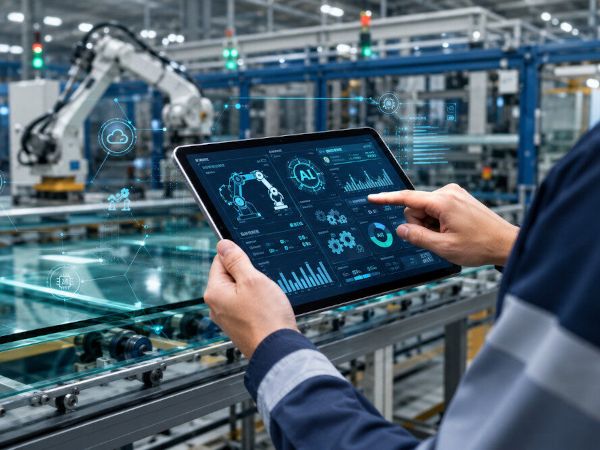

Glass manufacturing has evolved significantly over the last decade, driven by increasing quality standards across industries such as automotive, electronics, architecture, renewable energy, and medical devices. As manufacturers strive to eliminate production defects while improving efficiency, glass inspection automation has become an essential technology in modern production facilities.
California, known for its advanced manufacturing ecosystem and technological innovation, is witnessing rapid adoption of AI-powered machine vision systems for automated glass inspection. Whether producing transparent glass for electronic displays or automotive windshields for next-generation vehicles, manufacturers require highly accurate inspection systems capable of identifying even the smallest imperfections before products reach customers.
Modern inspection technologies are transforming quality assurance by enabling fast, reliable, and consistent defect detection in glass, helping manufacturers reduce waste, improve production throughput, and meet increasingly strict industry standards.
The Growing Need for Automated Glass Inspection
Glass products are used in countless applications where quality is critical. A microscopic scratch, bubble, crack, chip, coating defect, or contamination can affect durability, optical clarity, structural integrity, or overall product performance.
Traditional visual inspection methods rely heavily on human operators. Although experienced inspectors can identify obvious defects, manual inspection has several limitations:
- Inspection accuracy varies between operators.
- Human fatigue reduces consistency during long production shifts.
- Small or transparent defects are difficult to detect.
- Manual inspection slows production speed.
- Quality documentation is often limited.
These challenges have accelerated the adoption of glass inspection automation, allowing manufacturers to inspect every product with the same level of precision and reliability.
What is Glass Inspection Automation?
Glass inspection automation combines machine vision, artificial intelligence, industrial cameras, precision lighting, and automated material handling to inspect glass products without manual intervention.
An automated inspection system typically includes:
- High-resolution industrial cameras
- Specialized lighting for transparent and reflective surfaces
- Precision optics
- AI-based image processing software
- Automated conveyors or robotic handling systems
- Real-time quality monitoring dashboards
The system captures detailed images of each glass component and instantly analyzes them using intelligent algorithms that can identify various types of manufacturing defects.
Unlike manual inspection, automated systems can inspect every piece at production speed while maintaining consistent inspection accuracy throughout the manufacturing process.
Common Glass Defects Identified by Automated Systems
Modern AI-powered inspection systems can detect a wide variety of defects that may otherwise go unnoticed.
Some of the most common examples include:
- Surface scratches
- Cracks and fractures
- Edge chips
- Air bubbles
- Foreign particle contamination
- Coating inconsistencies
- Optical distortion
- Surface stains
- Black spots
- Seal defects
- Pattern irregularities
- Dimensional inaccuracies
Accurate defect detection in glass ensures that only products meeting quality specifications continue through production, reducing downstream failures and customer complaints.
Glass Inspection for Automotive Manufacturing
Automotive glass requires extremely high quality standards because it directly impacts vehicle safety, visibility, and driver assistance systems.
Modern vehicles include:
- Windshields
- Side windows
- Rear glass
- Sunroofs
- Camera protection glass
- LiDAR covers
- Head-Up Display (HUD) glass
Even minor defects can interfere with optical performance or compromise structural integrity.
Automotive manufacturers increasingly rely on glass inspection automation to inspect laminated glass, tempered glass, coated glass, and specialty automotive glazing throughout production.
Automated inspection systems can identify defects before assembly, minimizing production delays and reducing warranty claims.
Transparent Glass Inspection Challenges
Transparent glass presents unique inspection challenges because defects often have very little contrast against the surrounding material.
Conventional vision systems may struggle to detect:
- Tiny scratches
- Embedded particles
- Surface waviness
- Optical distortion
- Fingerprints
- Coating variations
Advanced machine vision systems overcome these challenges using specialized illumination techniques, polarized lighting, multi-angle imaging, and AI-powered image enhancement.
These technologies significantly improve defect detection in glass, even for highly transparent materials used in displays, touch panels, medical devices, and optical components.
Benefits of Glass Inspection Automation
Higher Inspection Accuracy
AI-powered inspection systems consistently identify microscopic defects that may be overlooked during manual inspection.
Increased Production Speed
Automated systems inspect glass continuously without slowing production, enabling manufacturers to meet higher throughput demands.
Reduced Manufacturing Costs
Early defect detection reduces scrap, rework, warranty claims, and production downtime, resulting in substantial cost savings.
Improved Product Consistency
Every glass product is inspected using identical quality standards, eliminating operator-to-operator variation.
Real-Time Quality Monitoring
Manufacturers receive instant feedback on production quality, allowing process adjustments before defects become widespread.
Comprehensive Data Collection
Inspection systems generate detailed reports, images, and analytics that support quality control, traceability, and continuous process improvement.
AI and Machine Vision Are Changing Glass Manufacturing
Artificial intelligence has dramatically improved inspection performance compared to traditional rule-based vision systems.
Instead of relying solely on predefined inspection rules, AI algorithms learn from thousands of defect images and continuously improve detection accuracy over time.
Machine learning enables systems to classify defects based on:
- Shape
- Size
- Texture
- Color variation
- Surface characteristics
- Optical behavior
This intelligent approach reduces false rejects while increasing the detection rate of actual manufacturing defects.
As production environments become increasingly automated, AI-driven glass inspection automation is becoming a core component of Industry 4.0 manufacturing strategies.
California Leads the Adoption of Smart Manufacturing
California remains one of the world’s leading centers for advanced manufacturing, supporting industries including electric vehicles, semiconductor fabrication, aerospace, renewable energy, medical technology, and consumer electronics.
These industries depend heavily on high-quality glass components, driving demand for intelligent inspection technologies.
Manufacturers across California are investing in automated inspection systems to:
- Improve production efficiency
- Meet strict regulatory requirements
- Reduce labor dependency
- Increase manufacturing scalability
- Maintain global competitiveness
- Deliver consistently high-quality products
The combination of AI, robotics, and machine vision is helping California manufacturers modernize production while maintaining exceptional quality standards.
The Future of Glass Inspection Automation
The future of automated inspection continues to evolve rapidly with advances in artificial intelligence and imaging technologies.
Emerging innovations include:
- Deep learning-based defect classification
- 3D glass surface inspection
- Hyperspectral imaging
- Cloud-based quality analytics
- Predictive manufacturing insights
- Robotic inspection integration
- Edge AI processing for real-time decisions
These technologies will further improve inspection speed, accuracy, and production flexibility while reducing operating costs.
As quality requirements continue to become more demanding, intelligent inspection systems will play an even greater role in manufacturing operations.
Manufacturers can no longer depend solely on manual quality inspection to meet today’s production requirements. The increasing complexity of glass products demands faster, more accurate, and highly repeatable inspection processes.
By implementing glass inspection automation, manufacturers can improve production efficiency, reduce operational costs, minimize waste, and ensure consistently high product quality. Advanced AI-powered machine vision systems are enabling reliable defect detection in glass, helping manufacturers identify imperfections before they affect downstream production or reach customers.
For manufacturers across California, investing in automated glass inspection technology is not simply an operational improvement—it is a strategic step toward smarter manufacturing, stronger quality assurance, and long-term competitiveness in an increasingly demanding global market.