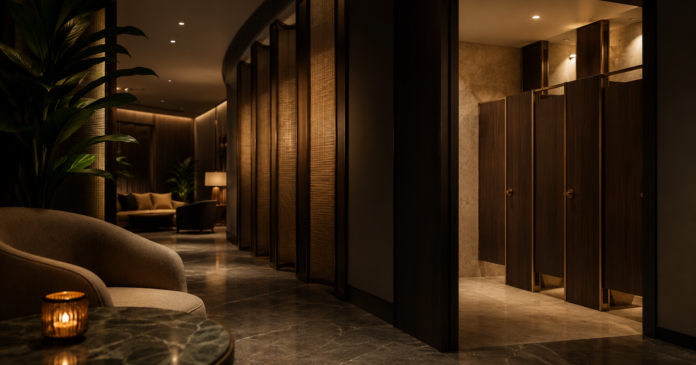

Walk into any high-end hotel, spa, or private club and something shifts. Your shoulders drop. Your voice lowers. You feel, in a word, safe. That feeling is not an accident. It is the product of deliberate design choices that respond to one of the most basic human needs: privacy.
Privacy is often treated as a legal or digital concern, but it is also deeply physical. The spaces we occupy either protect us or expose us, and our brains register the difference within seconds. Luxury environments understand this better than almost any other category of design. They sell comfort, yes, but what they really sell is the sensation of being shielded — from noise, from crowds, from the eyes of strangers.
This article looks at why privacy matters so much to the human mind, how premium spaces engineer it, and why even the most utilitarian corners of a building deserve the same attention.
Why the Brain Craves Privacy
A Need Older Than Architecture
Long before buildings existed, humans sought enclosure. Caves, tree cover, and defensible positions offered protection from predators and weather. That instinct never left us. Environmental psychologists call it “prospect and refuge” — the desire to see our surroundings while remaining partially hidden ourselves.
Modern research supports the idea that perceived privacy directly affects stress. According to the American Psychological Association, environmental stressors like noise and crowding measurably raise cortisol levels and reduce our sense of control. When a space removes those stressors, the nervous system relaxes. Guests describe this as “peaceful” or “calming,” but underneath the adjectives is a simple biological response: the body no longer feels watched.
Control Is the Real Luxury
Here is the part many designers miss. Privacy is not just about being alone. It is about choice.
A guest who can close a door, draw a curtain, or step into a quiet alcove feels in command of their own visibility. Psychologist Irwin Altman famously defined privacy as the selective control of access to oneself — a boundary we open and close at will. Luxury spaces excel at giving guests that dial. Budget spaces, by contrast, often decide for them.
How Luxury Spaces Engineer Protection
Sound: The Invisible Wall
Acoustic privacy may be the most underrated element of premium design. Thick doors, upholstered walls, layered textiles, and background music all serve the same purpose: they prevent conversations from traveling. A guest who knows their words stay at their own table speaks more freely, stays longer, and rates the experience higher.
Hard surfaces are beautiful, but they bounce sound everywhere. High-end venues balance marble and glass with rugs, drapery, and acoustic paneling. The result feels effortless. It rarely is.
Sightlines and Spatial Buffers
Luxury interiors manage what you can see — and what can see you. Entry sequences curve rather than open directly onto seating. Booths sit higher than walkways. Screens, planters, and half-walls break long views into intimate zones.
None of this reads as “hiding.” It reads as generosity. Space between tables, wide corridors, and semi-enclosed nooks tell guests they will not be brushed, overheard, or observed. That message lands even when no one consciously notices the layout.
Lighting That Softens Exposure
Bright, uniform light feels institutional because it leaves nowhere to retreat. Layered lighting — pools of warmth surrounded by shadow — creates psychological cover. Guests gravitate toward the edges of light the way our ancestors gravitated toward the mouth of a shelter. Dimmer scenes in the evening are not just about mood. They are about lowering the sense of being on display.
Service That Respects the Bubble
Privacy is also behavioral. Staff in top-tier hospitality are trained to read distance: when to approach, when to disappear, how to deliver without interrupting. A server who refills a glass without breaking a conversation is performing privacy as a service. Guests may never name it, but they feel it.
The Restroom Test: Where Privacy Is Won or Lost
Why the Most Private Room Matters Most
Ask guests where they feel most vulnerable in any commercial building and the answer is consistent: the restroom. It is the one space where exposure is personal rather than social. A stunning lobby cannot compensate for a restroom that feels flimsy, gappy, or poorly maintained. In fact, the contrast makes it worse.
This is why the restroom functions as a kind of honesty test. It reveals whether a business’s commitment to guest comfort extends beyond the areas that photograph well.
The Quiet Impact of Toilet Partitions
Toilet partitions carry more psychological weight than nearly any other fixture. Full-height panels, minimal sightline gaps, solid materials, and doors that close with a confident click all communicate one message: you are protected here. Thin panels that rattle, wide gaps at the edges, and hardware that barely latches communicate the opposite — and guests remember it.
Material choice matters too. Powder-coated steel suits high-traffic durability, solid plastic (HDPE) resists moisture and vandalism, phenolic handles humidity-heavy environments like gyms and spas, and stainless steel signals polish in upscale settings. Each option changes both the maintenance profile and the perceived quality of the room.
Finding the Right Fit for a Local Commercial Space
For business owners, the practical challenge is matching partition style, material, and layout to the realities of their building — traffic volume, moisture levels, accessibility requirements, and brand image. Local sourcing helps here, because lead times, measurements, and code compliance vary by region. Owners searching for toilet partitions in Chicago, for example, can work from accurate quotes and configurations suited to commercial codes in their area rather than guessing from generic catalogs. Getting this right is not a cosmetic upgrade. It is a direct investment in how protected every guest feels at the most sensitive point of their visit.
Accessibility deserves equal care. ADA-compliant stalls are a legal requirement in the United States, and the ADA’s official guidance outlines clearances and hardware standards that also happen to improve comfort for everyone. Compliance and dignity, in this case, point in the same direction.
Small Signals, Big Perceptions
Privacy accumulates through details. Consider how many of these a guest encounters in a single visit:
- A coat check that keeps belongings out of sight
- Seating angled away from foot traffic
- Frosted glass instead of clear
- Individual restroom stalls with real doors and real walls
- Staff who knock, pause, and wait
No single item carries the experience. Together, they form a pattern the brain reads as respect. And respect, more than thread count or finishes, is what guests describe when they say a place felt “luxurious.”
Conclusion: Protection Is the Product
Luxury is often mistaken for excess — more space, more polish, more expense. But strip away the surfaces and what remains is protection. The finest spaces make people feel unobserved when they want solitude, unheard when they want discretion, and unhurried when they want calm.
That feeling is built, not bought. It lives in acoustics, sightlines, lighting, service, and yes, in the humble hardware of a restroom stall. Businesses that treat privacy as a design principle rather than an afterthought earn something advertising cannot manufacture: guests who exhale the moment they walk in, and who come back because of it.