
If you manage paid media for a direct-to-consumer (D2C) brand or an e-commerce storefront, you know that the modern media buying algorithm is hungry. It doesn’t just want budget; it wants constant, fresh, engaging creative.
Historically, the industry treated targeting and bidding as the primary levers of ad performance. Today, targeting is largely automated by ad platforms, leaving creative as the last major competitive advantage. According to research by Nielsen, creative quality drives up to 47% to 56% of sales lift in digital advertising campaigns. Yet, maintaining that lift is incredibly difficult. AppsFlyer’s creative analytics shows that ad performance typically drops by 15% to 20% within the first two weeks of a creative’s lifespan.
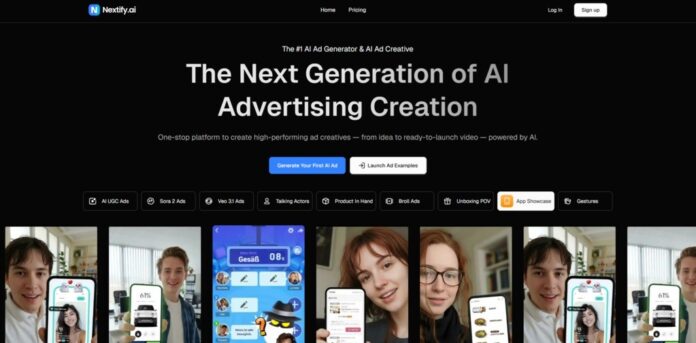
This rapid decay is known as creative fatigue. For years, my team struggled to outrun it. We relied on a traditional workflow: finding creators, sending them physical products, waiting weeks for raw footage, and manually editing variations. It was slow, expensive, and fundamentally unscalable. To survive, we had to rethink our operational model. That journey led us to restructure our workflow around an advanced AI Ad Generator, specifically testing tools like Nextify.ai to see if machine-generated user-generated content (UGC) could match the efficiency of our human pipeline.
The Traditional UGC Bottleneck: High Cost, Slow Turnaround
Before shifting our approach, our video production was a complex, multi-step headache. User-generated content (UGC) has become the gold standard for social platforms like TikTok and Meta because it feels native and authentic. However, producing authentic-looking content at scale is a logistical nightmare.
The Hidden Friction of Creator Outreach
Our old workflow began with creator sourcing. We spent hours scanning TikTok and Instagram, looking for micro-influencers whose aesthetic matched our brand. Once selected, we had to negotiate rates, draft contracts, and ship product samples. It was common to wait 10 to 14 days just for a creator to receive a product and begin filming. Even then, the output was highly unpredictable. Creators would occasionally miss deadlines, misunderstand the creative brief, or deliver videos with poor audio and lighting.
The Fragility of the Physical Production Pipeline
Once raw assets finally arrived, the heavy lifting began for our internal team. A single 15-second video often required hours of post-production editing—adding captions, adjusting color grading, and recording voiceovers. If we wanted to A/B test three different hooks or try different calls-to-action (CTAs), we had to hope the creator had recorded enough alternate takes. If they hadn’t, we were stuck.
This friction directly impacted our bottom line. According to industry surveys, the cost of creative production is cited as a major obstacle for many small-to-medium-sized businesses trying to scale their digital marketing. When you are spending hundreds of dollars per video concept, you simply cannot afford to test broadly. You end up putting all your budget behind a few creatives, praying they convert, only to watch their performance decay within a fortnight.
Shifting to Nextify.ai: A New Operational Model
To break this bottleneck, we began exploring AI ad tools that could decouple creative volume from physical constraints. Our goal wasn’t to replace high-production brand campaigns, but to build a rapid-testing engine for our daily paid social ads. This is where Nextify.ai entered our workflow.
From Script to Finished Ad in Three Minutes
Nextify’s core promise is turning simple product inputs into viral-style video ads in under three minutes. Instead of mailing physical inventory and waiting weeks, we could upload a clear product image or paste a product URL directly into the platform. The tool’s underlying AI then analyzes the product, auto-writes conversion-focused scripts, and pairs them with dynamic visual layouts.
By using an automated AI Ad Generator, we suddenly shifted our production timeline from weeks to minutes. If we wanted to test a new angle—for instance, pitching our product as a “perfect gift” versus a “daily life-saver”—we didn’t have to hire two different creators. We simply generated two different scripts, selected our target digital human, and let the software render the variations.
Leveraging High-Fidelity AI Avatars and Voices
One of our biggest hesitations with using an AI Ad Generator was the dread of the “synthetic” look. Consumers are incredibly quick to spot and dismiss robotic, lifeless AI avatars. Nextify addresses this by providing ultra-realistic digital human personas.
The platform features over 500 neural voices across 40+ languages, allowing us to customize the exact vocal tone—whether we need an excited, fast-paced TikTok style or a calm, authoritative explainer voice. We could select roles tailored to our target demographic, such as a “Beauty Blogger,” “Fitness Enthusiast,” or “Homemaker,” ensuring the virtual spokesperson felt highly relevant to our audience.
Eliminating Regional and Multilingual Friction
As we began scaling our DTC store globally, we faced a massive localization barrier. Translating, dubbing, and re-recording video ads for European or Asian markets traditionally meant hiring regional creators and starting the entire sourcing cycle over again. With Nextify, localization became a one-click task. The platform’s voice synthesis allowed us to translate our winning English scripts into Spanish, German, French, and Japanese instantly. The AI avatars synchronized their lip movements and facial expressions to match the new language, enabling us to launch localized international campaigns in hours rather than months.
Inside the Mechanics: What Makes AI-Generated Content Perform?
Transitioning to AI-driven production is more than just a cost-saving measure; it is a tactical pivot in how you approach paid media performance.
Beating the “Uncanny Valley” in Ad Creatives
A fascinating study highlighted by marketing researchers suggests that consumers have a natural “algorithm aversion”—a negative predisposition toward content they perceive as purely machine-made. However, when AI-generated ads are high-quality and blend seamlessly with organic social content, they bypass this penalty entirely.
Nextify’s rendering engine uses advanced physical modeling to deliver natural lighting, lifelike facial expressions, and realistic depth of field. When our ads appeared on a user’s Meta or TikTok feed, they did not scream “AI.” They looked like a typical content creator filming a product demonstration in their living room. Because the visual environment felt authentic, our thumb-stop rates remained high.
The Power of Product-in-Hand Simulation
One major challenge with basic video generation tools is their inability to make the digital actor interact naturally with the physical item. Nextify solves this by enabling realistic “product-in-hand” styling. This allows the digital persona to demonstrate the product dynamically. Product demonstration is one of the highest-converting angles in e-commerce, as it quickly answers the customer’s silent question: “How does this work in real life?” By using text prompts to dictate human-like gestures and precise product interactions, we can guide our AI avatar to turn a bottle, hold up a package, or point to key features on the screen, mimicking the natural flow of a live-action unboxing video.
Rapid Testing of Winning Hooks
In short-form video advertising, the first three seconds are everything. If your hook fails to stop the scroll, the rest of your video is wasted.
With traditional production, testing twenty different video hooks is financially prohibitive. With Nextify’s ad video generation AI workflow, we structured our testing into two clear phases:
- Phase 1 (Hook Testing): We generated one base video using a single digital avatar but paired it with ten different AI-written visual and text hooks. We ran these with a small test budget to see which hook generated the highest click-through rate (CTR).
- Phase 2 (Avatar and Scale Testing): Once we identified the winning three-second hook, we used Nextify to clone that specific ad format, swapping in three other avatar personalities and voices to see which demographic resonated best with our buyers.
This level of granular optimization was unimaginable when we were relying on manual editing.
The Hard Numbers of Workflow Optimization
Integrating Nextify.ai into our growth strategy fundamentally changed our balance sheet.
Reallocating Budgets from Production to Media Buying
Previously, a significant portion of our monthly ad budget was eaten up by creative production costs—fees for creators, editors, and graphic designers. By utilizing an automated ad creative platform, we collapsed our production costs by roughly 90%.
Instead of spending $2,000 to produce five raw UGC videos, we could redirect those funds straight into our active ad sets on Meta Ads Manager and TikTok Ads Manager. This meant our testing budgets were healthier, allowing our ad accounts to exit the “learning phase” faster and gather statistically significant data on our target audiences.
Ultimately, the goal of adopting AI tools is not to flood ad networks with low-quality spam, but to find the high-performing “winning” creatives faster and cheaper. By shortening our concept-to-launch cycle from 14 days to 3 minutes, Nextify.ai allowed our team to keep pace with creative fatigue, maintain a lower cost per acquisition (CPA), and scale our campaigns sustainably.