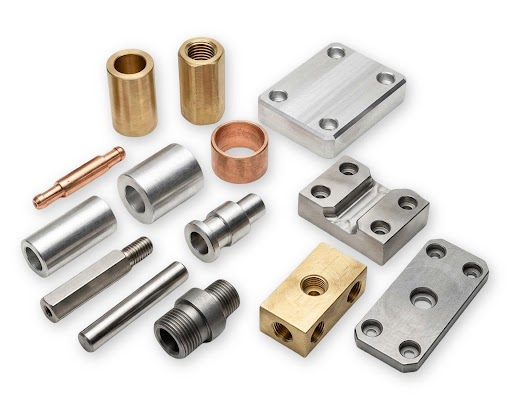

CNC parts can be manufactured from a wide variety of materials. Different CNC machined parts also require different machining processes according to part geometry, tolerance requirements, and production needs. In this article, we explain common CNC materials and machining processes used in CNC manufacturing.
Why Different Materials and Machining Processes Are Used in CNC Parts Manufacturing
Each material has its own advantages and limitations. CNC components can be made from various materials such as brass, copper, aluminum, steel, stainless steel, bronze, and plastics.
Not every CNC machined part requires the same level of precision. Tolerance and accuracy requirements depend on the application. Some parts require tight tolerances, while others can be produced with standard machining tolerances.
CNC machining includes processes such as turning, milling, drilling, boring, grinding, and broaching. The machining process is selected according to part geometry. Some parts have round and shaft-type features, while others contain flat surfaces, pockets, slots, and complex contours.
Not every CNC machined part requires the same level of precision. Tolerance and accuracy requirements depend on the application. Some parts require tight tolerances, while others can be produced with standard machining tolerances.
A CNC machining parts supplier must understand how material properties and machining processes affect part performance, manufacturing cost, and production efficiency. Each material provides different properties such as strength, weight, corrosion resistance, conductivity, surface finish, and machinability.
Material selection and machining processes depend on part geometry, application requirements, tolerance requirements, production quantity, and cost.
Common CNC Machining Processes
CNC machining processes are selected according to part geometry, tolerance requirements, and surface finish requirements. Many CNC parts require more than one machining process to complete the final component.
CNC Turning
CNC turning is commonly used for round and cylindrical parts. It is suitable for components with shaft-type geometry and external or internal threads. Common examples include shafts, bushings, pins, adapters, fittings and various brass CNC turned parts.
CNC Milling
CNC milling is used for flat surfaces, pockets, slots, and complex contours. It is commonly selected when the part contains features that cannot be produced through turning operations.
CNC Drilling
CNC drilling is used for creating through holes and blind holes according to part requirements.
CNC Tapping
CNC tapping is commonly used for producing internal threads and threaded holes.
CNC Boring
CNC boring is used for enlarging existing holes and improving hole accuracy and concentricity.
Common Materials Used in CNC Parts
CNC machining supports a wide variety of materials such as brass, copper, aluminum, steel, stainless steel, bronze, and plastics. Each material has its own benefits and limitations. Material selection depends on application requirements, machinability, strength, corrosion resistance, production speed, and cost.
Aluminum
Many aluminum grades are used in CNC machining according to application requirements. Aluminum 6061 is commonly used because of its machinability, easy to available, and good for anodizing. Aluminum 7075 is selected for high-strength applications. Aluminum 6082 is used for structural components. Aluminum 5052 is chosen for corrosion resistance, while Aluminum 2024 is commonly used in aerospace applications. Aluminum 6063 is selected for good surface finish.
Aluminum is widely used for CNC parts because it is lightweight, cost-effective, has good thermal and electrical conductivity, and provides a good strength-to-weight ratio. Aluminum also supports various surface treatments such as anodizing, powder coating, and bead blasting. It is commonly used for automotive parts, drone components, aerospace parts, housings, and structural components.
Aluminum also has limitations. It generally has lower hardness and wear resistance than steel. Galvanic corrosion can occur when aluminum is in contact with dissimilar metals in certain environments. For applications requiring higher strength, wear resistance, and thread durability, steel is often a better choice.
Brass
For brass CNC machined parts, common grades include C360 Free-Cutting Brass, which is widely used by precision CNC parts manufacturers because of its excellent machinability and dimensional stability. Other common grades include C260 Cartridge Brass for cold-working applications, C464 Naval Brass for marine and saltwater environments, C385 Architectural Brass for decorative and architectural components, and C69300 lead-free brass for lead-free product requirements.
Brass is chosen for CNC components primarily because of its high machinability, good thread quality, corrosion resistance, electrical conductivity, and dimensional stability. Brass also allows efficient machining and is commonly used for precision machined parts.
Brass also has limitations. Brass is heavier and generally more expensive than aluminum. It also has lower tensile strength and hardness than steel and titanium. For applications requiring higher strength, wear resistance, and lower weight, other materials may be more suitable.
Copper
For copper CNC parts, C101 Oxygen-Free Electronic (OFE) Copper and C110 Electrolytic Tough Pitch (ETP) Copper are the most common grades used for CNC machining. C145 Tellurium Copper is used when improved machinability is required, while C17200 Beryllium Copper is selected for applications requiring higher strength and wear resistance.
Pure copper is notoriously difficult to machine because of its gummy nature. Copper is primarily selected when high electrical conductivity is required. Copper CNC components also provide excellent thermal conductivity, high ductility, malleability, corrosion resistance, and non-sparking properties. Common applications include electrical contacts, busbars, and grounding components.
There are several limitations when choosing copper for CNC parts. Copper is more expensive than steel, aluminum, brass, and many stainless steel grades. Pure copper has poor machinability, which can increase machining time and production cost. Copper is also a dense and heavy material, making it less suitable for weight-critical applications.
Stainless Steel
Stainless steel is a family of steel alloys with corrosion-resistant properties. Common stainless steel grades used for CNC machining include SS304 and SS316. SS303 is commonly selected when improved machinability is required. For applications requiring hardness and magnetic properties, SS410, SS420, and SS430 are commonly used. SS430 is also a lower-cost stainless steel grade used in various industrial and household applications.
Stainless steel is selected for CNC parts because of its corrosion resistance, chemical resistance, tensile strength, temperature resistance, wear resistance, thread durability, and long service life. It is commonly used in automotive, marine, food processing, medical, and industrial equipment.
Stainless steel also has limitations. Compared with aluminum and brass, stainless steel has lower machinability and can cause higher tool wear during machining. This results in slower machining speeds and higher production costs. Stainless steel is also heavier than aluminum, which can be a limitation in weight-critical applications.
Steel
For steel CNC parts, common grades include Steel 1018, 12L14, 1045, and 4140. Mild Steel 1018 is commonly used because of its weldability and balanced mechanical properties. Steel 12L14 is selected for free-machining applications. Steel 1045 provides higher strength than 1018, while Steel 4140 is commonly used for gears, shafts, axles, and other high-stress components.
Steel CNC components are selected because of their strength, wear resistance, heat-treatability, fatigue resistance, thread durability, and cost-effectiveness. Steel is commonly used for structural, industrial, automotive, and machinery components.
Steel CNC parts also have limitations. Steel is heavier than aluminum and has lower corrosion resistance than stainless steel. Depending on the grade, steel can be more difficult to machine than aluminum and brass, which may increase machining time and tool wear.
Which Materials Fit Which Part Types
Which material fits a specific CNC part depends on the application requirements. Below are some common examples.
Aluminum is commonly used for manifold and valve bodies, electronic enclosures, heat sinks, housings, suspension knuckles, control arms, aircraft bulkheads, and other lightweight structural components.
Stainless steel is commonly selected when corrosion resistance and durability are required. Common stainless steel CNC parts include valve components, pump impellers, fasteners, shafts, medical components, food-processing equipment parts, and marine hardware.
Brass is selected for its machinability and thread quality. Common brass CNC parts include plumbing fittings, manifolds, bushings, adapters, electrical connectors, and marine hardware.
Copper is primarily selected for electrical and thermal conductivity. Common copper CNC parts include busbars, terminals, welding torch components, grounding components, and heat sinks.
Steel is selected when strength and wear resistance are important. Common steel CNC parts include automotive axles, crankshafts, transmission gears, mounts, brackets, pins, spacers, and machinery components.
Design Limits That Change Process Choice
Part design directly affects machining process selection. Features such as deep holes, thin walls, internal corners, small threads, and tight tolerances can increase machining difficulty and may require different machining operations.
- Deep holes are more difficult to machine and may require specialized drilling operations. They can also increase machining time.
- Thin walls create machining challenges because they can deform and vibrate during machining and may require different machining strategies.
- Internal corners are difficult to produce because standard milling cutters cannot create perfectly sharp internal corners. Corner radius requirements can also affect tool selection.
- Small threaded holes require smaller tools and can increase machining difficulty and tool breakage risk.
- Tight tolerances may require additional machining operations such as boring and grinding to achieve the required accuracy.
When One Part Needs Both Turning and Milling
Some simple parts, such as bushings and adapters, need only turning operations, while complex parts may need both turning and milling. Turning creates cylindrical features such as outside diameters and threads. Milling creates flats, slots, pockets, and other non-cylindrical features. For example, a shaft may need turning for the outside diameter and milling for keyways. The machining process depends on part geometry, tolerance requirements, and part function.
Prototype vs Production
In CNC machining, prototype development and high-volume production are different stages. For a CNC parts manufacturer, production manufacturing is different from prototype development. Prototypes focus on testing, design validation, functional evaluation, and verifying how a part fits and performs in the application. Prototype manufacturing is primarily used to evaluate the design before production begins.
Production manufacturing is different from prototype development. In production, machining processes are optimized for repeatability, efficiency, and cost control. CNC components manufacturers must maintain consistent quality across all parts while controlling machining time, tool wear, inspection requirements, and production costs.
How Material and Process Selection Affect Cost
The final cost of a CNC part is affected by both material selection and machining processes. Material choice has a major impact on cost. Aluminum and many carbon steel grades are generally less expensive than brass, copper, bronze, and many stainless steel grades. Material should be selected according to application requirements, not cost alone.
Machinability also affects cost. Materials such as brass and aluminum are easier to machine, which can reduce machining time. Materials such as pure copper and some steel grades can require more machining effort. For a wholesale CNC parts manufacturer, machining efficiency, tooling life, and cycle time have a direct impact on production cost.
Process complexity is another cost factor. A simple adapter may require only turning operations, while a more complex part may require turning, milling, drilling, and tapping. Additional machining operations increase production time and cost.
Tolerance requirements also affect cost. Precision CNC components often require tighter tolerances, additional machining operations, more inspection, and stricter process control. These requirements can increase machining time and overall production cost.
Conclusion
There is no single material that is superior and provides all-in-one functionality. Material selection depends on factors such as strength, weight, corrosion resistance, conductivity, machinability, and cost. Machining process selection depends on part geometry, tolerance requirements, production quantity, and application needs. Understanding material and process selection helps buyers work more effectively with an OEM CNC parts manufacturer throughout product development and production. The correct combination of material and machining process helps achieve the required performance, quality, and manufacturing efficiency.