
When industrial systems break down, cooling tower repairs become an immediate priority to prevent catastrophic facility shutdowns. An unplanned outage demands immediate attention and a highly structured recovery plan.
Severe issues like gearbox failure or the sudden need for fan shaft replacement will stop your operations completely if you do not act fast. You need a rapid response strategy to diagnose the exact problem, stabilize the equipment, and implement fixes safely. Without immediate action, rising temperatures compromise the entire production line.
Table of Contents
- Introduction
- What Happens During an Unplanned Cooling Tower Outage?
- Common Causes of Emergency Cooling Tower Failures
- Gearbox Failure
- Fan Shaft and Motor Issues
- Drift Eliminator Damage
- Water Flow Disruptions
- The 48-Hour Emergency Repair Timeline
- Hours 0–6: Stabilization
- Hours 6–24: Diagnosis and Temporary Fixes
- Hours 24–48: Full Repair and Restart
- 5 Critical Steps for Emergency Cooling Tower Repairs
- Step 1: Immediate System Stabilization
- Step 2: Rapid Fault Diagnosis
- Step 3: Priority Component Repair
- Step 4: Temporary Solutions to Resume Operation
- Step 5: Permanent Repair and Optimization
- Key Components to Inspect During Emergency Repairs
- Don’t Make These Emergency Repair Mistakes
- Securing Your Cooling Infrastructure
- Frequently Asked Questions (FAQs)
What Happens During an Unplanned Cooling Tower Outage?
An unplanned cooling tower outage brings industrial production to a grinding halt. The system immediately loses its ability to reject heat. Process temperatures rise rapidly. Equipment begins to overheat. The entire operation faces severe instability.
When a cooling tower fails, facility managers must act quickly to prevent permanent machinery damage. Here’s what happens:
- Thermal safety alarms are triggered on primary production machinery.
- A full, automatic shutdown of the system often follows.
- These shutdowns can cost facilities thousands of dollars per hour in lost revenue.
Common Causes of Emergency Cooling Tower Failures
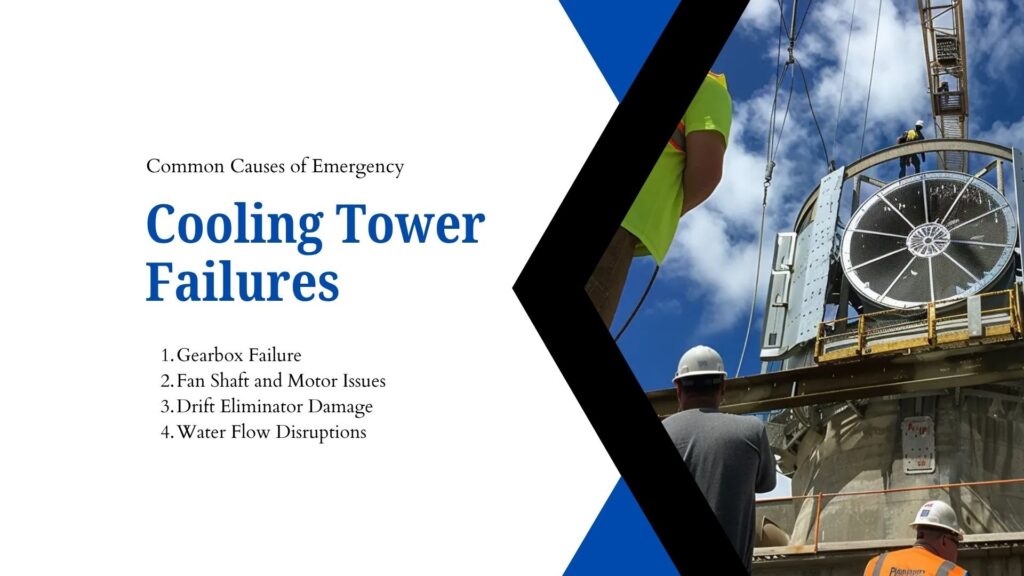
Cooling towers operate under extreme stress, and knowing the primary failure points is crucial when you need a cooling tower repair. Identifying the cause helps you deploy the right maintenance team immediately.
Gearbox Failure
Gearboxes endure massive mechanical stress during continuous operation. A gearbox failure stops the fan assembly completely. This immediately halts all airflow through the tower. Without airflow, the system cannot cool the circulating water, leading directly to a forced system shutdown.
Fan Shaft and Motor Issues
The fan shaft connects the motor to the gearbox and must remain perfectly aligned. Fan shaft and motor issues create violent vibrations throughout the tower structure. Severe misalignment destroys bearings and couplings. This vibration eventually tears the mechanical equipment apart if you do not stop the motor.
Drift Eliminator Damage
Drift eliminators capture water droplets escaping in the exhaust air. Drift eliminator damage causes massive water loss and reduces overall thermal efficiency. Broken eliminators also allow chemical-laden water to spray onto nearby equipment.
Water Flow Disruptions
A cooling tower relies on consistent water distribution. Water flow disruptions occur when debris clogs the spray nozzles or when the primary circulation pump fails. Dry spots form inside the tower, drastically reducing the heat transfer capability.
The 48-Hour Emergency Repair Timeline
Time is your most valuable asset during an equipment failure. Understanding the timeline of recovery ensures you make the right decisions at the exact right moment. Look at these critical phases of emergency restoration.
- Hours 0 to 6: You must secure the site and shut down all connected power sources.
- Hours 6 to 24: Technicians perform thorough inspections and apply temporary operational fixes.
- Hours 24 to 48: Engineers install new components, test the system, and restore full production.
First 0–6 Hours – Stabilization
Safety remains the top priority during the initial hours. You must shut down the system safely and lock out all electrical panels. Technicians identify visible damage immediately. You then alert your specialized repair team to mobilize to the site.
6–24 Hours – Diagnosis and Temporary Fixes
With the site secured, the focus shifts to a detailed diagnosis to understand the full extent of the damage. This phase involves a comprehensive inspection and implementing temporary solutions to prevent further issues while sourcing permanent replacements.
- The repair crew conducts a thorough inspection of all mechanical components to identify any hidden damage.
- They apply temporary fixes to prevent further degradation of the system.
- The procurement team begins sourcing the required spare parts from local suppliers.
24–48 Hours – Full Repair and Restart
This final phase is about restoring full functionality. Skilled technicians install factory-authorized parts, focusing on careful replacement and rigorous testing to guarantee system stability before a full restart.
After a series of tests, full operations are gradually restored while performance is closely monitored to confirm the repair’s success.
5 Critical Steps for Emergency Cooling Tower Repairs
When a severe equipment breakdown occurs, a clear plan for cooling tower repairs is essential. Executing these steps precisely guarantees a safe and efficient return to standard operation. Follow these guidelines to protect your facility.
- Secure the physical structure to prevent immediate collapse or secondary damage.
- Run diagnostic tools to isolate the exact mechanical or structural fault.
- Swap out broken parts with certified replacements to ensure longevity.
Step 1 – Immediate System Stabilization
The first step requires total isolation of the compromised unit. You must prevent further damage by closing water valves and cutting motor power. This creates a safe perimeter for the inspection team.
Step 2 – Rapid Fault Diagnosis
You cannot fix a problem you do not fully understand. Rapid fault diagnosis identifies the exact root cause of the breakdown. Technicians use vibration analysis and thermal imaging to pinpoint the exact failure point.
Step 3 – Priority Component Repair
Once the team identifies the fault, they focus on the most critical parts. Priority component repair includes addressing a gearbox failure or executing a fan shaft replacement. Structural fixes also take place during this step to ensure the tower can handle the mechanical load.
Step 4 – Temporary Solutions to Resume Operation
Sometimes custom parts take weeks to arrive. You must apply temporary solutions to resume operation safely. Quick fixes allow partial operation so the facility can maintain a minimum production level while waiting for the permanent components.
Step 5 – Permanent Repair and Optimization
Temporary fixes do not last forever. Step five involves executing the permanent repair and optimizing the system for long-term reliability. Engineers calibrate the fan pitch and align the driveshaft to factory specifications.
Key Components to Inspect During Emergency Repairs
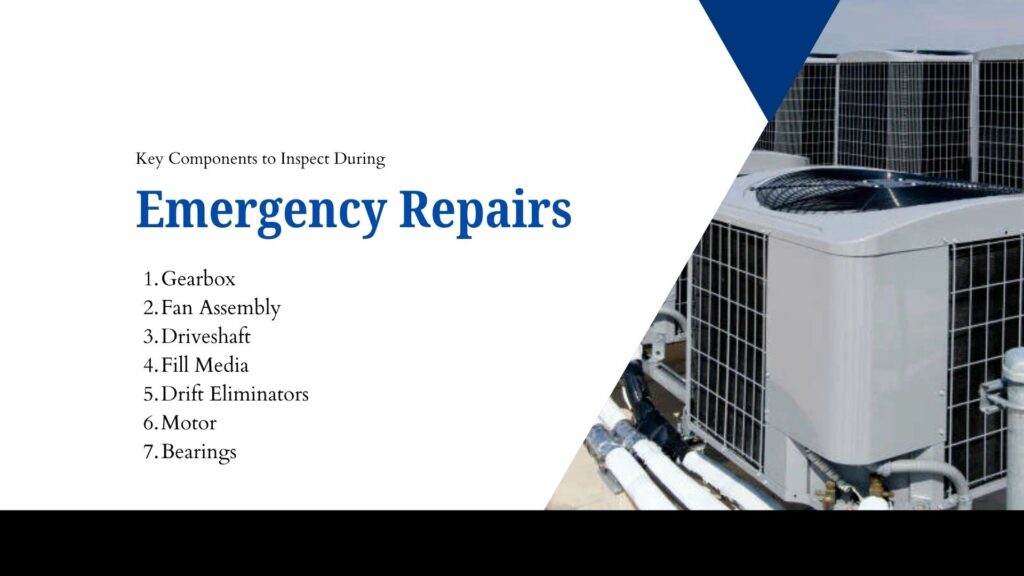
Knowing where to look is crucial for effective cooling tower repairs. Thorough inspections prevent repeat failures and can help you get your system back online faster. Check these specific areas immediately after a shutdown.
- Gearbox: Check for major oil leaks, metal shavings in the oil, and broken gear teeth.
- Fan assembly: Look for cracks in the blades, especially near the hub, and check the security of the mounting hub itself.
- Driveshaft: Inspect the carbon fiber or steel tubes for any signs of cracking, delamination, or damage from excessive torque.
- Fill media: Search for signs of heavy scale buildup, biological fouling, or collapsed sections that could restrict airflow.
- Drift eliminators: Verify that all panels are securely fastened and free from damage.
- Motor: Check for overheating, unusual noises, or signs of electrical failure.
- Bearings: Listen for grinding or squealing sounds and check for excessive heat or vibration.
Don’t Make These Emergency Repair Mistakes
Panic leads to poor decision-making. You must avoid specific errors that compound the initial problem. Learn from these frequent missteps to keep your recovery on track.
- Delayed response: Waiting too long to call for professional help can turn a minor issue into a major system failure.
- Incorrect diagnosis: Misidentifying the root cause of the problem leads to wasted time, ordering the wrong parts, and ineffective repairs.
- Ignoring minor issues: Overlooking small cracks, unusual noises, or minor vibrations is a surefire way to guarantee a more significant breakdown in the near future.
- Using incompatible parts: Opting for cheaper, non-standard components can compromise system integrity and lead to further damage.
- Neglecting safety protocols: Rushing the repair process without following proper safety procedures can endanger personnel and cause additional equipment damage.
Securing Your Cooling Infrastructure
Proper cooling tower repairs protect your bottom line and keep your facility safe. An unplanned outage does not have to result in days of lost production if you maintain a strict rapid response plan. Whether you are dealing with a shattered drive component or severe drift eliminator damage, knowing the exact steps to take guarantees a swift recovery.
Do not wait for a breakdown to build your emergency strategy. Establish contact with certified repair professionals today, upgrade your monitoring equipment, and ensure you have the resources ready for the next challenge
Frequently Asked Questions
What are emergency cooling tower repairs?
Emergency cooling tower repairs are immediate maintenance actions taken to restore a failed cooling system. They focus on stabilizing the equipment, replacing critical broken components, and restarting industrial production as quickly and safely as possible.
What causes sudden cooling tower failure?
Sudden failures typically result from severe mechanical breakdowns like shattered gearboxes, snapped fan shafts, or collapsed structural supports. A lack of routine maintenance significantly accelerates these component failures.
How long do emergency repairs take?
Most critical emergency repairs take between 24 and 48 hours to complete. This timeline depends entirely on the availability of spare parts and the extent of the internal damage.
What components fail most in cooling towers?
The mechanical drive components fail most frequently. This includes the electric motors, drive shafts, gearboxes, and fan blades. Fill media and drift eliminators also suffer from scaling and physical collapse over time.
How can downtime be minimized during repairs?
You minimize downtime by keeping critical spare parts in your inventory and establishing a contract with a 24/7 specialized repair contractor. Having an emergency action plan speeds up the diagnostic and recovery phases.