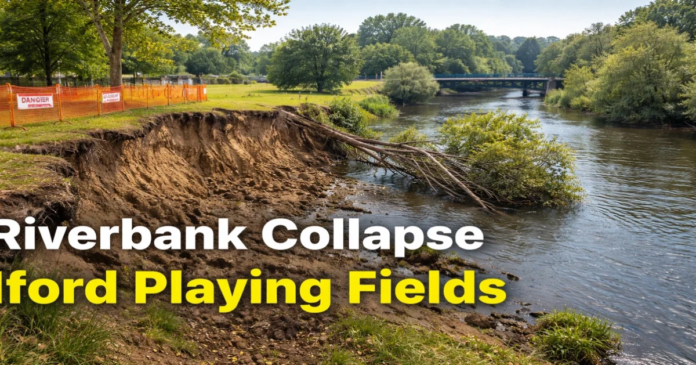

The riverbank collapse Iford Playing Fields experienced on May 29, 2025, transformed a popular recreational area into a public safety hazard overnight. Local residents discovered that a stretch of over 50 meters along the River Stour had vanished, with trees collapsing into the water as the embankment gave way. The incident immediately raised urgent concerns about the stability of surrounding areas and the safety of walkers, cyclists, and families who regularly use this South West England park. Authorities quickly cordoned off dangerous sections while assessing the environmental damage and risk of further failure.
What Happened During the Riverbank Collapse Iford Playing Fields
Timeline of the May 2025 Incident
Weather patterns across Dorset during mid-May to late May 2025 set the stage for the embankment failure at Iford Playing Fields. The region endured periods of heavy and prolonged rainfall that saturated the soil and weakened the riverbank’s structure. Late May brought additional stress through strong winds and fluctuating water levels that pressured an already compromised bank. Around May 27-29, local residents reported that a large section of the riverbank gave way almost overnight, with trees and soil falling into the River Stour. The collapse was not a single isolated event but rather the culmination of ongoing weather and environmental pressures.
Heavy rains saturated the soil, weakening soil cohesion and causing soil slumping. The combination of rapidly rising river levels, prolonged ground saturation, strong current flow against the bank, and natural erosion of the outer bend created conditions for bank failure. Strong winds combined with already weakened soil contributed to rapid bank subsidence. Once tree roots failed and large trees toppled, the combined effects triggered the sudden collapse that sent debris into the river.
Eyewitness Accounts from Local Residents
Nicky Adams, a local resident walking her dogs, first documented the damage on May 29. She stated that the collapse happened a couple of days previously after the strong winds, adding that she was quite surprised at how much had come away. Adams noted she hadn’t noticed any changes until this happened, describing the event as occurring pretty much overnight. She expressed concern that the area could be dangerous, particularly because it is popular for walking, cycling and paddleboarding, with children who sometimes play and swim around there in summer.
What seemed stable for years gave way quickly. Witnesses reported that the embankment failure appeared to happen almost overnight. The unpredictability and rapidity of the event underscored the real threat posed by cumulative erosion and extreme weather. Social media posts from local Facebook groups spread quickly, with residents expressing concern about safety, responsibility, and the adequacy of previous maintenance.
Scale and Extent of the Embankment Failure
The physical consequences proved significant and immediate. A wide section of the riverbank, several meters in length, was destabilized and lost into the River Stour, leaving behind an exposed scar of raw soil and uprooted vegetation. Trees that previously stood on solid ground were toppled with roots exposed and trunks partly submerged. The collapse created steep drop-offs and hidden hazards. Multiple trees fell into the River Stour as the embankment gave way.
The popular riverside footpath was compromised in the affected area. Fallen trees now lie partly in the river, creating potential hazards for paddleboarders and swimmers who regularly use this stretch during warmer months. BCP Council moved quickly to cordon off the highest-risk zones with barriers and safety signage following the incident. The embankment failure was unusually large, and immediately afterward, the Bournemouth, Christchurch and Poole Council began monitoring and cordoning off affected areas due to safety concerns.
Why Did the Riverbank Collapse at Iford Playing Fields Occur
Multiple environmental and human factors converged to destabilize the riverbank at Iford Playing Fields. BCP Council acknowledged that erosion occurs commonly in this area, though officials noted this collapse involved an unusually large section. Scientific understanding of riverbank failure points to complex interactions between water, soil, vegetation, and human activity that determine when and where embankments give way.
Heavy Rainfall and Soil Saturation Weakened the Bank
Weeks of repeated rainfall prevented soil from drying between events, causing full saturation that fundamentally altered the ground’s structural properties. When water fills spaces between soil particles, the material loses the friction that normally holds it together. Rainfall decreases suction in the soil matrix and increases the weight of soil units, leading to reduced slope stability. Research confirms that infiltrating water significantly reduces shear strength in soil initially in an unsaturated state, contributing directly to slope instability. At Iford, prolonged saturation made the bank far more vulnerable to forces acting from both the river below and the weight of trees and soil above.
Erosion from River Stour Flow Patterns
The River Stour constantly exerts lateral pressure against its banks through direct fluvial erosion at the bank toe combined with geotechnical instability. This process, known as undercutting, gradually removes foundational material until upper layers lose support. Water flows faster along the outer edge of river bends, which increases erosion pressure significantly. Years of gradual undercutting combined with saturated conditions created circumstances for sudden large-scale failure rather than slow incremental loss.
Loss of Stabilizing Vegetation and Root Systems
Vegetation controls bank erosion through root systems that bind soil particles and provide cohesion. Laboratory experiments confirm that plants create positive feedback on riverbank stability through their roots, thereby reducing bank failure frequency. Research demonstrates that vegetated banks experience erosion ratios of 24.34% compared to 40.24% for bare banks. At Iford, recreational use resulted in gradual loss of riverside vegetation, with path maintenance and foot traffic reducing the density of root networks. Without healthy root systems, the bank became increasingly dependent on soil cohesion alone.
Human Activity and Footpath Compaction Effects
Frequent foot traffic along riverside paths compresses soil and reduces vegetation growth. Human pressure on ground ranges between 60 and 500 kPa, with experimental work showing that compaction increases soil density by 20 to 22% at pressure levels up to 240 kPa. Compaction reduces biomass in the upper 5 to 20 cm of soil. Regular use of river edges in public spaces adds stress to vulnerable land, particularly when combined with maintenance practices that trim vegetation and reduce deep root systems.
Immediate Public Safety Threats Created by the Collapse
Unstable Ground and Hidden Cavity Risks for Walkers
Following the collapse, unstable soil near the affected zone poses immediate danger to anyone approaching the weakened edge. Ground that appears solid can give way without warning, especially after rain. Cracking in the riverbank, both deep and shallow, signals bank instability and indicates areas that should be avoided on foot, in vehicles, and by boat. Equally concerning, the ground beyond the visible edge may be undermined and could collapse unexpectedly.
Steep riverbanks with deep drop-offs to deep water face particular risk of further collapse. Leaning trees, including willows, indicate bank instability as their root systems weaken in unstable soil while their weight puts additional pressure on the riverbank. Exposed roots and steep inner slopes present slipping and entrapment risks. Bubbling in the water can indicate soil movement below the surface, signaling further instability.
Dangers to Children and Water Recreation Users
Families sometimes use riverbanks for swimming or play during warmer months. Unstable banks increase the danger of sudden slips into deeper or faster-flowing water. Bank subsidence heightens the risk of further collapse, with unstable edges threatening paddleboarders using the River Stour. Children who swim near the area during summer months face public safety hazards from the compromised embankment.
Recreational users of the playing fields now encounter increased risk near the river, particularly in areas with steep drop-offs or exposed roots. Submerged materials, including trees, may lie hidden beneath the water surface in areas where riverbank collapses occurred. Sporting events may be canceled, and informal gatherings relocate elsewhere. For children, the loss proves particularly noticeable as open green spaces remain vital for play and development.
BCP Council Safety Barriers and Access Restrictions
Temporary safety barriers were installed, with parts of the playing fields remaining restricted to ensure public safety while detailed assessments are conducted. Walking paths near the A35 Iford Bridge were closed temporarily to prevent accidents. Council officers cordoned off the immediate area and advised the public to keep clear. Access to adjacent public spaces and some cycle routes was temporarily diverted.
Portions of the playing fields remain unsafe for both sports and casual use, requiring temporary closure while flood risk assessments are completed by experts. Access restrictions, while frustrating, prevent further damage and give engineers time to assess the stability of surrounding areas. According to established safety protocols, fencing and warning signs have been deployed where visible collapse occurred or where known potential for collapse exists.
Environmental and Community Impact of the Bank Failure
Sediment Discharge Affecting River Stour Water Quality
Large quantities of sediment entered the River Stour during and after the collapse, increasing turbidity and disrupting aquatic ecosystems. Elevated turbidity affects fish and invertebrate populations when sediment clogs gill structures and reduces oxygen availability. Aquatic plants were uprooted or smothered, reducing the food and shelter they provide for river species. Light penetration decreased, affecting photosynthesis and the river’s food chain at its base. Nutrient imbalances developed as decomposing organic material from fallen trees released compounds into the water. The Environment Agency provided oversight on hydrological and ecological impacts, with monitoring of water quality and flow conditions ongoing in the period following the collapse.
Wildlife Habitat Destruction Along the Riverbank
The riparian habitat, which supports birds, insects, and small mammals depending on water, bank vegetation, and tree cover, suffered direct damage. Fallen trees damaged nesting sites, and loss of greenery affected overall local ecosystem stability. Birds nest in riverside shrubs, while small mammals forage among dense vegetation. When the collapse removed large sections of vegetation, these habitats were temporarily lost. The disruption reduced local biodiversity and weakened the ecological resilience of this section of the Stour corridor.
Disruption to Walking Routes and Recreational Spaces
Sections of playing fields and riverside paths were restricted for safety. Sports clubs that use the area for training had to adjust or relocate. Walkers and joggers rerouted their paths, and families with young children exercised more caution about visiting. What was once a peaceful environment now carries an air of uncertainty.
Concerns About Future Collapses in Adjacent Areas
Further erosion could occur, particularly during future storms. If left unchecked, the collapse may extend closer to the playing fields, jeopardizing infrastructure and even nearby transport links, including a train bridge.
How Authorities and Experts Are Responding to the Crisis
BCP Council Emergency Assessment and Monitoring
BCP Council confirmed the incident and began formal assessment of the affected riverbank. Immediate measures focused on public safety, including the installation of fencing and barriers along the most unstable sections and the erection of warning signage directing walkers away from the compromised bank edge. Drone surveys and ground photography have been used to track progress and identify any further signs of instability. A BCP Council spokesperson stated that erosion of the riverbank is common in this area, though this was an unusually large section, and officials are monitoring and seeking advice from partner organizations to determine next steps.
Environment Agency Role in Riverbank Stabilization
The Environment Agency has provided oversight on the hydrological and ecological impacts, with monitoring of water quality and flow conditions ongoing in the period following the collapse. This national body plays a central role in issuing flood alerts and maintaining river systems. Improved collaboration between BCP Council and the Environment Agency strengthens infrastructure resilience and ensures faster responses during River Stour flooding.
Engineering Solutions: Bioengineering vs Hard Armor
Environmental consultants and riverbank protection specialists have been involved in assessing what engineered interventions may be appropriate for the most severely affected sections. Bioengineering techniques such as willow spiling, coir rolls, or rock armor placement at highest-risk sections have been evaluated. Balancing ecological restoration with targeted engineering is the approach most widely recommended by UK riverbank specialists. Replanting of native trees and shrubs has begun in sections of the bank where vegetation was lost, as root systems are one of the most effective natural stabilizers for riverside soil.
Community Involvement in Restoration Planning
Community volunteers have played a role in monitoring and reporting, with local groups continuing to observe and document conditions along the bank.
Preventing Future Riverbank Failures and Protecting Christchurch
Early Warning Systems and Regular Bank Inspections
Fiber optic sensor systems offer distributed monitoring of soil wetting inside riverbanks to detect seepage-related weakness. Wireless transmission technology combined with embedded sensors tracks soil displacement. Continuous monitoring through drone footage and ground surveys allows authorities to detect early signs of erosion. Engaging local volunteers ensures timely reporting of cracks, slumping, or unusual water flow patterns.
Replanting Native Vegetation for Natural Reinforcement
Vegetation reinforcement strengthens soil cohesion and supports wildlife habitats. Species like willows, cottonwoods, and native grasses stabilize banks by anchoring earth with deep root systems. Planting riparian buffers prevents sediment flow and filters nutrient runoff.
Climate Resilience Planning for Extreme Weather Events
Climate resilience planning involves assessing vulnerability of systems and evaluating measures to increase resilience to changing conditions. Integrated urban planning must align city growth with ecological safeguards.
Lessons from Similar UK Riverbank Collapse Incidents
The 2019 Toddbrook dam incident resulted from poor maintenance, inadequate design, and torrential rainfall. Since 1925, no loss of life has occurred due to dam disasters in Great Britain, demonstrating effective management.
Long-Term Investment in Dorset River Management
The Dorset Coastal Engineering Partnership between BCP Council and Dorset Council provides coordinated flood and erosion protection. The partnership secured over £10M investment for conservation activities.
Conclusion
The riverbank collapse at Iford Playing Fields undeniably highlights the vulnerability of public spaces to extreme weather and environmental neglect. Heavy rainfall coupled with erosion, vegetation loss, and foot traffic created conditions for catastrophic failure. At the present time, BCP Council and the Environment Agency continue monitoring the site while implementing safety barriers and planning long-term restoration. Bioengineering solutions, native vegetation replanting, and early warning systems offer pathways toward stability. On the whole, this incident serves as a critical reminder that proactive riverbank management, community engagement, and climate-resilient planning remain essential for protecting Christchurch’s cherished recreational areas from future environmental threats.
FAQs
Q1. What caused the riverbank to collapse at Iford Playing Fields in May 2025?
The collapse resulted from a combination of factors including weeks of heavy rainfall that saturated the soil, erosion from River Stour flow patterns that undercut the bank foundation, loss of stabilizing vegetation and root systems, and compaction from regular foot traffic along the riverside paths. These conditions converged during late May 2025, causing over 50 meters of embankment to fail suddenly.
Q2. What safety measures have been put in place following the collapse?
BCP Council immediately installed temporary safety barriers and fencing around the most unstable sections of the riverbank. Warning signage was erected to direct walkers away from compromised areas, and portions of the riverside footpath near the A35 Iford Bridge were temporarily closed. Access to adjacent public spaces and some cycle routes was diverted to prevent accidents while detailed assessments are conducted.
Q3. How does vegetation help prevent riverbank collapses?
Vegetation plays a crucial role in stabilizing riverbanks through root systems that bind soil particles together and provide cohesion. Research shows that vegetated banks experience significantly less erosion compared to bare banks. Native species like willows and grasses create deep root networks that anchor the soil, making the embankment more resistant to erosion from water flow and heavy rainfall.
Q4. What environmental impacts did the collapse have on the River Stour?
The collapse released large quantities of sediment into the River Stour, increasing water turbidity and disrupting aquatic ecosystems. This affected fish and invertebrate populations by clogging gill structures and reducing oxygen availability. Fallen trees damaged nesting sites and wildlife habitats along the riverbank, while decomposing organic material created nutrient imbalances in the water.
Q5. What long-term solutions are being considered to prevent future collapses?
Authorities are evaluating bioengineering techniques such as willow spiling, coir rolls, and strategic rock armor placement. Plans include replanting native vegetation to restore natural root stabilization, implementing early warning systems with sensors to detect soil movement, and establishing regular inspection programs. The Dorset Coastal Engineering Partnership is coordinating long-term flood and erosion protection measures with significant investment in conservation activities.