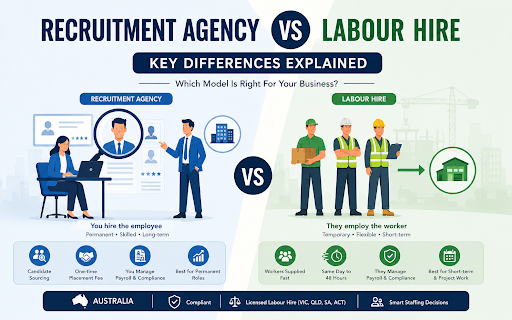

What is the Difference between Recruitment Agency vs Labour Hire in Australia?
Both recruitment agencies and labour hire companies connect workers with businesses. That is where the similarity ends. The way each model works, who the employer of record is, who handles payroll and compliance, and what type of work each is suited for are fundamentally different, and choosing the wrong model for your workforce need can cost your business time, money, and legal exposure.
The guide breaks down the exact differences between a recruitment agency and a labour hire arrangement in Australia, covering employer responsibilities, costs, legal obligations, and which model fits which situation.
What Is a Recruitment Agency in Australia?
A recruitment agency acts as a middleman between a business and a job candidate. The agency sources, screens, and shortlists candidates on behalf of the client business. Once a suitable candidate is identified, the agency arranges interviews between the candidate and the employer.
If the employer is satisfied and makes an offer, the candidate is hired directly by the employer. From that point, the employer becomes the legal employer of record and takes on full responsibility for wages, entitlements, superannuation, payroll tax, and workers compensation.
The recruitment agency receives a one-time placement fee, typically between 15% and 25% of the candidate’s annual salary, for successfully filling the role.
Recruitment agencies are best suited for:
- Permanent full-time or part-time placements
- Roles requiring specific qualifications, experience, or seniority
- Businesses that want to outsource candidate sourcing but retain hiring control
- Executive, professional, and specialist recruitment
What Is Labour Hire in Australia?
Labour hire is a fundamentally different model. A labour hire Sydney focused company employs the workers directly and then supplies those workers to a host business for a defined period. The worker goes to the host business’s site and performs work there, but the labour hire agency remains the legal employer throughout the arrangement.
The labour hire provider handles all employer obligations, wages, superannuation, payroll tax, workers compensation insurance, and entitlements. The host business pays the labour hire company a charge rate that covers the worker’s wage plus the agency’s margin and on-costs.
The key distinction: with labour hire, you are purchasing labour capacity, not hiring a person. You are not the employer. The labour hire company is.
Labour hire is best suited for:
- Short-term, project-based, or seasonal work
- Industries with fluctuating workforce demands, construction, manufacturing, logistics, warehousing, agriculture
- Situations where speed matters, workers can be on-site the same day without lengthy interview processes
- Testing a worker’s fit before committing to a permanent hire
Comparison B/W Recruitment Agency vs Labour Hire
| Factor | Recruitment Agency | Labour Hire |
| Who is the employer? | Client business (after placement) | Labour hire company (throughout) |
| Employment type | Permanent/part-time | Casual/temporary / contract |
| Payroll responsibility | Client business | Labour hire company |
| Superannuation | Client business | Labour hire company |
| Workers compensation | Client business | Labour hire company |
| Cost structure | One-time placement fee (15–25% of salary) | Ongoing charge rate per hour/week |
| Speed of placement | Days to weeks (interview process) | Same day to 48 hours |
| Suitable for | Permanent, skilled, specialist roles | Short-term, volume, project-based roles |
| Interview process | Yes, the employer interviews candidates | No, provider screens and sends workers |
| Licensing required? | No (in most states) | Yes (VIC, QLD, SA, ACT) |
Who Is the Legal Employer?
This is the most important distinction between the two models.
With a recruitment agency, once the candidate accepts the job offer, the client business becomes the employer. All legal obligations from that point, Fair Work Act compliance, National Employment Standards, termination procedures, and entitlements, fall on the client business.
With labour hire, the agency is always the employer. The host business directs the work, but the labour hire provider manages all employment obligations for the duration of the engagement. This is what makes labour hire attractive for businesses that want workforce flexibility without the administrative burden of being a direct employer.
Cost Structure
Recruitment agencies charge a one-off placement fee, usually calculated as a percentage of the candidate’s annual salary. For an $80,000 role at a 20% fee, the business pays $16,000 once, and then the employee is on their payroll permanently.
Labour hire charges an ongoing hourly or weekly rate that covers the worker’s base wage plus the agency’s margin, superannuation, insurance, and on-costs. This rate is higher than what you would pay an employee directly on an hourly basis, but the business avoids all employer administrative costs and compliance obligations.
For short-term needs, labour hire is typically more cost-effective. For long-term permanent roles, recruitment agencies deliver better value.
Speed and Process
When you engage a recruitment agency, you still need to interview candidates, make hiring decisions, and manage your own onboarding process. The agency does the sourcing and screening, but the final hiring steps remain with you. This process typically takes days to several weeks depending on the role.
Labour hire is designed for speed. The provider screens workers, handles inductions, and sends them to your site ready to work. You do not interview each person individually. You specify what skills and how many workers you need, and the provider delivers. This makes labour hire the practical choice when you need workers tomorrow, not next week.
Occupational Health and Safety (OHS) responsibilities
Workplace health and safety obligations differ between the two models and are frequently misunderstood by Australian businesses.
With recruitment agency placements, the client business is the employer and holds primary responsibility for workplace health and safety once the worker starts.
With labour hire, OH&S responsibilities are shared between the labour hire provider and the host business. The host controls the worksite, the equipment, and the day-to-day work environment, meaning the host carries significant responsibility for worker safety even though it is not the legal employer. Both parties must meet their obligations under the relevant state and federal work health and safety legislation.
Licensing Requirements in Australia
Labour hire licensing is a significant regulatory consideration that does not apply to recruitment agencies in the same way.
Victoria, Queensland, South Australia, and the ACT all require labour hire providers to hold a valid licence before operating. Host businesses in these states must also verify that any labour hire provider they engage holds a current licence and face penalties if they use an unlicensed provider.
Victoria requires licensing under the Labour Hire Licensing Act 2018, administered by the Labour Hire Authority (LHA). Unlicensed providers and hosts that knowingly use them face substantial financial penalties.
Queensland requires licensing under the Labour Hire Licensing Act 2017.
South Australia significantly expanded its licensing requirements from 29 January 2026. Under the Labour Hire Licensing (Scope of Act) Amendment Act 2025, all labour hire providers across all industries in SA must now hold a licence, not just those in the five previously covered sectors. Providers newly captured by the expansion have until 29 July 2026 to obtain their licence.
ACT has required licensing under its Labour Hire Licensing Scheme since May 2021.
Recruitment agencies that purely place candidates into direct employment arrangements are generally not captured by labour hire licensing legislation, though businesses operating across both models should seek legal advice to confirm their obligations.
When to Use a Recruitment Agency
Use a recruitment agency when:
- You need a permanent employee in a skilled, professional, or specialist role
- You want to outsource candidate sourcing and initial screening but retain full hiring control
- The role requires specific qualifications, experience, or cultural fit that takes time to assess properly
- You are filling an executive, technical, or senior leadership position
- Long-term headcount growth is the objective
When to Use Labour Hire
Use labour hire when:
- You need workers quickly for a project, seasonal peak, or short-term contract
- You want to avoid direct employer obligations including payroll, superannuation, and workers compensation management
- Your workforce needs fluctuate throughout the year
- You want to trial a worker before committing to a permanent hire (try-before-you-buy model)
- You operate in industries like construction, manufacturing, warehousing, logistics, or agriculture where flexible staffing is standard
- You need volume workers rather than a single specialist placement
Can You Use Both at the Same Time?
Yes, and many Australian businesses do. A common approach is to use labour hire for operational and production-level roles where flexibility and speed matter, while using recruitment agencies for management, technical, and specialist roles that require a permanent hire.
Some Labour Hire Company in Sydney operate across both models under one roof, offering both permanent recruitment services and labour hire arrangements. If you engage a provider that does both, ensure you have a clear written agreement in place, including a Recruitment and Labour Hire Agreement, that captures the terms of each arrangement separately.
Which Model Is Right for Your Business?
| Your Situation | Best Option |
| Need a permanent skilled employee | Recruitment Agency |
| Need workers for a short-term project | Labour Hire |
| Want to avoid payroll and compliance admin | Labour Hire |
| Filling an executive or specialist role | Recruitment Agency |
| Need workers on-site within 24–48 hours | Labour Hire |
| Want to trial a worker before hiring permanently | Labour Hire |
| Building long-term headcount | Recruitment Agency |
| Peak season workforce top-up | Labour Hire |
Frequently Asked Questions
Who pays the worker’s wages in a labour hire arrangement? The labour hire company pays the worker’s wages directly. The host business pays the labour hire provider a charge rate that covers wages, superannuation, insurance, and the agency’s margin. The host business is not the employer and does not manage payroll.
Does a recruitment agency need a labour hire licence in Australia? Pure recruitment agencies that place candidates into direct employment do not typically require a labour hire licence. However, businesses operating across both models, placing workers and supplying them on an ongoing basis, may fall within the scope of state labour hire licensing legislation and should confirm their obligations with a legal adviser.
What is the typical recruitment agency placement fee in Australia? Placement fees generally range from 15% to 25% of the candidate’s first-year salary, depending on the seniority of the role, the industry, and the agency. This is a one-off fee paid by the client business upon successful placement.
Can a labour hire worker become a permanent employee? Yes. Many Australian businesses use labour hire as a trial period before converting a worker to direct employment. This is commonly referred to as a temp-to-perm arrangement and typically involves a conversion fee payable to the labour hire provider unless otherwise agreed in the contract.
Who is responsible for workers compensation if a labour hire worker is injured? The labour hire provider holds the workers compensation insurance policy and is the employer of record. However, host businesses carry significant responsibility for maintaining a safe work environment under work health and safety legislation. In practice, liability can be shared depending on the circumstances of the incident.
Is labour hire more expensive than direct hiring in Australia? The hourly charge rate for a labour hire worker is higher than the equivalent direct employment cost because it includes the agency’s margin and all on-costs. However, when you factor in the time saved on recruitment, payroll administration, compliance, and the flexibility to scale up or down without redundancy obligations, labour hire can be more cost-effective for short-term and project-based workforce needs.
READ ALSO: Simple Ways to Beat Anxiety Before an Online Chemistry Exam